
Siemens washing machine markings
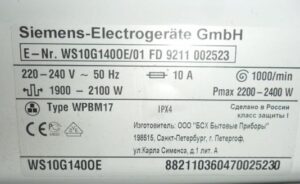 Siemens washing machine markings contain valuable information about the machine. By deciphering the markings, you can learn a wealth of information about the machine: the type of washing machine, series, model, country of manufacture, and more. Let's figure out how to correctly interpret the markings.
Understanding model codes
Siemens washing machines have long won the trust of customers. Equipment produced under the German brand is known for its high quality, reliability, and versatility.
In reality, Siemens' product line is limited, with only a few washing machines available. Each series includes several models with distinct technical specifications. Let's briefly explain the distinctive features of each Siemens washing machine series.
- "Avantgarde." Washing machines in this series feature a new, modern design. They are equipped with a large, user-friendly touchscreen.
- iQ800 These washing machines feature the i-Dos dosing system. They are equipped with an iQDrive inverter motor and a touchscreen for easy operation.
- The iQ700 series features built-in Wi-Fi and the Home Connect control system. The machines are equipped with a touchscreen display and an i-Dos automatic detergent dispenser.
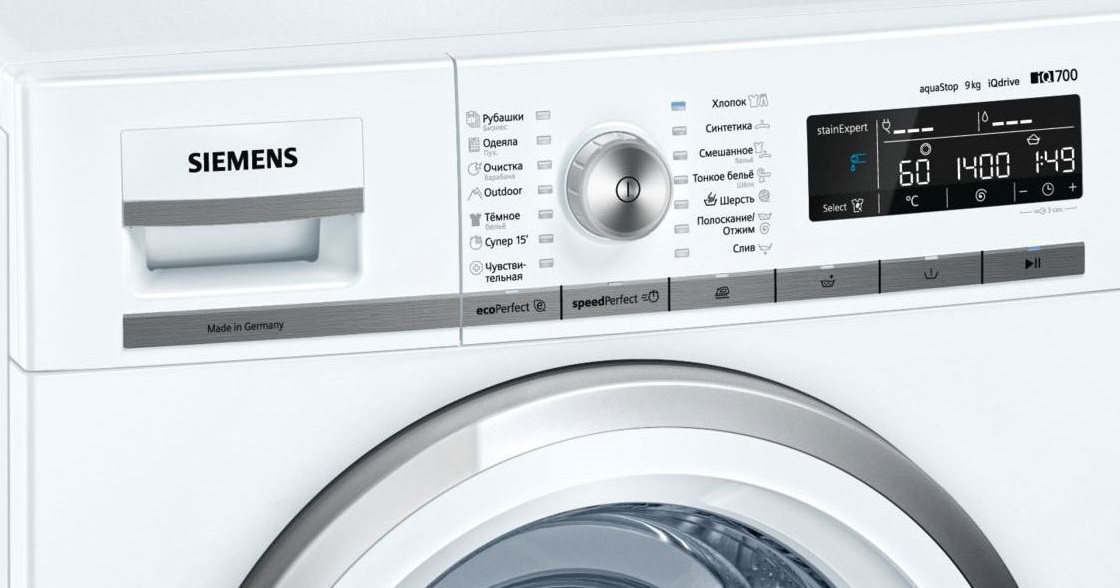
- iQ500 Automatic washing machines of this series are equipped with high-tech iQDrive inverter motors;
- iQ300 machines are equipped with a conventional motor; only some are equipped with an iQDrive inverter. The maximum drum speed during spinning has been reduced.
To correctly decipher the markings, it is important to know that the manufacturer uses two types of designations.
The difference is that in the first case, the markings contain symbols identifying the Siemens washing machine series, while in the second case, they describe the model's technical features (control type and modification). Let's figure out how to decipher these symbols.
Type 1 marking
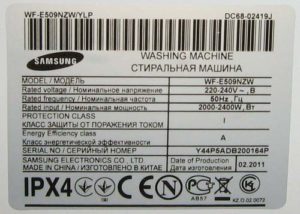
When examining the nameplate of a Siemens washing machine, in addition to the power rating, serial number, and other information, you might find an "encrypted" inscription consisting of a series of incomprehensible letters and numbers. This is the machine's marking. For example, on the information sheet, you might find the inscription WS12T440OE. Let's look at what each symbol means: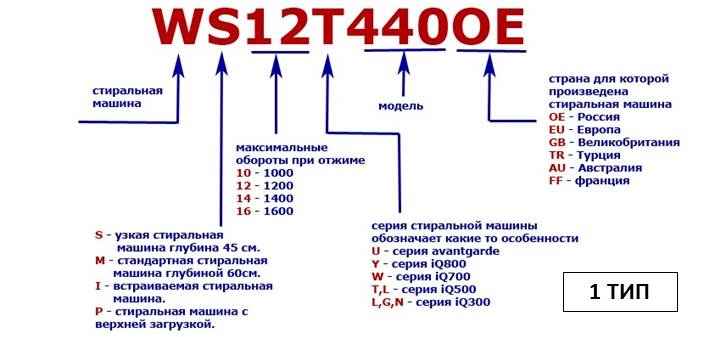
- the first letter is always the same – W. It explains that this is a washing machine;
- the second symbol tells about the type of washing machine: S – narrow machine, M – standard “front-loading” machine, 60 cm deep, I – built-in machine, P – “vertical”;
- the next pair of numbers indicates the maximum spin speed: 10 – 1000 rpm, 12, 14 and 16 – 1200, 1400, 1600 rpm respectively;
- the fifth letter represents the SMA series. U – “Avantgarde”; Y – iQ800; W – iQ700; T or L – iQ500; L, G or N – iQ300;
- the next three digits are the model of the Siemens washing machine;
- The last two letters indicate the country for whose domestic market the equipment was manufactured. OE stands for Russia, EU stands for Europe, GB stands for Great Britain, TR stands for Turkey, AU stands for Australia, FF stands for France, and ES stands for Spain.
The example's markings reveal that this is a narrow Siemens iQ500 series washing machine with a maximum spin speed of 1200 rpm. Model 440 was released specifically for the Russian market.
Marking of the second type
Some Siemens washing machines have slightly different "codes," although the differences will be minor. Among the differences in the second type of markings are: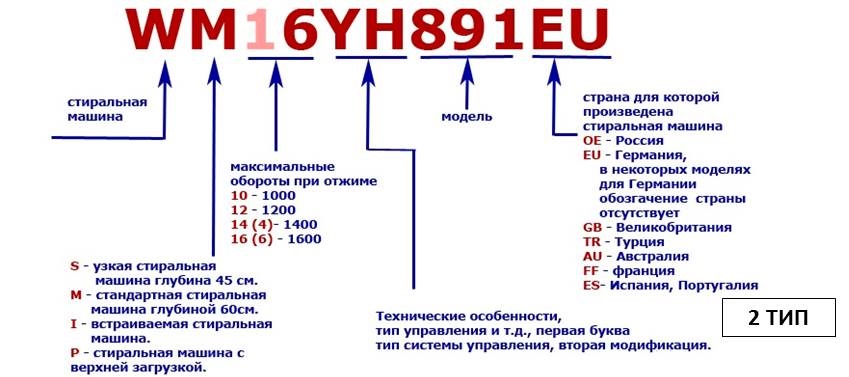
- the maximum spin speed can be indicated by one or two numbers: 10 – 1000, 12 – 1200, 14(4) – 1400, 16(6) – 1600;
- After the number of revolutions there are letters that tell not about the washing machine series, but about the technical features: the type of control and modification of the machine.
A clear example of the second type of marking: WM16YH891EU. This is a standard 1600 RPM front-loading washing machine, model 891. Manufactured for the European market.
Interesting:
1 reader comment
Add a comment
Headings
Washing machine repair




For buyers




For users


Dishwasher




Thank you, you helped a lot.