
Water consumption in dishwashers
 The usefulness and necessity of a dishwasher still seems far-fetched to some housewives. Why bother with such a helper that consumes so much energy and detergent? However, everyone notes its main advantage: saving time. However, this isn't the only advantage of a dishwasher; in addition to saving time, it also saves water, which is significant given the ever-increasing water prices. Different dishwashers use different amounts of water; let's look at how much water this consumes in liters.
A regular dishwasher
By a regular dishwasher we mean narrow floor (9-placeholder) and full-size (10-14 placeholder) mid-range dishwashers. Typically, water consumption in these machines ranges from 9 to 14 liters. This is usually cold water, as dishwashers are typically connected to a cold water supply, which is reasonable from both an economic and safety standpoint.
Please note: Hot water contains more impurities that can affect the dishwasher's components.
Why is water consumption per wash cycle so low for such a large load of dishes? It's explained by the way the machine operates. After filling with water, it reuses it several times during the wash cycle, and the water constantly passes through the cleaning filter, which is crucial. The machine then fills with water for the rinse cycle and again for the final rinse. In this case, the water is sprayed under very high pressure, and the water passes through the arms at high speed, washing the dishes. This technology does not require a large amount of water.
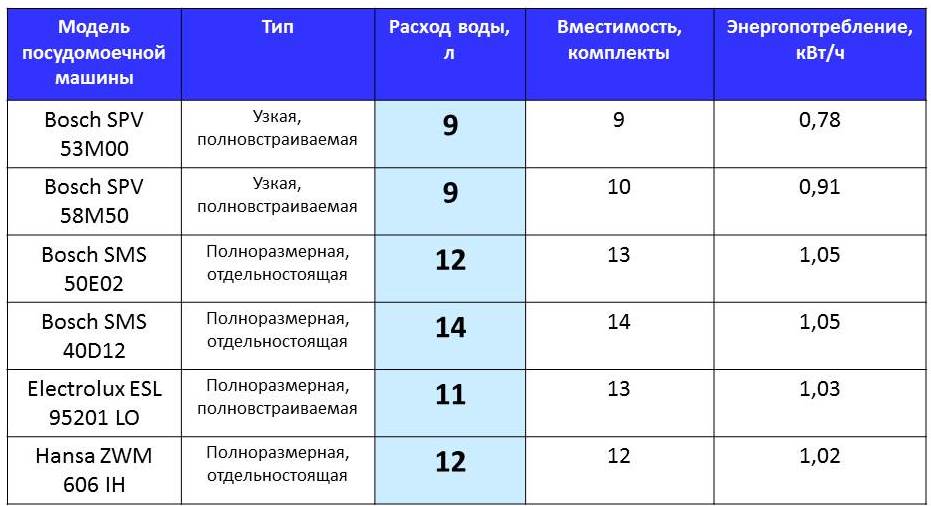
Here are some examples of popular conventional dishwashers priced under $400. The water consumption per wash cycle for these machines is shown in the table.
- Bosch SPV 53M00;
- Bosch SPV 58M50;
- Bosch SMS 50E02;
- Bosch SMS 40D12;
- Electrolux ESL 95201 LO;
- Hansa ZWM 606 IH.
Economical and compact dishwashers
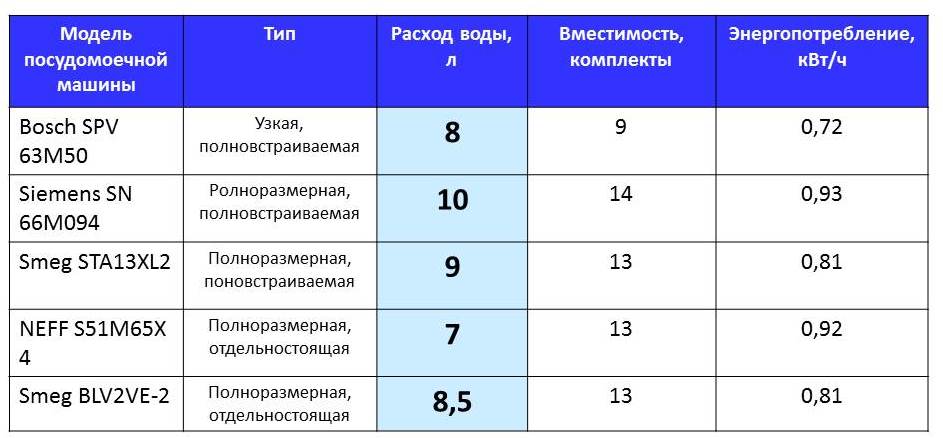
Today, 9 liters of water consumption is not the limit for a dishwasher. Premium-class machines, as well as smaller dishwashers, can use no more than 7 liters of water. This is achieved thanks to certain technologies and the dishwasher's design. Reduced water consumption is reflected in its cost, usually in premium-class dishwashers.
- Bosch SPV 63M50;
- Siemens SN 66M094;
- Smeg STA13XL2;
- NEFF S51M65X4;
- Smeg BLV2VE-2.
The models listed are slim and full-size, with water consumption per cycle shown in the table. These dishwashers are truly economical, with water consumption up to 40% lower.
Important! If your dishwasher has a half-load feature, and these dishwashers almost certainly do, water consumption will be reduced by another 20-30 percent—not 50%, as some people think, but still quite good. Energy consumption will also decrease, but the machine will still run for the same amount of time as normal.
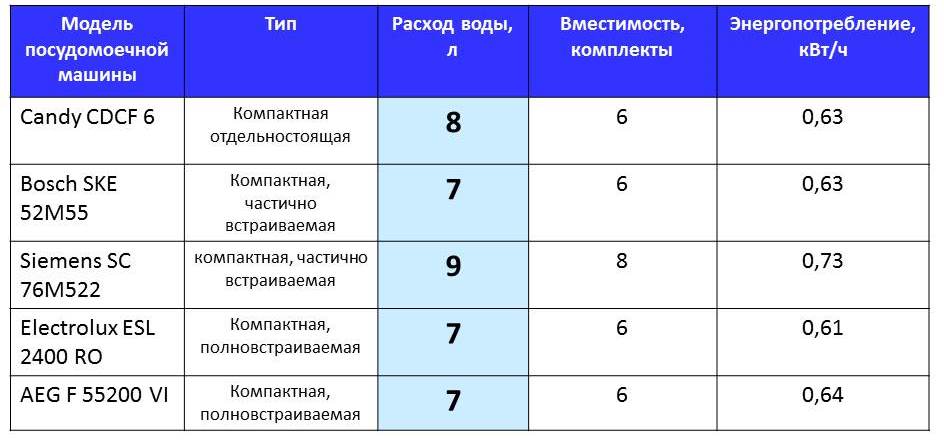
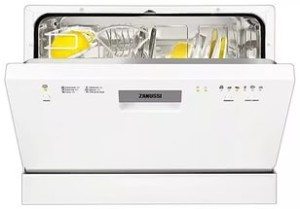
You also need to look at how much power a compact or small dishwasher uses per wash cycle. The difference in water consumption with narrow dishwashers is not great and amounts to only 2-3 liters, some models have no difference in water consumption at all, At the same time, they can wash fewer dishes. So, whether this is a saving or not, decide for yourself. So, we looked at how much water the following compact dishwashers use:
- Candy CDCF 6;
- Bosch SKE 52M55;
- Siemens SC 76M522;
- Electrolux ESL 2400 RO;
- AEG F 55200 VI.
Please note! The actual water consumption of a dishwasher may differ from the stated water consumption by 1-2 liters. Is this significant? Probably not, but it would be nice if the information in the instructions were accurate.
Are there any savings?
Now let's analyze: if there's a difference in how much water a dishwasher uses and how much a person uses to wash the same amount of dishes, does the machine actually save water or not?We can only talk about saving water consumption if you have water meters installed; if you don't, then the dishwasher's water consumption is irrelevant.
If you take, for example, a narrow Siemens SN 66M094 dishwasher with a capacity of 14 sets and load 63 items into it, for example:
- 18 plates,
- 14 cups,
- 2 saucepans,
- 3 salad bowls,
- 1 cutting board,
- 1 teapot,
- 24 pieces of cutlery,
then in about three hours at intensive mode it will use 10 liters of water.
We tried washing half the dishwasher's full load, 34 items. The entire process took 20 minutes. The water was turned off when the dishes needed soaping. In total, we used 23 liters of hot water and 20 liters of cold water, for a total of 43 liters. That seems like a significant amount for just one wash.
If we convert the savings from liters to dollars, this is what we get: Over one year of daily use, you can save 8,280 liters. The average cost of hot water in Moscow in 2016 was $1.30. This means that a dishwasher saves $10.76 of your budget on hot water. The savings on cold water is $1.08.
Conclusion! A dishwasher will save you $11.84 on water per year. But this assumes water efficiency when hand washing; some people use up to 100 liters of water per day on washing dishes, meaning a dishwasher will save even more.
Of course, this isn't a huge amount, and to truly see savings, you'd need to factor in electricity consumption and detergent costs. Regarding electricity, water savings offset the electricity costs by about three to four times. That leaves about $8.30 left over for detergent. This might not be enough for a year, depending on what you use and what you use, but it's safe to say that the overall costs for hand and machine washing are roughly equal. However, there is still a big advantage in favor of a dishwasher: it will save you time, which can be spent more enjoyably.
So, even by the most conservative estimates (with a water consumption of 14 liters), a dishwasher saves water. But whether it saves your family money or not, you have to calculate for yourself. It all depends not so much on the model of the dishwasher as on the detergent you use for washing dishes. In our opinion, is this investment worth a few minutes of rest after work?
Interesting:


Readers' comments
Headings
Washing machine repair




For buyers




For users


Dishwasher




Add a comment