Ditching an automatic washing machine can be a major inconvenience, and even a lack of space in the bathroom doesn't stop you from making the long-awaited purchase. The search for alternatives begins, and often the kitchen becomes the first choice. While space isn't an issue, fitting a washing machine in a small kitchen can be challenging. In such cases, it's best to draw inspiration from tried and tested ideas and consider the details of installing the washing machine without compromising the interior or square footage. The most popular options are discussed in this article.
Let's hide a top-loading washing machine
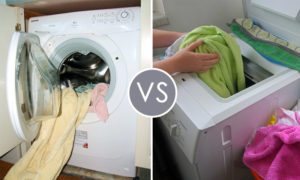
The most difficult thing to fit into a small kitchen is a top-loading washing machine. They are typically extremely awkward in size and unattractive in appearance, so it's best to conceal the machine within the cabinetry. Another problem arises: simply placing the machine under the countertop isn't feasible, as blocking access to the loading hatch is counterintuitive.
The solution is a folding tabletop, which allows for easy loading and unloading of items, while the appliance itself is hidden within the furniture module. Moreover, the new cabinet will successfully replace a bulky dining table and become a bar counter.Another option is an additional workstation.
Let's try to build in the machine
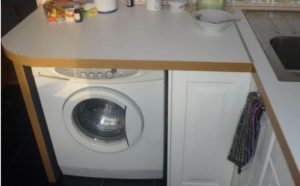
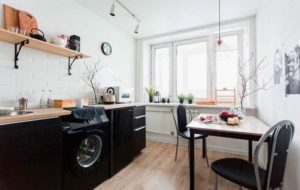
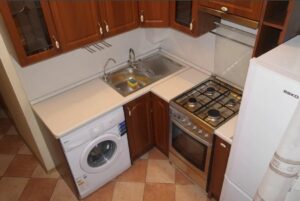
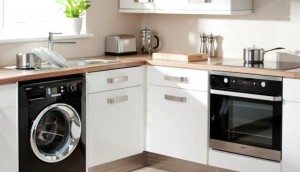
A different approach is to fit a front-loading appliance into the empty niche of the lower section of the kitchen unit. This saves space, avoids cluttering the already small room, and significantly increases the overall work area. This is especially true if the appliances blend in with the room's decor, without being overpowering in color or style. However, with an existing kitchen unit, it's more difficult to choose the right size and avoid gaps and voids. It's often difficult to connect utilities to the empty unit. Therefore, the best solution is to order a new kitchen unit.
If purchasing new modules isn't an option, and the machine itself clashes strongly with the kitchen's design, built-in models are a better choice. Their main feature is special grooves on the body for installing decorative doors, which completely conceal the unit from view.
You'll have to accept the high cost of these machines and choose the right dimensions for the machine (there should be 3 cm of clearance on each side).
Another popular idea for kitchens in Khrushchev-era apartments and other typical panel buildings is to order a tall cabinet and place a washing machine inside, with a dryer above. The "tower" is designed to match the refrigerator. The resulting symmetry will greatly save space and make the interior unusual.
In addition to placement, it's recommended to consider the future use of the appliance. For example, if possible, raise the machine off the floor to load the drum with minimal tilt. Also, allocate a nearby storage area for detergents and plan the machine's location so that the door, when open for ventilation, doesn't interfere with movement.
The advantages and disadvantages of a washing machine in the kitchen
It's entirely possible to beautifully and conveniently place a washing machine in a modest kitchen, but whether it's worth it is another matter. Before planning a relocation, it's best to familiarize yourself with the advantages and disadvantages of your washing machine's new home. This approach will avoid surprises and potential inconveniences. Let's start with the negatives.
The chosen location cannot be changed. The machines are installed in precisely designed niches, where utilities are also connected. Everything is designed for long-term operation without relocation or modification.
Disharmony arises. If there's no money for a built-in washing machine or a stylishly designed appliance, the overall look is disrupted.
It's difficult to ventilate the door. When space is limited, an open hatch is a major nuisance, and closing it will lead to mold growth and damage.
There's nowhere to store dirty clothes. You need to find additional storage space for soiled clothes, as simply throwing them in the drum isn't an option.
Substances are harmful to health. During washing, detergent particles are released into the air, which then ends up on food.
But the disadvantages are outweighed by a number of advantages. Firstly, the kitchen's low humidity and ventilation with optimal air circulation increase the lifespan of household appliances. Secondly, the utility rooms are connected to sewer and water pipes, making it easy to connect the machine to the utilities. Thirdly, a compact bathroom is freed from the clutter of a washing machine. Moreover, the standard 60 cm width of the module allows for the installation of a larger model with a capacity of over 8 kg. And the most obvious "plus" is that housewives don't need to run to another room to check the cycle or restart the wash, since the machine is located next to the stove and sink.
Machine installation rules
To create a functional kitchen with a washing machine and refrigerator, remember to follow the installation guidelines. First, carefully consider the placement of the washing machine, ensuring it isn't positioned "next door" to the stove or freezer. Ensure the prepared base is perfectly level and stable, with at least 3 cm of clearance between the machine and the cabinet.
Note! Ordering a 25 cm wider module will provide more space for cleaning supplies.
Keep the back panel of the appliance open to facilitate connection and easy repairs. This will ensure safe and convenient operation of the washing machine.

 Ditching an automatic washing machine can be a major inconvenience, and even a lack of space in the bathroom doesn't stop you from making the long-awaited purchase. The search for alternatives begins, and often the kitchen becomes the first choice. While space isn't an issue, fitting a washing machine in a small kitchen can be challenging. In such cases, it's best to draw inspiration from tried and tested ideas and consider the details of installing the washing machine without compromising the interior or square footage. The most popular options are discussed in this article.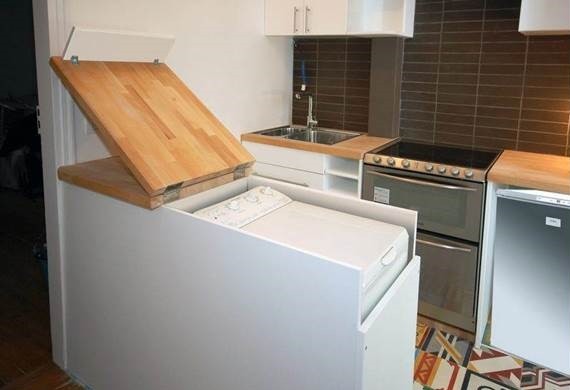
 A different approach is to fit a front-loading appliance into the empty niche of the lower section of the kitchen unit. This saves space, avoids cluttering the already small room, and significantly increases the overall work area. This is especially true if the appliances blend in with the room's decor, without being overpowering in color or style. However, with an existing kitchen unit, it's more difficult to choose the right size and avoid gaps and voids. It's often difficult to connect utilities to the empty unit. Therefore, the best solution is to order a new kitchen unit.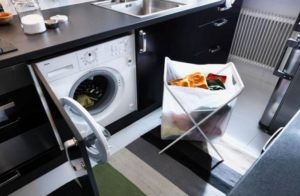














Add a comment