
How to disassemble the drum of a Beko washing machine?
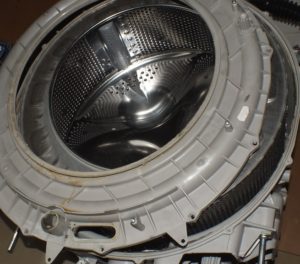 Over time, the drum assembly of any washing machine fails: the shaft becomes loose, the seal leaks, and the bearings wear out. All this prevents smooth rotation and leads to play, which increases vibration and noise. This situation is also common among Beko owners, so it's important to prepare for possible malfunctions. To solve the problem, you'll have to disassemble the Beko washing machine drum and replace the worn parts. Now let's find out where to start and what to do next.
What will you face?
Before disassembling, it's worth outlining the scope of the work and understanding what you'll be dealing with. The bearing assembly is what powers the drum, transmitting the impulse from the motor through the shaft. Due to the high load, bearings wear out faster than other parts of the washing machine, making it difficult to spin the mechanism.To correct the situation, it will be necessary to replace the worn out elements.
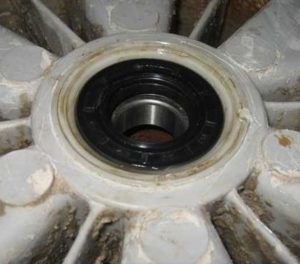
The difficulty lies in the bearings being located on the drum cover. To access the problematic area, you'll have to not only disassemble the washing machine almost completely, but also cut the drum in half. Beko owners face an even more difficult situation, as their machines are equipped with one-piece drums that can't be easily repaired.
Beko washing machines are equipped with one-piece tanks, so disassembling them requires a metal saw.
The one-piece drum can't be disassembled using conventional methods. Therefore, service centers charge high prices for replacement, and most often recommend completely removing the worn-out component and installing a new one. The cost of the "exchange" isn't cheap—usually around 50-70% of the washing machine's price. Alternatively, you could buy a new one, but you'll be out even more.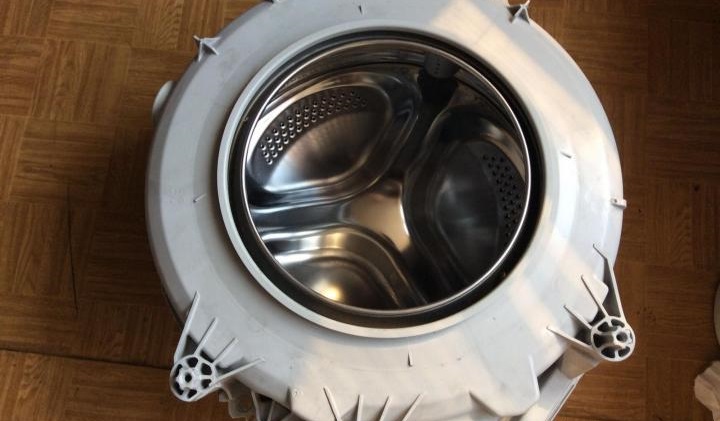
If you don't have the money to buy a new tank or the entire machine, you can try repairing it yourself. You'll need to cut the non-separable tank apart with a metal saw, replace the bearings, and then glue everything back together and put it back together. It's a lot of work, but you can save a lot of money. Are you ready? We offer step-by-step instructions and recommendations.
Let's prepare carefully
If you decide to undertake a DIY repair, it's important to prepare thoroughly. First, gather or purchase the bare minimum of tools needed. Fortunately, the list is fairly standard:
- a set of screwdrivers (flat, Phillips and indicator);
- a saw or hacksaw for metal;
- pliers;
- pliers or pliers;
- set of open-end wrenches (8-18 mm);
- set of heads;
- puller (a car version will do);
- socket wrenches;
- hammer;
- awl;
- chisel;
- multimeter.
After gathering the tools, we begin preparing the work area. If the washing machine is installed in a spacious bathroom, you can work there. In small spaces where it's difficult to maneuver, it's worth finding another option—a hallway, kitchen, workshop, or garage. It's important to ensure there's at least two square meters of space available, otherwise disassembling the machine will be difficult. In general, here's how to proceed: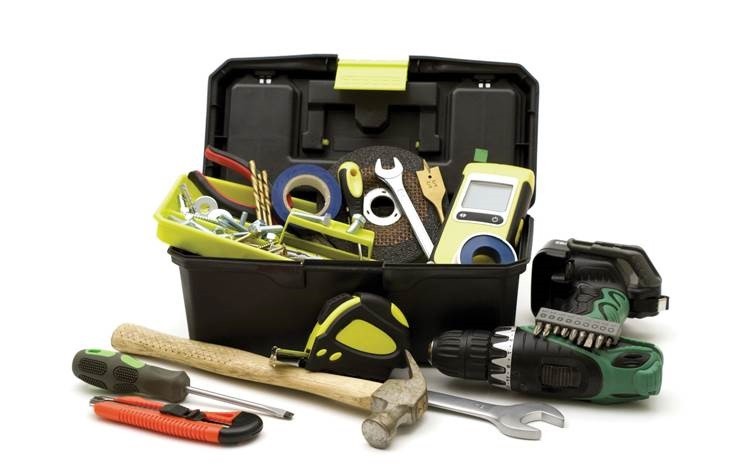
- we disconnect the machine from all communications (electricity, sewerage, water supply);
- we move the washing machine to a place convenient for repair;
- we cover the space around the equipment with oilcloth, rags or newspapers;
- Pulling towards you, we take out the detergent tray from the housing;
- After unscrewing the waste filter, we drain the remaining water from the tank.
Before disassembling the machine, it is necessary to de-energize it and disconnect it from the sewer and water supply!
For convenience, it's recommended to set aside a separate area for small parts—bolts, screws, clamps, and other fasteners. Once you've completed these preparations, we can begin troubleshooting.
Removing the tank and disassembling the machine
To get to the gas tank, you'll have to disassemble the machine almost completely. It's actually not that difficult—anyone can do it, as long as you know what to do and in what order. So, disassembly begins with the basics:
- remove the top cover of the case by unscrewing the retaining bolts at the back and pulling the panel forward and up;
- we remove the “back” by unscrewing the corresponding fasteners;
- unhook the drive belt from the pulley;
If there is rust or oil stains on the wall behind the pulley, the bearings are damaged.
- We remove the heating element from its seat, having first disconnected the connected wiring.
In theory, it's possible to disassemble the washing machine down to the drum without removing the heater, but experienced technicians recommend against taking this risk. The fact is that failure to remove the heating element often leads to damage to the latter: contacts are broken or the “spiral” itself is deformed. It's better not to try to save time, but to protect yourself from having to replace an expensive part later.
Next up is the electric motor. It also needs to be removed from the washing machine. To do this, remove the motor's wiring, loosen the bolts, rock the motor, and pull it toward you. Be extremely careful not to damage the tachometer located on the motor.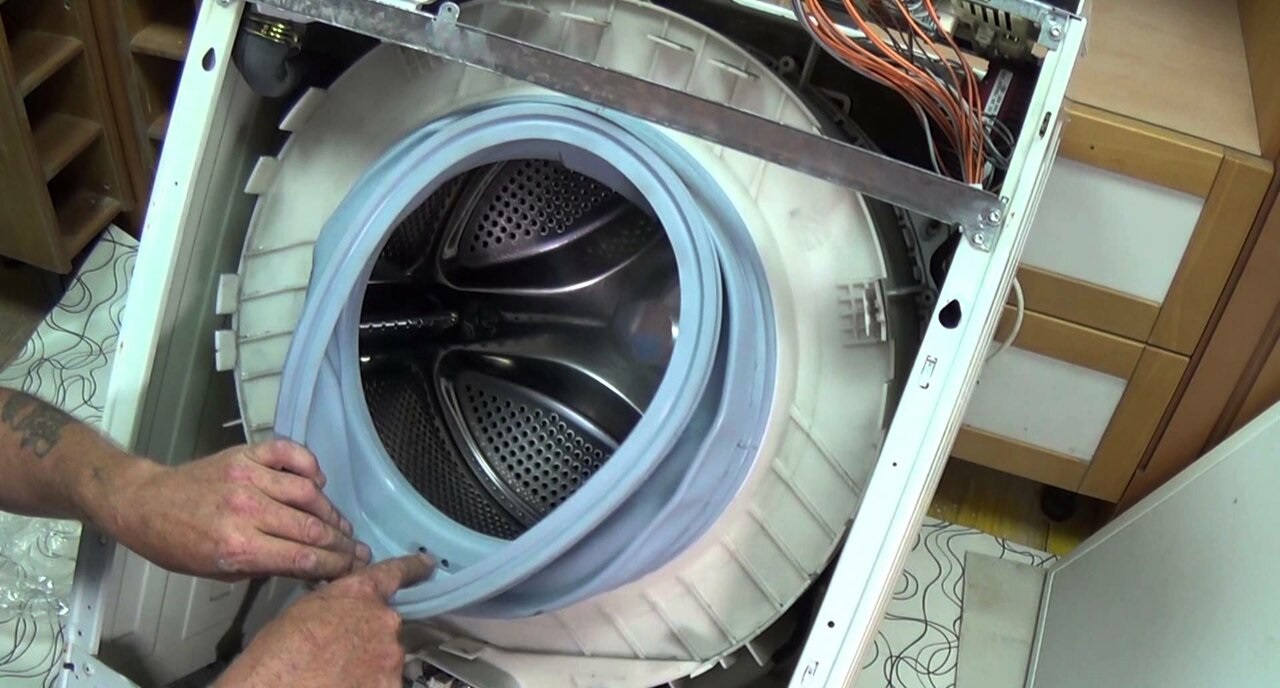
Let's move on to the "upper" part, or more precisely, the counterweights. These are concrete blocks that sit above the drum and absorb the centrifugal force emanating from it. Removing the stones is easy: just use a socket wrench to loosen the retaining bolts and remove the concrete from the machine. But be aware of its weight—it's best to call someone to help.
Now you need to remove the dashboard. Follow these instructions:
- unscrew 2-4 bolts located next to the powder receptacle;
- we loosen another clamp located on the left side of the case;
- remove the board from the plastic latches by lifting the panel upwards;
- disconnect the wires leading to the inlet valve;
- We hook the removed panel onto the service hook or put it aside.
Next, we turn our attention to the inlet hose. Nearby is the inlet valve and the powder receptacle, which also need to be removed from the housing. It's very simple: use a screwdriver to pry off the clamps and disconnect the connected pipes and wiring.
You also need to remove the pressure switch from the machine. To do this, unhook the wires from the washer, unscrew the retaining screws, and carefully pull the plastic tube out of the tank. Don't rush—the part is very fragile and easily damaged by sudden movements.
We go down to the hatch and loosen the clamp holding the rubber seal. Then, we tuck the seal inside the drum and turn off the door lock. Next, we turn the washing machine on its side. The reason is simple: most Beko models lack a drip tray, so the "empty" bottom makes it easier to access the drainage system. Here, we loosen the fasteners, remove the clamps, and remove the drain hose. Using a socket wrench, we loosen the shock absorbers. Now we're ready to return the machine to a horizontal position and begin cutting the drum.
We divide the tank into two halves
Cutting the tank while it's still inside the machine won't work—it needs to be removed. Despite its apparent lightness, this unit is very heavy, so it's best to enlist an assistant. Next, grasp the edges of the drum, rock the tank sideways, lift it slightly, and pull it toward you. The tank should slide out of its seat.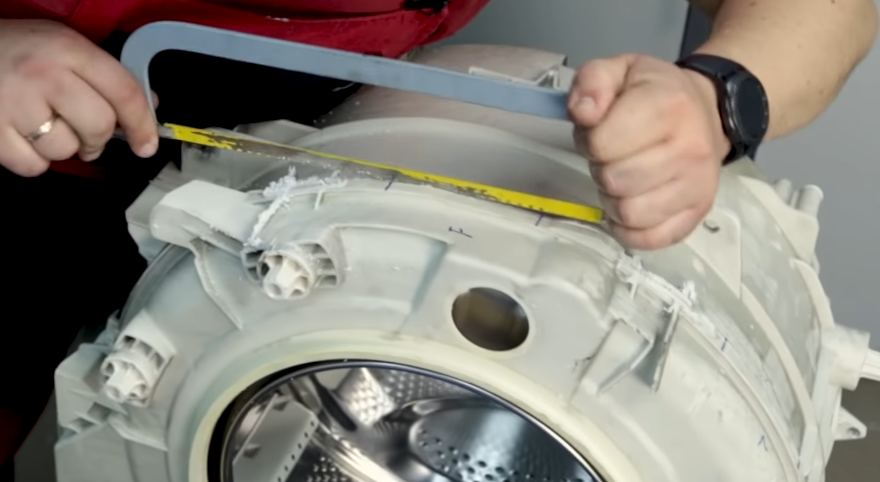
After emptying the tank, we inspect it. We need to make sure it's a solid piece and truly requires this manipulation. If so, we get to work:
- we prepare a place for cutting: we put a car tire, which will increase stability;
- we place the tank vertically on the tire, with the seam facing up;
- We take a saw or a hacksaw for metal and cut the tank in half strictly along the seam.
This must be done with extreme care, as the slightest deviation will compromise the tank's seal. Once the cut is complete, remove the top of the tank and turn the bottom over so the crosspiece is facing up. The bearings are "hidden" directly under the shaft, so we move on to the next step—removing the seals and rings.
We extract damaged bearings
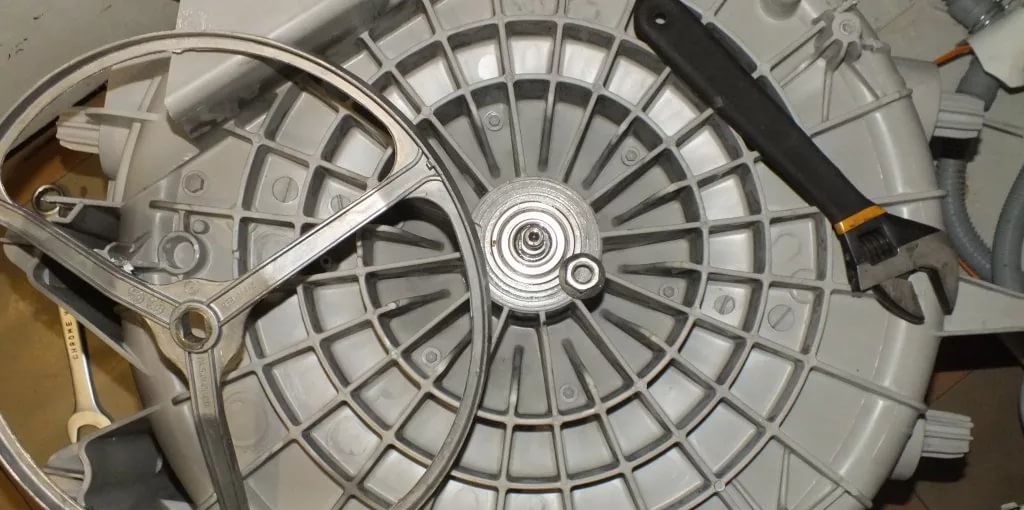
To get to the drum and bearings, you need to deal with the "back". While the top half of the tank comes off quickly and easily after cutting, the bottom half will require more work. First, loosen the nut securing the drum pulley. Then, proceed as follows:
- remove the pulley;
- screw a bolt into the released thread (it is better to use a third-party bolt, since after the “procedure” it will be heavily deformed);
- cover the bolt head with the rubber part of the mallet (if you don’t have one, a regular wooden block or a thick piece of rubber will do);
- generously treat the threads with WD-40 (if it is clear that the joint is heavily stuck and rusted);
- We tap the structure with a hammer until the lower part moves.
WD-40 will help deal with stuck parts.
After removing the other half of the tank, we can finally access the drum. We need the bearings located on the shaft. To remove the ball rings, simply use a car puller.If you don't have the latter, we resort to the help of auto mechanics or arm ourselves with a hammer and chisel.
After that, all that's left to do is knock out the old bearings and install new ones in their place. Once the replacement is complete, reassemble the Beko. First, connect the two halves of the drum with bolts and sealant, then return the drum to the washing machine body, followed by the remaining components. We won't go into detail about the assembly process; just follow the instructions above, but in reverse order.
Interesting:

Readers' comments
Headings
Washing machine repair




For buyers




For users


Dishwasher




Add a comment