
How to disassemble and clean a washing machine?
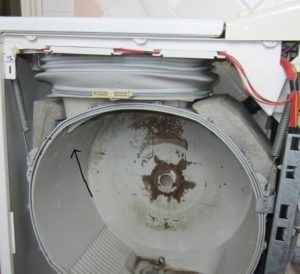 Modern washing machines can do many things automatically, but none can clean themselves. Meanwhile, hard water, low-quality detergents, and dirty laundry leave their mark on the machine—soap scum, dirt, and grime. If all the accumulated debris isn't removed promptly, the washing machine will become clogged and stop washing.
To restore your appliance to its original state, you need to disassemble the washing machine for cleaning and remove any debris and buildup. Now, let's figure out what to clean and in what order.
Where does the main dirt collect?
A washing machine gets dirty everywhere, but most of the scale and debris settles in certain places. To clean your washing machine, simply identify the dirtiest areas and wash them one by one. We are talking about the following “pain points” of the machine.
- The debris filter. Its name is no accident – this attachment collects approximately 90% of the debris that ends up in the washing machine. It should be cleaned first.
Almost 90% of the dirt that gets into the washing machine settles on the waste filter.
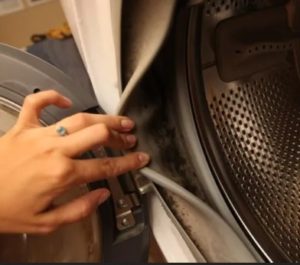
- Sunroof seal. Debris and foreign objects accumulate in the folds of the rubber seal. The situation is further complicated by the fact that water, in addition to debris, also gets trapped in the rubber seal, which, if left to dry for a long time, can lead to mold and mildew.
- The pump. More precisely, the pump impeller, whose blades tend to become tangled with hair, lint, and fur. Less commonly, the impeller is blocked by large debris that has leaked through the drain filter.
- Detergent dispenser. The remaining detergent in the dispenser hardens and, over time, becomes covered in mold and limescale. If the dispenser is not cleaned, the nozzle will become clogged and stop dispensing soap into the tank.
- Tank Bottom. Debris inevitably accumulates at the bottom of the main tank. Cleaning it requires partial disassembly of the machine.
Once you've identified the most debris-prone areas of the machine, begin a thorough cleaning. You can handle the task yourself, but sometimes you'll need help from your spouse or friend. For this "cleaning," you'll need screwdrivers, a cloth, water, soap, and WD-40.
Cleaning out the trash bin
The first thing you need to do is clean the dust filter. This is usually located at the front, in the lower right corner of the unit. The nozzle is usually hidden behind a decorative rectangular or round door. Accessing the drain is easy; just follow the instructions:
- tilt the machine body back so that the front legs rise into the air by 5-7 cm;
- we place a small container under the technical hatch to collect water;
- We pry the hatch with a screwdriver, unfasten the plastic latches and remove the door;
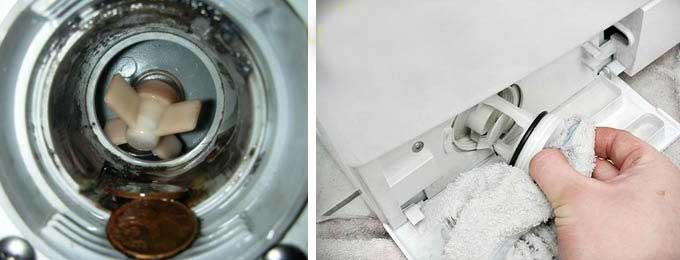
- inspect the filter, the black or blue plug, and the emergency drain hose, orange or red;
- pull the hose and drain the water into a basin;
- If there is no drain hose, then unscrew the waste filter counterclockwise, getting rid of the water;
Do not empty the machine through the waste filter immediately after the high-temperature cycle ends – the water will not have time to cool down and will burn you!
- unscrew the "trash can" all the way;
- we evaluate the condition of the seat and the filter itself;
- We clean the nozzle from debris and scale.
A heavily soiled filter will need to be soaked in a warm lemon solution. Screw the clean attachment back in, and return the machine to its original position.
Powder receiver compartments
The powder compartment is also easy to clean. But first, you need to remove it from the housing. Here's how:
- pull the tray towards you until it stops;
- Without releasing one hand, with the other we press on the plastic tongue, mostly blue in color, located in the central compartment for rinse aid;
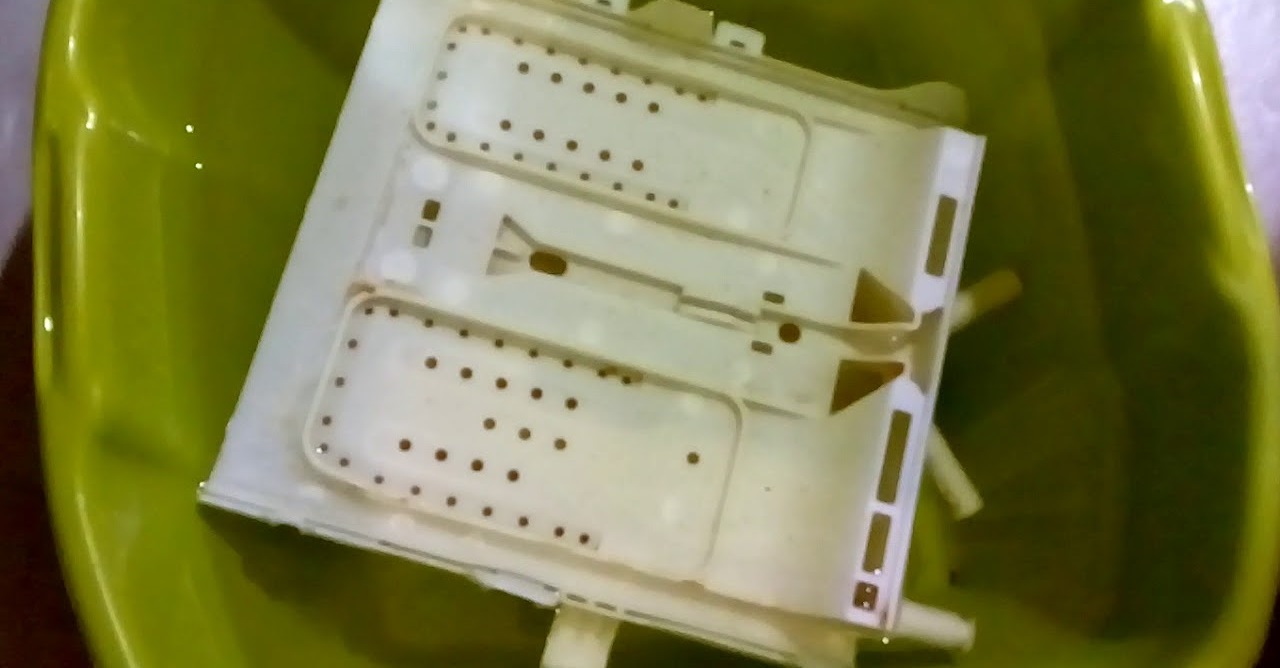
- we pull the bunker out to the end.
Before cleaning, the powder receptacle should be soaked in a cleaning solution for 1.5-2 hours.
By removing the tray, it is easier to assess the degree of contamination and begin cleaning. Hardened powder cannot be washed off by simply rinsing – the plastic must be soaked for some time. This method has proven itself well:
- fill the basin with water heated to a temperature of no more than 60 degrees (in boiling water, plastic will deform and deteriorate);
- dissolve 200-250 g of citric acid or 100 ml of vinegar in water;
- we lower the powder receiver into the solution so that the tray is completely covered with water;
- We wait at least 1.5 hours.
We remove the soaked powder container from the solution and begin mechanical cleaning. The main task is to remove any remaining powder and debris using an old toothbrush or toothpicks. Finally, we rinse the container and wipe it dry with a cloth.
Cuff
The door seal is vulnerable to dirt and debris. Detergent particles, lint, and dirt tend to settle at the bottom of the seal between the folds. To remove accumulated debris, open the drum, pull back the rubber seal, and thoroughly clean all hard-to-reach areas. Use a dish sponge or soft cloth for this purpose.
The hatch cuff can be damaged by mold if not cleaned in a timely manner.
After the initial surface cleaning, we move on to the second stage: cleaning with a cleaning agent. Apply bleach, vinegar, or lemon solution to a sponge, then wipe the entire seal. Then, close the door for 30-40 minutes, during which time the cleaning agent will complete the process: dissolving deposits and disinfecting the rubber from fungus. After half an hour, rinse the drum with clean water and wipe dry.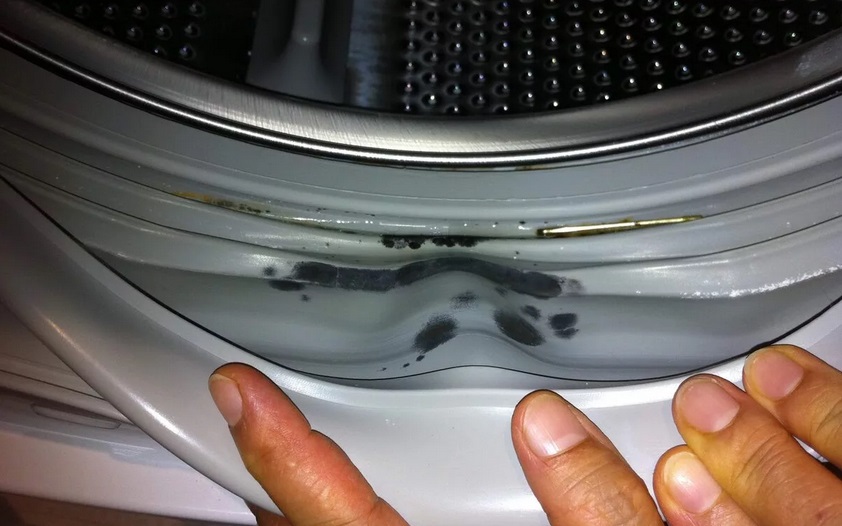
When cleaning the cuff, it's important to choose the right cleaning agent. Avoid using caustic or overly aggressive acids, as these compounds will damage the rubber.
Cleaning the pump
Cleaning a pump impeller clogged with hair or other debris is somewhat more difficult. This requires assistance, as the pump will need to be removed and disassembled. First, unplug the washing machine and move it away from the wall, allowing access to the rear wall. Then, attach the hoses to the housing and begin cleaning:
- make sure there is no water in the detergent drawer;
- carefully turn the machine onto its right side;
- We look under the bottom of the washing machine and look for the pump - a round black part located on the snail and screwed with four bolts;
- we photograph the location of the screws and wires;
- we release the pump by disconnecting the connected wiring and unscrewing the fasteners;
- We swing the pump and remove it from the snail.
The pump impeller should rotate, but not freely, but with noticeable difficulty.
Next, we assess the condition of the impeller. If the impeller is in good condition, the blades will rotate with noticeable difficulty. If the impeller doesn't move at all, it needs to be cleaned of any threads, hair, or lint. Free rotation is abnormal: the part has likely fallen off or slipped off the axle. There are two options: either tighten the fasteners or replace the pump with a new one. Most importantly, don't try to "secure" the device with sealant or glue, as such a design is unreliable and unsafe.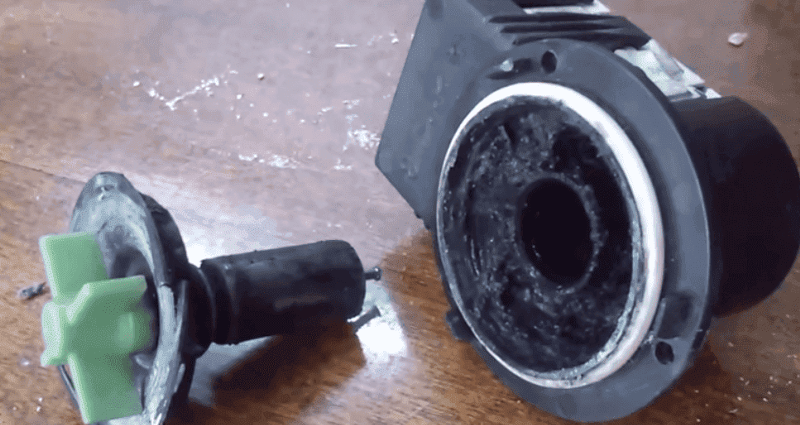
If the impeller is in good condition, we begin disassembling the pump. We unscrew the housing, clean the two halves of any dirt, and then reassemble and test the blades again. Non-disassemblable pumps cannot be split in half for repair – only a complete replacement of the part is possible.
We penetrate into the tank
The most difficult part to clean is the washing tank. It is better not to take it on without a reason or serious cause, since this will require disassembling the machine. Routine cleaning isn't a valid reason. However, if a foreign object, such as a bra underwire or keys, gets stuck under the drum, there's a risk of damaging the metal and plastic tanks.
It is recommended to record all actions on camera to simplify the reassembly process and avoid errors when connecting wires.
You can access the bottom of the tank through the heating element opening. Here's how:
- disconnect the washing machine from the power supply, water supply and sewerage system;
- move the equipment away from the wall, freeing up space at the back wall;
- tilt the machine back, place a basin underneath it and drain the water from the tank through the waste filter;
- remove the back panel by unscrewing the bolts holding it;
- find the heating element, which is located mainly under the drum, in the lower part of the body;
- disconnect all connected wires from the heater plug, having first fixed their location on the camera;
- remove the temperature sensor;
- unscrew the fastening nut and push the axle inward;
- swing the heater and remove the heating element from the mount.
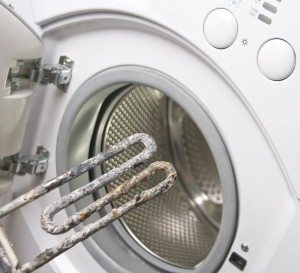
Using a wire or your hand, scrape out any debris or foreign objects from the bottom of the drum through the hole left by the heating element. Then, replace the heating element and reassemble the washing machine.
Interesting:
1 reader comment
Add a comment
Headings
Washing machine repair




For buyers




For users


Dishwasher




When it's very dirty, you can't take the heating element out.