
Bosch Dishwasher Door Repair
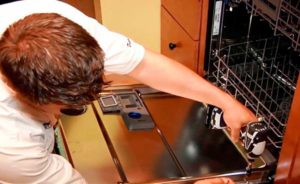 Door failure is a real scourge of modern Bosch dishwashers. Just 12 years ago, the company produced "indestructible" appliances, and that's because they didn't use small plastic parts, only metal. Unfortunately, now there's more plastic, and brittle plastic at that. Oh well, let's leave that on the manufacturer's conscience. Our task now is to repair the dishwasher door, but first, we need to determine whether it's truly broken and what's causing it.
Symptoms of a breakdown
Understand that the doorBosch dishwasher It's not that difficult to break. A breakdown will inevitably manifest itself with obvious symptoms that are impossible to ignore. What could happen?
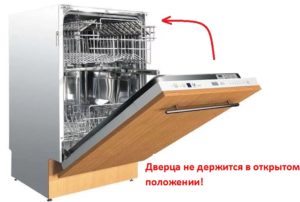
- The door will no longer stay in a half-open position and will start to fall with a crash if you don’t hold it with your hand.
- The door will stop latching, although it may still latch, but only after you press hard on the door.
- The door will begin to creak terribly and jam, making it very difficult to move.
In the worst case, the door will jam so much that it will stop opening and closing altogether.
The door's design is quite simple, so there are only three possible causes for the symptoms mentioned above. Either the locking mechanism is broken, the soft-opening mechanism is damaged, or the hinges require lubrication or replacement. Let's try to figure out how to fix these three types of problems.
The door falls or closes poorly
The most common problem is the door falling. As soon as we open it, gravity forces it to fall unhindered to the "wide open" position. A fall like this can cause further damage to the door, so you'll have to hold it while opening it. The problem is that with this type of malfunction, the door must not be left ajar to allow the wash chamber to dry after the program is complete. This, in turn, can lead to mold growth inside and damage to the rubber seals. How can the problem be diagnosed?
- We completely disconnect the dishwasher from all utilities and remove it from the niche in which it was installed. There is no need to remove the door panel.
- Some models have side walls that need to be removed.
- We walk around the side of the dishwasher and look at the very bottom of the cabinet. There's a groove there that holds the spring, cable, and plastic adapters.
- In this situation, either the cable broke or, more likely, the plastic adapter broke, separating the cable from the spring. This led to a breakdown of the locking mechanism.
Once we've determined exactly what's broken, we have two options. First, we can go to a Bosch store (or visit the online store) and order a new plastic part. It's inexpensive, but there's no guarantee the problem won't recur after repairs, as plastic is fragile, and the load, given the weight of the door panel, is quite high. Second, we can slightly modify the mechanism to make it much more reliable, but this will require a bit more effort. We suggest the second option, which is a "do it and forget it" approach.
- We remove the spring and cable from the groove to the side so that these parts do not interfere with us.
- We drill a hole for a bolt in the end of the groove on the rear wall side. We'll use a 5 cm long bolt.
- We step back three turns from the edge of the spring and insert a washer with wide margins.
- From the back of the spring, insert the bolt so that it passes through the washer inserted into the spring. The bolt threads should almost completely protrude from the spring.
- Place a washer on the thread, then screw on the nut, firmly connecting the bolt to the spring. Tighten firmly to prevent the washers from shifting left and right.
- Take the end of the cable that goes to the spring, place the washer on it first, then the nut. Tie a knot at the end of the cable so that the nut and washer don't slip off.
Instead of a washer and nut, you can use a steel wire hook, but the connection will not be as secure.
- Using round-nose pliers, carefully bend back three turns of the spring on the opposite side.
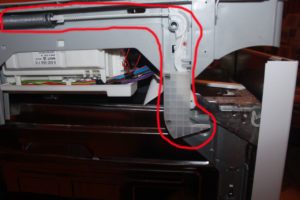
- We insert the washer with the cord between the turns and tighten them well. At this stage you may experience some difficulties, but you have to try.
- Thus, the spring is connected to the cable, and at the other end a fairly long thread comes out of it.
- We place the spring with the cable in the groove, and thread the pin through the drilled hole.
- We put a washer with wide margins on the exposed thread, and screw a nut on top, firmly fixing the spring in the groove.
What did we get? Here's what we got. The spring is firmly seated in the groove, and the cable is securely attached to it, without any plastic "gamyrs." To break this connection, you'd have to at least break the strong cable, which is made of synthetic fiber, and that's very difficult. We check how the door opens and closes; if everything is fine, then we reassemble the machine and connect it to the utilities.
The door does not latch
Bosch dishwasher locks are quite reliable; they rarely break, but they do jam quite often. If you push too hard on the door when closing it, the problem immediately becomes apparent. The jammed locking mechanism stops working. After this, you can slam the door as much as you want, but it won't close. What should you do?
First of all, don't panic; this isn't a malfunction, but rather an annoying flaw in the locking mechanism. Take a screwdriver, open the dishwasher door, and look at the top of the washing chamber. There should be a small metal tab protruding from it. Press the tip of the screwdriver gently on this tab; it should click and retract into the locking mechanism. Try closing the door. If the door latches properly, the problem is solved.
To prevent this problem from recurring, latch the door gently, without applying force. Don't press on the door.
It creaks and moves with difficulty.
If your Bosch dishwasher door squeaks and moves with difficulty, you should first lubricate the hinges. Take WD-40 and spray it onto each hinge using a small tube. Wiggle the door a few times to distribute the lubricant throughout the mechanism. Leave the dishwasher for 10 minutes, then try opening and closing the door again. If the problem persists, you'll need to inspect the hinge mechanism for damage.
Remove the dishwasher's side panels and inspect the hinges. In some cases, they may have become slightly deformed due to impact during transport, or a foreign object may have gotten caught in them and jammed. Repairs will depend on the cause and nature of the damage, but typically, this doesn't cause any serious problems. Bend the deformed elements using a flat-head screwdriver and pliers, after which the hinges should begin to function normally.
So, we've covered the common problems that can arise with a Bosch dishwasher door, as well as how to fix them. If you have any questions, please leave a comment below or create a thread on our forum. Our specialists will be happy to investigate your problem and provide expert advice. Good luck!
Interesting:



3 reader comments
Add a comment
Headings
Washing machine repair




For buyers




For users


Dishwasher




Can I order a repair from you, as described in the article regarding the cable?
Thanks so much for the video! I ended up doing it exactly as you suggested, only using rigging staples.
Hello! My Bosch dishwasher has stopped working. It still works after I press the door. I assume there's something wrong with the door sensor?