
DIY Samsung Dishwasher Repair
 Samsung appliances are highly respected in our country and around the world. Televisions, refrigerators, washing machines, microwave ovens—you name it—are produced under the Samsung brand. In particular, the company produces a whole line of high-quality dishwashers. However, like any appliance, these machines have their weaknesses, which we'll definitely discuss when we discuss Samsung dishwasher repair.
What breaks most often in these dishwashers?
Freestanding and built-in Samsung dishwashers have similar common problems. Some defects are common to most dishwashers, while others are more common only on Samsung appliances. Regardless, let's list them.
- Firstly, these are various blockages. Typically, the debris filter and the inlet valve filter are the most commonly clogged.
- Secondly, there are problems with the inlet valve. The inlet valves on Samsung dishwashers are not very reliable, as many experts acknowledge. This, in turn, has led to frequent breakdowns of this component.
More often than not, it’s not even the intake valve mechanism itself that breaks down, but its electrics.
- Thirdly, there are problems with the drain pump, which often breaks down in most dishwasher models.
- And finally, fourthly, it's worth mentioning defects in the flow-through heating element. Water heating problems are the most common defect in Samsung dishwashers. Heating elements break down very often and have to be replaced because they cannot be repaired.
So, here's a list, not too long, that we'll discuss today. Let's give it a try.
Clearing filter blockages
Filters are a common problem with any dishwasher, including Samsung ones. In fact, clogs can be easily avoided with proper and, most importantly, regular maintenance, but very few people do this. Thankfully, at least some people read the instructions and read that dirty dishes should be cleaned of food residue before loading them into the racks. Many don't even do that.
How can the dust filter not get clogged and cause problems for the user? A clogged dust filter indicates the following: water stops draining from the machine, it freezes, and stops working. The error occurs within the first 15-20 minutes of the program. What should I do?
- Carefully open the machine door and remove the dish basket located at the bottom.
- We collect dirty water with a rag, which may remain in some quantity at the bottom of the washing chamber.
- We remove the lower sprinkler, which is held in place by a plastic latch.
- We grab the debris filter, which is located next to the mesh at the bottom of the washing chamber, and turn it counterclockwise by half a turn.
- We take out both the mesh and the filter, and then rinse these parts under running warm water.
To clean the filter, use dishwashing liquid, as its membrane may be coated with a layer of grease that does not allow water to pass through.
If the machine drains normally but has problems filling, the flow filter at the inlet of the inlet valve may be clogged. How can I clean it myself? First, turn off the water. Then, unscrew the inlet hose and check for blockages. If the hose itself is clean, locate the small plastic mesh at the base of the inlet valve, remove it, and inspect it. Very often, a layer of limescale forms on this mesh, which prevents water from passing under sufficient pressure into the dishwasher.
After cleaning the strainer, we put it back in place, then screw on the inlet hose and turn on the water. Incidentally, blockages can also be located deep inside the dishwasher. Yes, these blockages are difficult to reach, but there is a solution. You need to use dishwasher cleaning productsJust run your machine through an empty drain with this product once a month, and clogged drains will be a thing of the past.
Replacing the fill valve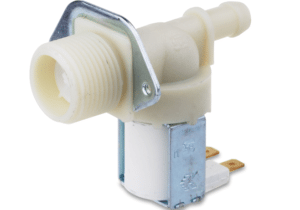
If no water is entering the dishwasher at all and there are no clogs inside, the inlet valve may be malfunctioning. This needs to be checked. First, disconnect the dishwasher from the power and water lines, then move it to a location where it's easy to work. Next, unscrew the right side panel and move the soundproofing aside.
Once this is done, all the main components of the dishwasher will be revealed, including the inlet valve. Disconnect the wires from it and check the electrical system with a common device called a multimeter. As mentioned earlier, the inlet valve's electrical system often burns out in Samsung machines. If this is detected during the inspection, replace the valve. Buy a new part, unscrew the old one, and screw the new one in its place—it's not that difficult.
How to change the drain pump?
The pump is also easy to find if you remove the side panel of your Samsung dishwasher. Repairing the pump if it's defective is possible, but it's a tedious task, and not worth the effort; replacing it is easier. The pump should be checked visually and with a multimeter, paying particular attention to the impeller. When installing a new pump, it's important to connect the wires correctly, so novice technicians are advised to take photos of the old part installed to avoid confusion due to inexperience.
The old pump is removed by turning it counterclockwise. The new one is installed by turning it clockwise. It seems like a simple process. If the drain pump appears to be in good condition, you should check the power supply wiring; it's possible that it's the problem.
Solving heater problems
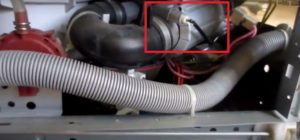 A burnt-out heating element will indicate that the machine will attempt to wash dishes in cold water. The situation with a broken heater is unpleasant because a new part is quite expensive. Replacing it won't be difficult, even for someone who's never seen the inside of a dishwasher. What should be done? How can this problem be solved?
- Remove both side walls of the Samsung dishwasher and remove the sound insulation.
- You will see the heating element immediately, as it is fixed between two thick black pipes.
- We remove the power wires from the part and check the resistance of the heating element. If the multimeter reads 30 ohms, the part is working; if the reading approaches zero, the heating element needs to be replaced.
- We unscrew the clamps and remove the old heater.
- We put a new one in its place and connect the wiring correctly.
- We assemble the machine in reverse order and check its operation.
So, repairing a Samsung dishwasher yourself isn't as difficult as it might seem at first glance. It all depends on the defect. If the control module is intact and something else is broken, you can take on the repair, but if the defect is in the electronics, it's best to trust a professional. Good luck!
Interesting:



2 reader comments
Add a comment
Headings
Washing machine repair




For buyers




For users


Dishwasher




Good day. The temperature sensor on my dishwasher broke. I've scoured the internet and even contacted a Samsung service center, but I can't find a replacement. What should I do? Maybe you can help me. Thank you in advance for your help.
Good afternoon! Could you please tell me my car won't start right away? It beeps several times and then keeps running! The power is disconnected. The filter is clean. Everything is working properly. But it won't start right away.