
Miele dishwasher repair
 Miele dishwashers aren't yet very popular in Russia, at least not as much as Bosch, Indesit, or Hansa. This is likely due to their inflated price, though we'll leave that to the marketers to figure out. We're more interested in repairing Miele dishwashers. Miele dishwashers are German-made and assembled in Germany, so there's no doubt about their quality. However, over time, these machines do break down, and these problems often vary from user to user. Let's talk about them.
The most common symptoms of breakdowns
As with any other dishwasher, anything can break down in the Miele, because it is a machine. However, the components of this dishwasher rarely break down, as the manufacturer provides a separate reliability guarantee for the motor, pump, valves, and sensors, and these components are truly reliable, as confirmed by both technicians and users.
A reasonable question arises: why does a dishwasher break down in the first place? There are many reasons, including improper operation, poor water quality, electrical problems, and wear and tear. What kind of problems occur, and what symptoms do such malfunctions cause?
- Water is leaking from the Miele dishwasher.
- The water entering the dishwasher does not heat up to the required temperature or does not heat up at all.
- Miele dishwasher refuses to turn on.
- The machine stops working and displays an error code.
The dishwasher is leaking
Modern Miele dishwashers are equipped with a special leak protection system called Waterproof. This system protects the Miele dishwasher hose and the dishwasher itself from ruptures, leaks, and water hammer. If the hose ruptures, its outer casing will contain the water pressure, and a valve will activate, reliably shutting off the water.
If a leak occurs anywhere in the dishwasher's body, water will inevitably flow into a special tray. This tray contains a float with a sensor. As soon as water enters, the float rises, triggering the sensor, which sends a signal to a solenoid valve, which shuts off the water. Nothing special, really; the Waterproof system is, in this sense, very similar to the well-known Aquastop system.
Please note! The Waterproof, Aquastop, and Aquacontrol systems are similar in design and serve the same function: to stop leaks.
The question arises: if the car has a leak protection system, then why does it still leak?
- The inlet hose may be damaged or incorrectly installed where it connects to the
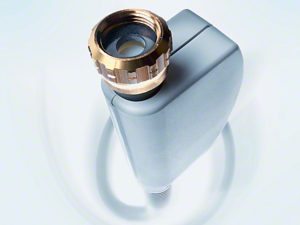 tee tap or dishwasher. Quite often, when installing a dishwasher, incompetent mechanics overtighten the hose mount, squeezing the gasket - as a result, the dishwasher begins to leak at the joints. The Waterproof system will not help in this case.
 - The drip tray may be damaged. The drip tray with the Waterproof sensor in most Miele dishwashers is plastic and inherently quite flimsy. Manufacturers must have skimped on materials here, especially considering the machine can cost anywhere from $1,500 to $2,000. It's not uncommon for the drip tray to be hit during transport and crack, but the user won't notice because the machine is working properly. Later, a leak develops: water enters the damaged drip tray but can't stay there, the float fails, and water spills onto the floor.
- The door doesn't close properly. Accidental damage to the rubber seal around the door or wear can cause leaks. Water will leak from cracks during washing, sometimes into the tray and sometimes onto the floor.
The above problems can be resolved as follows. If the hose or tray is damaged, replacing them will help. You can try to seal the tray yourself, but as you understand, there will be no guarantee that it will withstand a leak.In the case of the door, you'll need to replace the rubber seal. This is quick and easy; the key is to find and purchase an original Miele seal. If you want to know why, the dishwasher is leaking, read the article of the same name on our website.
The machine washes dishes with cold water.
If your dishwasher stops heating water, an experienced technician will immediately list the possible faults:
- the heating element burned out;
- the triac on the control board responsible for the heating element burned out;
- the contacts of the heating element itself burned out.
This isn't a complete list, but it's accurate when it comes to any other dishwasher, except the Miele. What we've listed above happens to Miele dishwashers once in 5,000 times, in other words, very rarely. So what causes the dishwasher to stop heating water? There's only one reason: a faulty thermistor.
The thermistor (or temperature sensor) is a weak point in Miele dishwashers; for some reason, these sensors are the ones that most often fail. Experienced technicians are already familiar with this feature of Miele dishwashers, and if they encounter a problem with their machine not heating water, they immediately check this sensor. How to find, test, and replace this sensor is described in detail in the article. The water in the dishwasher does not heat up..
Please note! The thermistor is easy to replace yourself and is very inexpensive.
The machine refuses to turn on
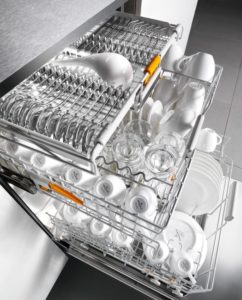 Miele dishwasher repairs may be necessary when they refuse to turn on. This occurs when the dishwasher is not receiving any power and none of the indicators light up, despite the power cord being plugged into a working outlet and the on/off button being pressed. What faults can cause this symptom? There's usually one cause: burnt contacts in the on/off button (a fairly rare occurrence).
If problems arise with the on/off button, you need to check it, make sure that the problem is in it, and then replace it.Let's do the following.
- Open the dishwasher door to gain access to its interior.
- We unscrew the screws from the ends of the door and its inner part.
- We disassemble the door, unscrew and disconnect the control board connectors.
- We take a voltmeter and measure the resistance of the on/off button contacts.
First, you can try cleaning the contacts with a special cleaning solution for PCBs, then measure the resistance again. If the button is clearly faulty, you should replace it with a similar one.
Important! When soldering the control module board components, be extremely careful not to damage the tracks. Otherwise, the board will need to be replaced, which is quite expensive.
The dishwasher displays an error code and stops.
 Miele dishwashers, like many others, feature a self-diagnostic system. In some cases, the machine can automatically detect and identify a malfunction, displaying a corresponding error code. This code makes it much easier for the user or technician to identify the problem. The most common errors displayed by the machine are:
- F01, F02 – thermistor is faulty;
- F11, F12 – there were problems with water supply;
- F13, F14 – pressure relay is faulty.
If the control module displays any of these errors, it stops the dishwasher until the underlying fault is corrected. The key is to correctly identify the error and determine the best solution. In this case, you may need the help of a qualified technician.
In conclusion, we'd like to point out that German Miele dishwashers are extremely reliable, but they can also experience various types of breakdowns. In this article, we've provided an overview of the symptoms of these breakdowns, the malfunctions that cause them, and how to troubleshoot them.
Interesting:

Readers' comments
Headings
Washing machine repair




For buyers




For users


Dishwasher




Add a comment