
AEG dishwasher repair
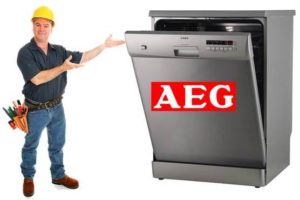 Until relatively recently, AEG dishwashers assembled in Poland were the subject of criticism from experts. A small advertising campaign (or rather, anti-advertising campaign) was even launched against these machines. In reality, this is nothing more than a manifestation of competitive pressure. These machines have always been and remain highly high-quality, as eloquently demonstrated by service center statistics. Repairs to AEG dishwashers are rare, and the list of typical problems with these appliances is quite short. Let's discuss this.
What to do if an error occurs?
It's not uncommon for AEG dishwasher users to rush to call the service center the moment a system error appears on the display. Don't panic ahead of time; it's possible there's no breakdown at all, just a temporary glitch in the machine's electronics that can be fixed with a reboot. What should you do?
- Press the power button and turn off the machine.
- Unplug the power cord from the socket.
- Wait about 15-20 minutes.
- Turn on the machine and try to run the washing program.
To be on the safe side, you can repeat the reboot 2-3 times.
There's a good chance the error code will disappear and never return. If the error appears again, you'll need to decipher it and try to find the cause.
Typical defects
As we've already noted, AEG washing machines have few common malfunctions, but even these can cause significant problems, so users should be aware of any potential issues in advance. Let's list these common defects.
- All sorts of problems with the drain pump, including its clogging and complete failure.
- Incorrect operation of the intake valve. Its coil may burn out or it may become clogged. Its power supply may also be disrupted.
- Contamination and blockages of various natures, which in 90% of cases occur due to the fault of the user.
So, we've identified the list of defects, now we need to analyze them. We need to determine how to access each part, how to check it, and how to repair it, if that's even possible—in some cases, replacement is the only solution.
Incorrect operation of the drain pump
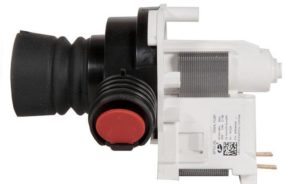 The AEG dishwasher pump can behave differently. It might hum but not drain. It might not work at all. It might also drain, but very slowly. Each problem is indicated by its own error code, but one way or another, you need to access the pump, remove it, and inspect it. How do you do this?
- We de-energize and disconnect the equipment from all communications.
- We drag the machine to the middle of the kitchen.
- We unscrew the fasteners holding the right and left walls of the case.
- We remove the walls.
- Having gained full access to the contents of the pan, we remove the pump, first disconnecting its wires.
The space between the washing chamber and the tray is sufficient to allow work with almost all parts located below.
- We check the part with an ohmmeter; if it is in good working order, we also check the wiring.
- If the pump has burned out, the defect can only be eliminated by replacing the part.
If the ohmmeter doesn't reveal any electrical issues with the pump, you should inspect it carefully. Physical damage or contamination can also negatively impact the component's performance. Hair and threads often become tangled around the impeller, slowing its rotation. Cleaning these items will give the component a new lease of life.
Intake valve dysfunction
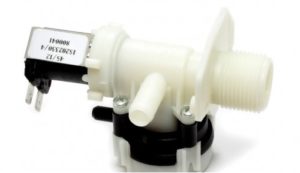 The inlet valve is responsible for supplying water to the dishwasher. The control module commands the valve to open and close, delivering the required amount of water, accurate to a tenth of a liter. If your AEG dishwasher isn't receiving water, check the inlet valve coil. If the coil is functioning properly, check how well the valve opens and closes to ensure it's not leaking. If even the slightest problem is detected, the valve should be replaced immediately.
If the valve isn't working, but the inspection reveals no problems, you should inspect the wiring that powers the component and communicates with the control module. Any broken wires should be replaced. The control board itself and its software should also be checked. It's possible the valve malfunction is electronic in nature.
Contamination and blockages
Blockages can quickly become the bane of an AEG dishwasher if the user neglects to maintain their "home assistant" and does not follow the operating instructions. By not cleaning dishes before placing them in the baskets, the user will quickly contribute to the contamination of the waste filter. This will stop the water from circulating, and the machine will stop with the water still in it. This type of problem can easily be resolved by cleaning the debris filter. This article describes how to do this. Replacing and cleaning the dishwasher filter, we won't focus on this now.
But a clogged dust filter isn't the only problem. If you don't keep your AEG dishwasher salt-free, the ion exchanger will quickly fail. Once this happens, limescale will build up inside within six months. This limescale will cause blockages inside the dishwasher, and the appliance will be sent to the landfill.
Your $900 will go down the drain. So, you need to keep a close eye on your machine and give it a thorough cleaning every three months.
Another problem can be a clogged flow-through filter located on the inlet valve. Tap water isn't completely clean. It contains sand and other small debris, which accumulate in the flow-through filter and, over time, cause a blockage. To prevent this, unscrew the inlet hose, remove the strainer, and clean it every 4-6 months. This will prevent clogging.
So, we've described the most common defects of AEG dishwashers. We've explained why these defects occur and how to fix them yourself. If you have any questions, don't hesitate to ask them in the comments or on our forum. We hope we've provided you with useful information. Good luck!
Interesting:


Readers' comments
Headings
Washing machine repair




For buyers




For users


Dishwasher




Add a comment