
How to repair a Saturn semi-automatic washing machine yourself?
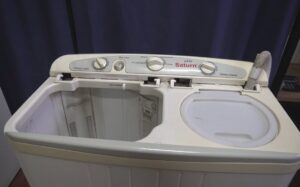 The brand only appears Russian; in fact, the Saturn brand originates from the Czech Republic and is manufactured and assembled in China. These semi-automatic washing machines are sold in Russia and the CIS and are known for their questionable quality. Due to cheap components and uncontrolled assembly, these Chinese-Czech semi-automatic machines often break down.
What's worse, repair shops don't undertake repairs for Saturn semi-automatic washing machines, so you'll have to do it yourself. Let's take a closer look at what to do and how.
Common problems and their solutions
Before repairing a washing machine, it's important to identify the cause of the problem. Semi-automatic machines lack modern self-diagnostic systems, so you'll have to manually identify the problem. Knowing typical problems on Saturn simplifies the search.
The most common problem is that the machine won't turn on. When plugged in, the machine doesn't respond to the dial, the motor doesn't turn, and the wash cycle doesn't start. In this case, you'll need to check the electrical system, the clockwork, the motor, and the capacitor yourself.
- Electrical diagnostics. Saturn semiautomatic transmissions have twisted wiring, which often causes wires to fall off. To find the problem, carefully inspect all contacts for breaks, probe them, and test them with a multimeter. If a leak is found, fix it. Be sure to also check the fuse. A blown fuse should be replaced.
- Inspecting the timers. The clock mechanisms can become out of order, especially if they are repeatedly "winded" backwards. First, detach the instrument panel from the housing by unscrewing the bolt on the back of the housing, sliding the cover sideways, and pulling it out of the grooves. Next, unscrew the clamps, remove the hook from the valve, and test each "circle" with a multimeter. If there is a malfunction, remove the timer and install a new one.
- Checking the capacitor. The motors may not be starting because of the capacitor. This "barrel" is located next to the centrifuge motor and dries out over time, stopping its ability to conduct electricity. Remove it from its slots, find the 10 μF wires (usually yellow), and connect them to the working container. The old one can be discarded.
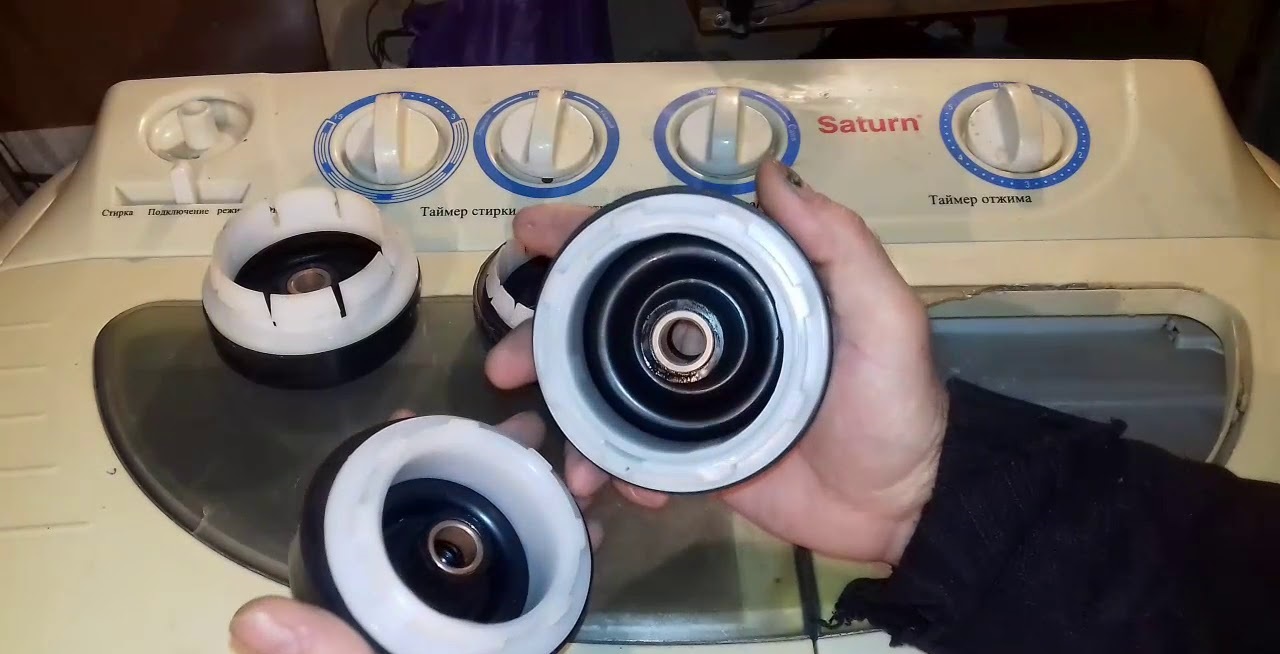
If your semi-automatic washer washes but doesn't spin, there's a problem with the motor or wiring. First, test the wires from the plug to the motor by running the wash timer full blast. Are there any leaks? Then it's time to check the motor, or more specifically, the capacitor. The wires marked "5 μF" are cut off and connected to a new capacitor of similar wattage.
Less common problems include problems with heating, leaks and clogged drainage.
- The machine isn't heating up. This means the heating element is damaged. The heating element can't be repaired; it can only be replaced with a new one.
- Water leaks during the spin cycle. If a leak is noticed, the problem is a faulty drain valve or a damaged seal. The seal and valve mechanism need to be replaced.
- The water isn't draining. The drain hose may be kinked or the end of the hose may be raised above the bottom of the tank. Another possible cause is a broken pump.
To repair a Saturn, faulty components must be replaced. This is especially true if the motor or water pump is broken. These are virtually impossible to repair—the only option is replacement.
The motor is changed together with the seal; otherwise, water from the tank may get onto the motor winding and cause it to fail.
It's a different story if the washing machine starts a cycle, the motor hums, but the drum doesn't spin or suddenly stops. Most often, the actuator stalls for two reasons: an overloaded drum and clogged filters.Sometimes the problem is in the drive belt, which slips off the engine pulley. In the latter case, you need to stop the program, replace the old rubber band, or tighten a new one. Even less commonly, a loose brake cable is the culprit.
People's opinions about Saturn technology
Alexander, Barnaul
I've been using the Saturn ST-WM1605 semi-automatic washer for over seven years. I was tempted by the low price, and it paid off – after all this time, it still delivers great results with its simplicity and high-quality washing. Not a single breakdown in all those years! The standard wash cycle lasts 15 minutes, which is more than enough to clean moderately soiled clothes. There are no problems with cleaning: stains come out easily, clothes don't tear, and dirt doesn't collect inside. The built-in centrifuge also works well. The Saturn does have its drawbacks. The machine often doesn't spin at full speed. Clothes remain very damp, forcing you to repeat the cycle. It's also important to spread the laundry well and evenly throughout the centrifuge, otherwise the semi-automatic machine starts vibrating wildly.
Alina, Uman
I bought a Saturn ST-WK7614 a month ago, and so far I'm happy with it. I chose this model because I couldn't connect the machine to the mains—the semi-automatic machine doesn't require a central water supply. The equipment is easy to use, makes virtually no noise, and rarely malfunctions during spinning. There are two modes: normal and enhanced. One drawback I'd note is the lack of water heating. For the price, this unit is excellent.
Interesting:


Readers' comments
Headings
Washing machine repair




For buyers




For users


Dishwasher




Add a comment