
How to repair a Samsung washing machine
 Samsung manufactures a variety of appliances, including washing machines. Companies in various industries typically produce mediocre products, but not Samsung. Their products are always high-quality, and washing machines are no exception. However, any appliance breaks down, and sooner or later, consumers will have to deal with the issue. In this article, we'll look at common problems with Samsung washing machines and discuss how to fix them yourself.
What breaks most often?
An automatic washing machine, no matter who makes it or what it's made from, inevitably breaks down, whether it's a top-notch German brand or a cheap Italian machine assembled in China. Any Samsung washing machine also has its weak points, and these should be the first thing to be addressed. Based on statistics from leading service centers worldwide, we've concluded that the most common faults in most Samsung washing machine models are:
- drive belt;
- heating element;
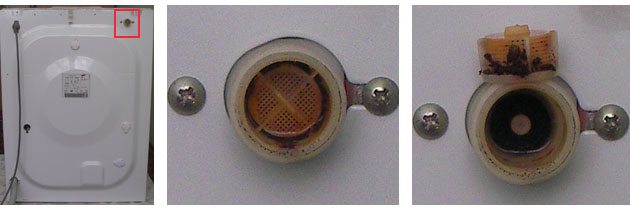
- fill valve;
- drain pump;
- drain pipe.
 The strong point of Korean technology is its electronics, which fail 3 times less often than the above-mentioned units, Electric motors – they break down twice as rarely in washing machines. I'd like to draw special attention to the electrics.
When you open the Samsung washing machine's case, you'll notice how orderly it is. All the wires are bundled and secured with cable ties. The wires themselves are quite thick, and the terminals are made of high-quality metal. Overall, quality appliances reveal themselves even in the smallest details. However, sometimes the poor design of individual components leads to failures of the above-mentioned components, which deserve further discussion.
Important! Most often, people contact service centers with broken heating elements (54%), followed by drive belts (21%), filler valves (12%), and the remaining percentage is split between other machine components.
We repair the drive belt
To check, repair, or replace the drive belt, you need to remove the back panel of the washing machine. The drive belt is considered a relatively accessible component of a Samsung washing machine, making it easy to access. First, remove the belt from the pulley. Here's what to do:
- we grab the belt with our hand somewhere in the middle between the pulley and the engine;
- We pull the belt towards ourselves with some effort;
- take a Phillips screwdriver, insert it into the pulley groove with one hand, not forgetting to pull the belt with the other hand;
- We move the screwdriver along the groove until the belt comes off the pulley.
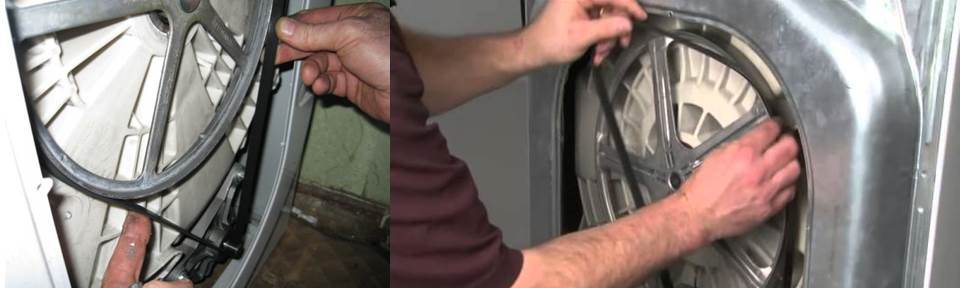
Once the belt has been removed, it must be inspected very carefully. We will be looking for any damage, even hints of damage. The belt should not have any significant abrasions, cracks, torn sections, or anything else. If any signs of damage are detected, the belt must be replaced immediately; repair is not possible in this case. The belt must be replaced with an original one - there is no need to look for any similar spare parts, don't risk your home assistant.
Please note! Carefully inspect the bottom of the washing machine. If you see rubber shavings, this indicates a worn drive belt.
Installing a new drive belt is somewhat similar to fixing a slipped chain on a bicycle. Slide the belt onto the engine pulley. Then, place the inside of the belt against the groove of the drum pulley with one hand, while rotating the pulley with the other. The belt will slide on easily.
We solve problems with the inlet valve, drain pump and pipe
Problems with the drain pump and hose of a Samsung washing machine come down to cleaning them. In the vast majority of cases (80%), the drain pump loses its functionality precisely because of a blockage., so experts recommend a thorough cleaning after removing this element and the hose. To clean the hose and pump of a Samsung machine, you need to access them.
Some people think this requires disassembling half of their Samsung washing machine, but it's actually much simpler. The manufacturer has ensured the main components of its appliance are accessible, so to access the drain pump and hose, you need to:
- remove the powder tray from the machine;
- carefully lower it onto the left or right wall;
- unscrew the bottom protection.

After this, you'll see the drain pump and outlet in all its glory. Accessing these modules through the bottom is much easier than through the front or back. To clean the drain pump and outlet, follow these steps.
- Take a large, highly absorbent cloth and place it under the drain pump.
- We unscrew the clamps holding the ends of the pipe.
- Disconnect the plugs from the drain pump sensor.
- We disconnect the drain hose, not forgetting to loosen the clamp.
- Unscrew the drain pump's fasteners and carefully remove it. Be aware that water will leak from it.
- We remove the pipe and rinse it with a stream of hot water, and do the same with the drain pump.
- We install the washing machine components back into place, screw the bottom on, place the machine on its feet, connect it, and check its functionality.
If the drain pump is faulty and cleaning it doesn't work, repairs can be quite complex. Experts advise against attempting to disassemble and repair this unit, as this can cause further damage. It's best to take the drain pump to a professional; they may be able to repair it. If you notice signs of damage to the washing machine hose Samsung, it needs to be replaced with a new one immediately.
Please note! The hose typically wears where it contacts the metal clamp, so check these areas carefully.
Inlet valves don't fail on Samsung washing machines very often, but they do happen, and it's important to know what to do. It's worth noting that repairing such a valve yourself is often quite easy, and the repaired unit will provide long-lasting, trouble-free operation. What's the most common problem with inlet valves? The rubber seals, of course. Over time, they harden, dry out, and crack, losing their ability to hold water, leading to water backing up into the drum.
To repair the fill valve yourself, you need to.
- Remove the top cover of the washing machine. To do this, you need to unscrew the two bolts located on the rear projection of the top cover.
- Pull the lid slightly towards you, then upwards and it will come off easily.
- Now you need to locate the fill valve. To do this, pay attention to the place where the fill hose goes; in the housing, it connects to a small barrel-shaped element - this is the fill valve.
- We loosen the clamps and unscrew the filler valve, not forgetting to disconnect the sensor wire.
- We check the condition of the valve sealing rubbers and replace them with new ones.
- We check the resistance of the sensor contacts using a multimeter.
- If everything is in order, replace the module and test the Samsung washing machine. Your DIY repair is complete.
We repair or replace the heating element
You can repair the heating element of a Samsung washing machine yourself, but keep in mind that it's somewhat more complicated than with other brands. This is primarily due to the inconvenient location of this module. With other brands of automatic machines, simply removing the back panel reveals the heating element. At the cars Samsung's heating element is located at the front, meaning you'll have to do the labor-intensive work of removing the front panel.
This detail is often the reason why experts criticize Samsung washing machines, as the heating element is a component that breaks relatively frequently. Removing the front panel of the machine carries the risk of introducing a new malfunction: you can tear the seal, break the clamp, break the plastic tabs so that the front panel won't fit back in place, or even tear the wires of the door lock sensor. Let's try to act like professionals and remove the front panel without damage.
- First, unscrew the bottom plate of the front wall of the washing machine.
- We take out the powder tray; there are several fasteners in the tray niche; we unscrew them.
- We remove the top cover of the washing machine as described above.
- We unscrew all the screws holding the control panel and remove the control panel.
- Take a screwdriver and carefully pry up the clamp of the washing machine cuff and remove it (the cuff is an elastic band located around the hatch).
- We unscrew the two bolts securing the hatch locking device and pull it out, remembering to disconnect the sensor wires.
- Very carefully pull out the cuff.
- We unscrew the remaining fixing bolts and remove the front wall.
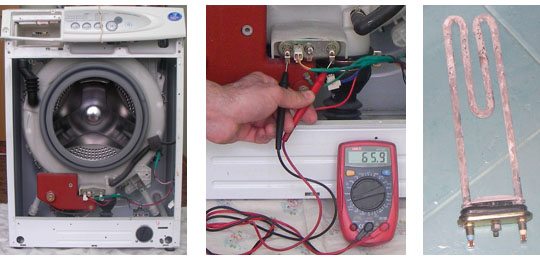
The front wall of the washing machine is now removed – we can begin repairing the fault. First, let's check the resistance of the heating element contacts. To do this, take a multimeter, connect the probes to the contacts, and read the value on the display. If no faults are found, remove the heating element. To do this, unscrew the fastener located midway between the heating element contacts, and then, using a side-to-side rocking motion, pull the heating element out of the drum.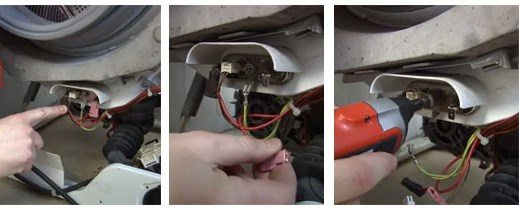
In most cases, a large layer of scale forms on the heating element, which causes the module to fail. If scale has already formed, the heating element must be replaced. Such malfunctions cannot be fixed, but in the future, remember to use water softeners and then everything will be fine.
Important! When replacing the heating element, don't forget to also replace the rubber seal; it's included with the new heating element.
In conclusion, it's worth noting that Samsung washing machine repairs are entirely possible to do yourself, especially when it comes to the common problems we've discussed in this article. Owners of these washing machine models encounter these types of problems most often, but surprises can happen. If a problem arises that you can't correctly identify and fix, contact a specialist.
Interesting:


38 reader comments
Add a comment
Headings
Washing machine repair




For buyers




For users


Dishwasher




Everything was explained very clearly and well, thank you.
The screen does not light up when pressing buttons
Thanks, guys!
After cleaning the drain pump, it doesn't fill completely or drains. How can I fix it?
Thank you very much
When I start washing, the drum can't pick up speed for 3-5 minutes and rocks like a cradle. What is this?
The belt is most likely worn out.
Thank you, everything is clear.
When the spin cycle starts, the drum starts to bounce back and forth. The counterweights are fine, the drive belt and pulley are fine, and the shock absorbers and springs are fine. What else could be the problem?
Thanks for the detailed instructions. Saved me 2000 rubles!
When I turn on my Samsung washing machine, the circuit breaker in my apartment's electrical panel trips. Could you tell me what's wrong with the machine? Is the heating element broken?
Can anyone help me with the Samsung p1001j schematic?
What should I do? The water just pours in and that's it?
Thank you, now everything works.
The machine is stuck on rinsing.
Whistling sound during spin cycle.
When switching to intermediate spin, 6E lights up on the display, what can be done?
The drum won't spin. What should I do?
When I start it, a 3D image appears. And that's it, the car won't start.
It fills with water, then displays a hatch error, what should I do?
The drum does not spin.
The car has a leak, and I think it’s coming from the cuff.
The "Wash" cycle is in progress. After 10 minutes, the water drains and E6 lights up on the display. A beep sounds. The water starts draining completely, but nothing happens after that. Could you help? What's the cause?
The error has been coming out 4th three or four times in the last month. I checked the water filter and the water pressure. Everything is fine, and when I press "OK," it continues working. Today, it came up with the same error again. I checked it, and everything is fine. The technician says the circuit board needs to be repaired. The washing machine isn't controlling the water inlet valves... what should I do?
The filter mesh at the back of the inlet is most likely clogged. "No water" error.
It doesn't turn on. For example, there is one in the socket.
It's the same for me!
Is it possible to replace the front half-tank DC61-00365A with DC61-00365H on a SAMSUNG washing machine?
Please help. The machine doesn't fill with water when turned on. However, it works fine in rinse mode.
Thank you
Whenever I start any mode, the drain pump turns on. Washing is basically impossible because the water is immediately pumped out. Could you tell me what the problem is?
How to open the door if it is locked after washing?
It works flawlessly. However, when spinning, a dull thud is heard. The higher the speed, the more frequent this noise. The machine is in excellent condition and operates without vibration.
When I turn on the washing machine, water flows through the detergent dispenser. What should I do?
When I turn it on, everything goes as planned: water fills, the valve triggers, the relay activates, and that's it. The engine doesn't start. After the relay clicks, the machine sits silently in the standby mode and doesn't display any errors. I've already checked everything: the module is fine from a visual inspection, the line filter and heating element are also fine. The terminals on the motor and the belt are intact and in good condition. The motor brushes are also good. When I set it to spin mode, the water is pumped out. I can't figure out what's causing this. Maybe something's wrong with the module?
During the wash cycle, it freezes at 30-21 minutes (something inside is buzzing, but it doesn't spin). That's when the wash cycle ends... what should I do?
When washing without laundry, the full cycle runs, but when washing with laundry, the pilot trips after 6-7 minutes. What's the cause?
Samsung washing machine. Model WW65K42E09WDLP. The reload door won't open. It clicks inside, but won't open. Is there a way to open it in emergency mode?