
Repair of faulty semi-automatic washing machines
 Semi-automatic washing machines haven't yet been replaced by automatic ones and are often found in cottages and homes without running water. Like any complex machine, they can break down and may require repair. With basic electrical skills and the ability to read electrical diagrams, you can repair a semi-automatic machine yourself, without having to take it to a repair shop. We'll help you understand common problems and troubleshoot them.
Common faults and their causes
Semi-automatic washing machines Washing machines with or without a spin cycle have a long list of problems. All of them, in one way or another, are related to either the washing or spin cycle, meaning the machine either doesn't wash, doesn't wash well, or doesn't spin. Here's a list of the malfunctions of these washing machines:
- The machine does not start to wash, the motor is silent. When the machine does not respond when turned on, the cause may be a simple faulty plug or socket, or a broken motor or electrical system.
- The machine hums, but the actuator or drum doesn't rotate. This malfunction is caused by a missing drive, meaning the drive belt has slipped.
- If water is leaking from under your washing machine, the cause should be found in a broken pump, hose, or machine body.
- If the machine does not pump out water or does so poorly, the cause is a clogged hose or pump.
- Water leakage during spinning indicates a breakdown of the drain pump, centrifuge tank, loose connections of drainage system components, damage to the drain valve or sealing rubber.
- If the centrifuge isn't spinning and the motor isn't running, there's a problem with the motor or the electrical system. If the motor hums but doesn't spin, the centrifuge tank may be overloaded with water or laundry.
Repairing automatic washing machines requires not only certain skills, but also time and tools such as open-end wrenches, pliers, and a multimeter, as well as spare parts to replace faulty components.
Spare parts can be problematic, so repairing semi-automatic washing machines is often not practical.
Problems with drainage and water leakage
To troubleshoot problems with semi-automatic washing machines related to leaks and water drainage, you can use the following instructions.
- Unplug the semi-automatic machine and check for blockages. Clean the filter and drain hose if necessary. While you're at it, check the drain hose for kinks and holes.
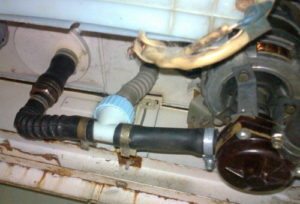
- Next, using a screwdriver, we open the machine body and find the drain pump.
Please note! Depending on the machine model, there may be two pumps: one for the centrifuge drain and one for the wash tank. If there is only one pump, the wash tank drains by gravity.
- We disconnect the pump and open it to clean out any debris from the impeller. We also test its functionality with a multimeter or ohmmeter. If the pump winding is burned out, it will have to be replaced with a new one.
- In cases of water leaks, it's also important to check components such as the gaskets, diaphragm, and membrane. These can easily be replaced with similar ones.
- We check the tightness of the connections of the drainage system, between the pump and the pipes, as well as the water drain valve.
- If you have a centrifuge, inspect the tank for damage and cracks. If any are present, seal them with sealant or cold welding, after removing the tank from the semiautomatic machine.
Repair of moving parts
In this section, we will discuss faults related to the motor and drive parts that rotate the drum or activator. If the centrifuge does not rotate during spinning, you must first ensure that the drum is not overloaded with laundry. To do this, remove some of the items and try spinning again. If nothing happens, you'll have to disassemble the machine.
 The main problem with the motor is brush wear. Replacing them yourself can be difficult for someone trying to do it for the first time. To replace them, remove the motor of the semi-automatic washing machine. Then, disconnect the wires from the brushes and remove the brushes. Take the new brushes and insert them in the same position as the old ones, that is, in the same direction as the ground-down corner. Then reconnect the wires and secure the motor in the machine.
If the centrifuge motor fails, it will need to be replaced. Let's look at the replacement process using the Siberia washing machine as an example.
- Using a 10 mm wrench, unscrew the 6 bolts holding the top cover of the semi-automatic machine.
- Unscrew the tank nut. It's best to do this with two people: one should hold the centrifuge tank while the other unscrews the nut.
- We also work together to remove the tank from the shaft, using a hammer. One holds it, the other hits it.
Please note! Hammering must be done carefully, otherwise this type of repair may lead to further problems.
- If it's difficult to get it going, don't hammer on the tank as hard as you can; spray some WD-40 on the shaft and try again.
- We move the tank to the side, and then take out the mounting pin, which is inserted into the engine shaft.
- The next step is to lift the body of the car and place it upside down.
- Carefully remove the motor from the washing machine body.
Now we just have to decide what to do with the old engine. You can try to restore it by giving it to a specialist for rewinding (rewinding it yourself is not an option), or you can find and purchase a working engineBoth options are quite expensive; it's easier to buy a new semi-automatic washing machine, but if repairs are a matter of principle, then the decision is yours.
Electrics
If the motor isn't working properly or isn't working at all, it's not necessarily the problem. It's quite possible that the root cause lies in the electrical system. To repair this type of semi-automatic washing machine, you'll need to obtain a wiring diagram for your model of "home helper."
Please note! Absolutely all semi-automatic washing machines produced during the Soviet era were equipped with wiring diagrams to simplify repairs. Modern semi-automatic machines only come with an instruction manual, but that doesn't mean the diagram can't be found online.
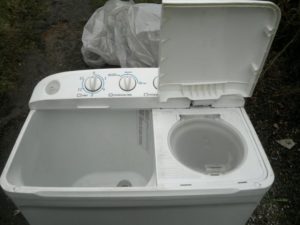 Before attempting electrical repairs on a semi-automatic washing machine, it's important to understand what exactly is wrong. Let's look at the symptoms. The main symptom is the motor stopping working during the spin cycle, but working normally during the wash cycle. What other possible problems could arise?
- One of the wires in the machine's electrical circuit has broken or frayed. This type of problem is common in older semi-automatic washing machines.
- The microswitch is out of order, the thermal relay or time relay is broken.
- The start relay or start capacitor has burned out.
- The transformer burned out.
How can I determine what exactly is broken, and how can I check all these components? Semi-automatic washing machines don't have a self-diagnostic system, so I'll have to diagnose the problem myself.You need to take an electrical diagram, look at the normal resistance of all the above components, then arm yourself with a multimeter and check them all one by one, each module and each wire. With a certain amount of skill, this work will take about 30-40 minutes.
If the fault isn't found, repeat the check from the beginning, noting the modules you've already checked; you may have missed something the first time. If a burned-out electrical component is detected, it must be replaced.
In conclusion, we'd like to emphasize a very important point. Before attempting to repair a semi-automatic washing machine, consider its cost-effectiveness. It might not be worth the effort. Good luck!
Interesting:

27 reader comments
Add a comment
Headings
Washing machine repair




For buyers




For users


Dishwasher




The engine is spinning, but the actuator is not, but the belt is tight. What should I do?
I have the same problem... but the actuator doesn't stay in place, it rotates slowly and creaks. I think there's some foreign material stuck under the actuator. How do I remove the actuator and check it?
Most likely the actuator drive (reducer) has failed.
But if it works in the gentle mode, but when I switch to normal, the timer ticks, but the machine doesn’t work, what’s the reason?
How to change the centrifuge seal on a Saturn washing machine?
My centrifuge isn't spinning, but it's humming. What could this be? Please tell me.
The flush isn't working! What should I do?
The car turns one way and hums the other. What could this be? Can anyone tell me?
Engine replacement.
The bottom of my washing machine has popped up (..this disk with pimples... The computer is working properly... but the drum is now stuck... What should I do?
Both reels spin simultaneously
Water flows from my washing machine into the centrifuge. How do I replace the valve?
The valve needs to be cleaned, not replaced.
The belt is loose, how to tighten it?
The centrifuge doesn't squeeze
I need to remove the drum in my Saturn washing machine. I don't understand how. There are two tanks. One for washing, one for spinning. I need to remove the one that washes.
New semi-automatic machine. It washes well, the actuator turns, but the sound is strange. It feels like it turns normally in one direction, but the other is strained. The laundry flutters smoothly. I took the laundry out, and the sound is normal with just water. I don't overload the machine. What could be the cause?
Possibly a weak belt.
Water from the machine goes into the centrifuge, how to clean the valve?
I replaced the hose underneath the machine and secured it with wire. It's still leaking. What should I do? How do I attach the hose so it doesn't drip?
The washing timer on my Slavda semi-automatic washing machine doesn't work.
When turned on, the actuator rotates in one direction, but when it's supposed to change direction, it stops. If you nudge the actuator slightly, it starts rotating again until you switch it back in the same direction again. Could you tell me what might be causing this?
Please provide a wiring diagram for the Saturn semi-automatic washing machine.
The Snow White semi-automatic washing machine rips clothes during washing, and gives electric shocks when running and when the power cord is plugged in and the washing machine is turned off.
Hello! I have an Artel washing machine. The motor is running, the repairs are tight, but the actuator won't start; it barely turns over. Please tell me what to do?
My semiautomatic machine turns fine in one direction, but barely makes a noise in the other. Sometimes it even stops. What should I do?
My Issuri washing machine is 1.5 years old. The spin and drain cycles work, but the washing machine makes a terrible grinding noise, both with and without laundry. What's the cause?