
Whirlpool washing machine repair
 Currently, the CIS market primarily sells Whirlpool washing machines assembled in Italy or Slovakia. Italian machines are quite expensive and less common, while Slovak-made washing machines are readily available in every home appliance store. Perhaps due to their European assembly, these machines rarely break down, and only one in 15 owners of a Whirlpool washing machine requires repairs. Nevertheless, it's important to learn the intricacies of these machines, just in case!
External signs of typical breakdowns
Any complex appliance, especially household appliances, can potentially break down. Listing every possible problem with modern Whirlpool automatic washing machines and describing how to fix them would fill a book. Therefore, in this article, we'll only cover the typical defects that, according to statistics provided by service centers, are the most common.
- The water does not drain from the machine after washing.
- Washing programs are glitchy, don't work as they should, or don't activate at all.
- The water collected for washing is not heated according to the set program.
- Water leaks from under the closed hatch cover during washing.
Please note! These typical signs of malfunction indicate serious problems that require immediate attention, as otherwise your Whirlpool washing machine may break down completely.
Water remains in the machine and does not drain.
You've probably experienced this too: you load the laundry, set your favorite wash cycle, and go into another room to do some chores. You come back a short while later and the machine is frozen, the tank is full of soapy water, and the wash cycle isn't finished. You restart the machine, but the cycle repeats itself: the wash cycle can't finish because the water won't drain. What should you do in this situation, and what's the cause? There are three main causes:
- there is a blockage in the drain pipe or drain filter;
- there is a blockage in the drain hose or sewer;
- The electric drain pump broke.
But before you begin to figure out the cause of your Whirlpool machine's breakdown, you need to prepare it yourself, namely, turn it off and drain the water from the tank manually. You can quickly and safely remove all water from the tank using the emergency drain hose., which is located next to the drain filter. Place a basin or other container under the hose and open the plug, allowing all the water to drain. Next, we'll begin troubleshooting, moving from simple to complex.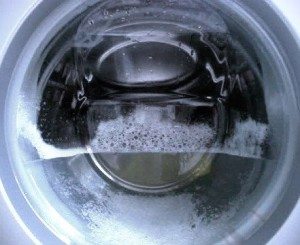
- Place a container or rag under the drain filter opening and unscrew the plug. Clean the filter of any dirt and replace the plug.
- Carefully unscrew the drain hose and clean it from dirt, then screw it back into place.
- We check to see if the sewer is clogged.
The above steps don't require disassembling the Whirlpool washing machine, so after a thorough cleaning, try restarting the machine. If nothing changes and the machine still refuses to drain, you'll need to access the machine's interior.
Important! In almost all Whirlpool washing machine models, access to the drain hose and pump is simply achieved by turning the machine on its side and removing the bottom.
To get to the details we're interested in, we'll follow these steps:
- remove the powder tray;
- disconnect the machine from the water supply, sewerage and electrical networks;
- we put the machine on its side;
- unscrew the fasteners and remove the bottom;
- take a multimeter and measure the resistance at the pump contacts;
- changing the drain pump to a new one, if the problem is not in it, then we move on to the next step;
- loosen the clamps of the drain pipe and remove it;
- We clean out any blockages and put it back in place.
The washing programs are glitching and not turning on, the water in the tank is not heating up
Sometimes, after turning on the washing machine, its control panel seems to go crazy. The display starts flashing, followed by all the lights and indicators on the switch. The washing program may not even be set. If you experience this, Immediately unplug the machine and wait about 1 minute. Then turn the Whirlpool washing machine back on, and if the problem persists, call a technician. The problem lies with the control board, and repairing it yourself is extremely difficult; it's best not to waste time and effort.
If your washing machine refuses to wash in warm water, you can not only diagnose the problem yourself but also fix it yourself, without the help of a professional. Most likely, the problem lies in the heating element or the thermistor; in either case, you'll need to check both elements at once. Here's how to do it.
- We turn the washing machine so that the back wall is facing us, so that it is convenient.
- We unscrew the bolts and remove the back wall of the machine.
- We unscrew the bracket that will interfere with working with the heating element.
- At the bottom of the tank, you'll see two protruding contacts—that's the heating element. Four wires connect to it: two in the middle to the thermistor and two on the edges to the heating element. All of them need to be disconnected.
- We take a multimeter and measure the resistance of the thermistor contacts.
- If everything is ok, we measure the resistance on the heating element.
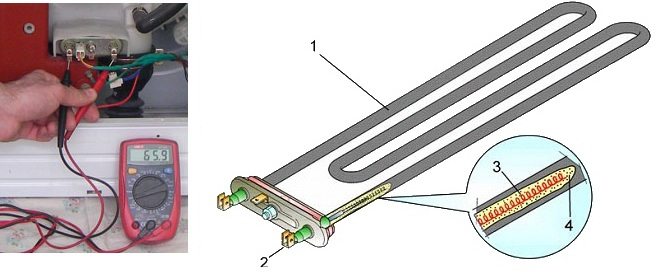
In this case, you will most likely find a fault and will have to replace the heating element. Usually, when removing the heating element from the tank, the cause of the breakdown immediately becomes clear, since the surface of the heating element is completely covered with scale. If the scale is light, it won't burn out the heating element. However, if the limescale layer is more than a centimeter thick, it can cause damage to the Whirlpool washing machine element. We'll replace the heating element ourselves.
- We have already removed the contacts with the wires, now let's unscrew the plastic shield.
- Next, unscrew the bolt located between the large contacts of the heating element.
- We grab the heating element contacts with our hands and pull it towards ourselves. If the heating element doesn’t move, try to gently rock it. The rubber gasket will be a little in the way, but nothing can be done about it.
- Having pulled out the heating element, we also remove the gasket.
Please note! Experts recommend not installing a new heating element on an old rubber gasket. It's best to replace the old rubber gasket along with the heating element, as a leak is the worst thing that could happen to this element.
- We remove dirt and pieces of scale from the resulting hole, thoroughly clean the edges, and then insert a new gasket.
- We insert a new heating element and screw it on.
- We screw on the plastic shield.
- We connect the contacts with wires to the thermistor.
- We connect the contacts with wires to the heating element, put the bracket and the back wall in place.
Water leaks from the closed hatch during washing
If water leaks from under the door of your Whirlpool washing machine during the wash and rinse cycles—at first a few drops, then more and more—you should carefully inspect the largest rubber seal in the machine, the gasket. The gasket is impossible to miss, as it encircles the opening of the door and serves to prevent water from escaping from the drum.
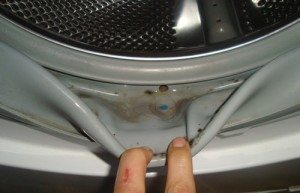 Pay particular attention to the bottom edge of the seal, as dirty water often accumulates there. If left unwiped, the rubber seal in this area will begin to crack and burst. Subsequently, even the slightest touch can cause it to tear. A torn cuff cannot be used, as it will not hold water and will have to be replaced. First, we properly remove the old cuff.
- We open the hatch cover as wide as possible.
- We take a flat-head screwdriver and try to pry up the thin wire clamp that is located on the outside of the cuff and holds it in place.
- As soon as we manage to pry it up, we apply a stronger screwdriver underneath it and begin to move in a circle until we find the connecting element with the bolt.
- We loosen the clamp and put it aside.
- We take hold of the cuff with both hands and pull it out with force.
Be sure to purchase only the original replacement cuff, which will fit precisely into the groove of the hatch of this model of Whirlpool washing machine, otherwise problems may arise.
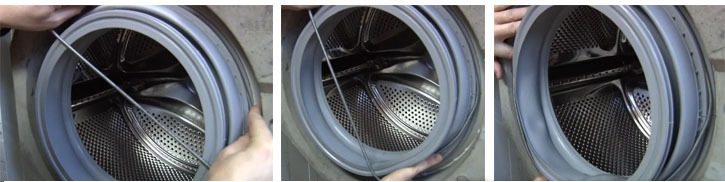 We unpack the new cuff and push it into the groove. In this case, everything must be done carefully and, of course, do not use any sharp tools such as a screwdriver. Once the cuff is firmly in place, attach the clamp and tighten it. Check that the door closes properly and run a test wash.
In summary, European-assembled Whirlpool washing machines are relatively reliable and don't have many common breakdowns. More often, problems arise due to poor maintenance by the user, such as not cleaning the hoses and filters regularly or not wiping the seal, which ultimately leads to malfunction. Take care of your washing machine, and you won't have to repair it often!
Interesting:
5 reader comments
Add a comment
Headings
Washing machine repair




For buyers




For users


Dishwasher




When filling with water, water leaks from under the powder tray. This happens during the initial filling. I turn it off and on again—everything is fine.
I start the program, the water fills and heats up. And that's it. It just sits there and doesn't wash. The drum doesn't spin. Even when I just spin it, it's stiff.
Dropped the car and broke the lid mount. How do I fix the plastic tabs? Help!!!
After washing starts, the machine stops and the message “contact service” lights up.
It washes, starts spinning, doesn't develop speed, switches to styling mode.