
Repairing Miele washing machines yourself
 Washing machines from the German manufacturer Miele are among the most expensive and reliable. Their quality is prized worldwide. The very first Miele automatic machine was released in 1956, and since then, production technologies have only improved. A Miele washing machine can last 20 years without malfunction or breakdown.
However, isolated malfunctions do occur, and among these rare cases, technicians note characteristic faults. The following discussion will discuss how to repair Miele washing machines yourself.
Features of Miele washing machines
A distinctive feature of Miele washing machines is their unique design. All parts are manufactured from high-quality materials and exclusively in factories located in Germany. Furthermore, these machines are equipped with highly sophisticated electronics. This significantly complicates DIY repairs.
High-quality repairs may require specialized computer equipment, which requires skill. Therefore, Miele washing machine repairs are often entrusted only to professionals. However, technicians note that In 89% of cases, such machines can be repaired for relatively little money. Only 2% of broken washing machines cannot be repaired at all, but it can be noted that they have worked for at least 10 years.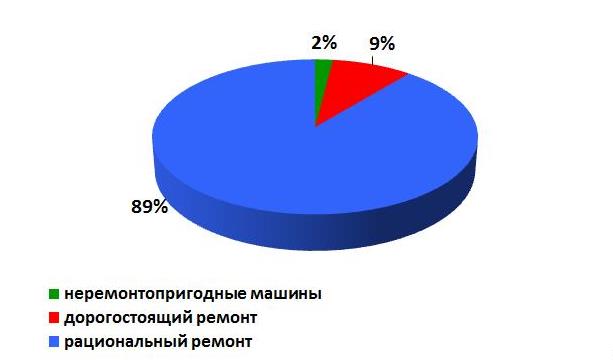
What breaks most often?
If Miele washing machines are reliable, why do they break down, and what can go wrong? The quality of the components is truly beyond doubt, as evidenced by this renowned company's long history. But the cause of the breakdown may be improper operation and connection. For example, a sudden power surge in a washing machine can damage the electronics, wiring, and even the motor.
Constantly using hard water for washing and washing at high temperatures can cause scale buildup on the heating element, which can lead to its failure. A burnt-out heating element can also damage the control module.
Such reasons for failure of household appliances occur only due to the fault of the consumer.
But let's return to the question: what's the most common problem with a Miele washing machine? The answer is quite simple:
- drain pump, it is called a pump or pipes;
- water level sensor (pressure switch);
- heating element (TEN);
- drive belt;
- hatch lock;
- sensors and electronics.
We clean the drain pump and change the pressure switch
If, at some point, your washing machine stops draining wastewater, you need to check the drain filter, drain pump, and drain hose. Cleaning the filter in a Miele machine, as in other brands, follows the same process—from simple to complex.
- The easiest thing to clean is the drain filter, so that's where you should start. Note that in most machines, the filter is located at the bottom right of the housing, while in Miele machines, the filter is at the bottom left.

- We open the plastic cover and find a cork behind it.
- Take a container of water or just a large rag and spread it near the filter, not forgetting to tuck it under the machine body.
- We unscrew the plug, and the water in the filter will flow out onto the rag.
- We collect the water and then look into the filter hole with a flashlight and clean out all the dirt, hair, and small objects stuck there.
- We screw the plug back into place and check the machine’s functionality.
Cleaning the drain filter may not produce the expected results. In this case, you'll need to focus on the drain pump and drain hose. There's a good chance there's a blockage somewhere. We'll check both the hose and the drain pump at the same time.
- First we need to remove it, and for that we will have to disassemble the washing machine, namely, unscrew the front panel. This will give us access to all the components we need.
- We prepare a container for water, because when we start removing the pipe and drain pump, water will flow out of them.
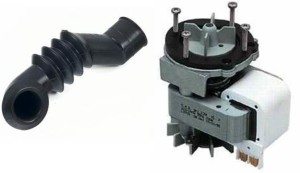
- We unscrew the clamps connecting the pipe to the drain pump and the tank, and disconnect the terminals from the drain pump sensor.
- We unscrew the clamps connecting the drain pump and the drain hose.
- We unscrew the fasteners holding the drain pump and remove it together with the pipe.
- We inspect the drain pump and hose for blockages, flush them, and then reinstall them in reverse order. We replace the front panel of the Miele washing machine and test its operation.
If the question arose about replacing the washing machine pressure switch, then you can easily resolve it yourself. The whole process will take little time.
Most importantly, buy a similar sensor, do not try to replace it with something similar.
We change the heating element and drive belt, check the electrical system
 If the heating element breaks, the wash cycle will be performed in cold water. If the heating element is broken, the wash cycle may take longer. Another symptom of a faulty heating element is the circuit breaker tripping during the wash cycle. To confirm the heating element is faulty, you'll need to remove it from the housing and test it with a multimeter.
In Miele washing machines, the heating element must be removed not through the back wall, as in many machines, but through the front.
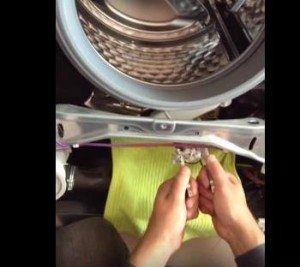
We described how to disassemble the front of the machine above. Once the machine is open, you'll see two protruding heating element contacts underneath the tank. To remove the heating element completely, pull it toward you while rocking it from side to side. Then, remove the rubber seal. Replace the faulty heating element with a new one, carefully inserting it into the connector.
As for the drive belt, it can slip off the pulley, break, or fray. This will cause the drum in the machine to stop rotating. According to mechanics, this type of breakdown in Miele machines happens quite often. To replace the drive belt in a Miele top-loading machine, you need to:
- Remove the left side cover of the housing.
- Inspect the belt; if it is broken, take a new one.
- You need to put it on the engine first, then pull it upwards and place the belt on the right side of the pulley.
- Next, holding the part of the belt that is already put on the pulley, turn the pulley counterclockwise and try to put the belt on all the way.
- We close the housing cover.
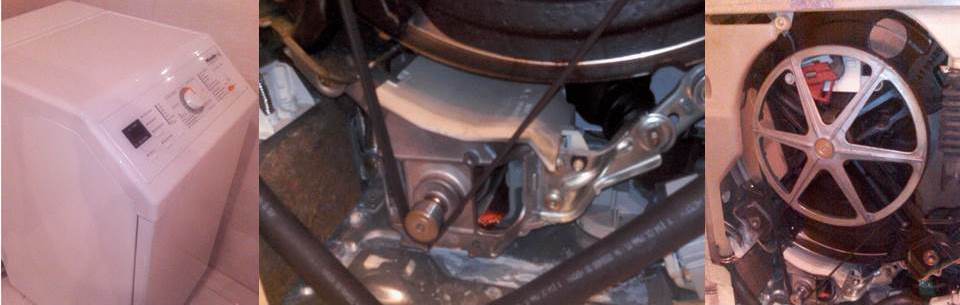
Checking the electrical system of a Miele washing machine involves testing and visually inspecting all wires, terminals, and other components.
This is absolutely necessary, even if you're repairing a different problem and have disassembled the washing machine's body. Checking the machine's electrical system isn't difficult, but it's quite painstaking. You'll need to test every contact, every connection, and every plug outlet. The job can take anywhere from 40 minutes to 1.5 hours, but it's worth it.
We get a multimeter, prepare it to check the resistance of electrical elements by setting the toggle switch to the appropriate position, disconnect the washing machine from the power supply and begin checking. Experts recommend starting with the control unit contacts and then gradually moving towards the washing machine module sensors. We unscrew the fastening elements of the instrument panel, remove it and pull out the control unit without disconnecting it from the wires.
We begin the resistance test with the on/off button, attaching the probes to its contacts and observing the reading. If the display shows zero, there's a problem with the contact. We check all the control unit contacts one by one, then the engine sensors, pressure switch, heating element, intake valve, and drain pump. It's highly likely you won't find the problem the first time, and you'll have to repeat the test.
Pay attention to the capacitor of the electric motor of the Miele washing machine; this is the main problem with German equipment.
Tachometer sensor repair
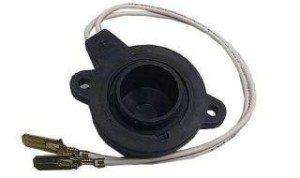 A tachogenerator is a simple and ingenious device that's installed on an electric motor and measures the rotational speed of moving parts. Without a tachogenerator, the control unit won't know the required drum speed for the washing program to run efficiently, and therefore won't be able to adjust the speed.
To get to the tachogenerator, you need to get to the motor of the Miele washing machine., and to do this, you'll again have to remove the front panel of the washing machine. The tachogenerator can't be repaired, and it's not necessary; it's important to correctly identify the problem and replace the faulty element. The sensor is quite inexpensive and comes complete with an electrical cable and plug for connecting to the motor. Detecting a faulty tachogenerator is easy: connect it to a multimeter and measure the resistance.
Please note! The normal resistance value for a tachometer sensor is approximately 70 ohms. A value 20 ohms higher or lower is normal, but a significantly higher or lower value requires replacement.
Checking the electronics
 Checking the electronics of a Miele washing machine is perhaps the most difficult stage of repair. Modern models of such machines, in addition to the usual control unit board, are equipped with a microprocessor board, which significantly increases the washing machine's performance and can effectively manage dozens of washing programs, numerous sensors, and user programs—it's pure magic and convenience. The problem arises when the electronic component fails, and you have to decide what to do next.
To begin, experts recommend checking the washing machine's electrical system (as described above) without accessing the circuit board. The problem may not be with the circuit board at all. If the electrical system is OK, you can either remove the control unit and have it tested and repaired by a specialist (this is the best option), or try testing it yourself. To test it yourself, you need to address several issues at once:
- Correctly connect the control unit to the computer via the COM connector.
- Find and get working software for electronic testing of washing machine board like Monitoraggio Lavabiancheria.
- To obtain a certain result and confirm the faulty component of the board, you need to understand the values program output, because most of them were created for professionals and are not at all adapted for ordinary users.
Our recommendation: take the circuit board to a service center. If they confirm that repair is not feasible, simply buy and install a similar one. It's not cheap, but it's still better than buying a new washing machine.
So, it's better to have Miele washing machine repairs done by a service center than by yourself. Although, of course, if the problem is a clogged pump, you can handle it yourself. And most importantly, take care of your machine and ensure proper plumbing, sewerage, and electrical connections. This will determine how long your Miele machine will last.
Interesting:


1 reader comment
Add a comment
Headings
Washing machine repair




For buyers




For users


Dishwasher




Hello. Could you please tell me how to clean rust from a universal joint?