
Checking the pressure switch of an Indesit washing machine
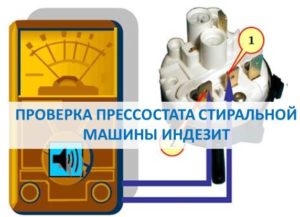 If the pressure switch fails, your Indesit washing machine may freeze mid-cycle and stop working. To resolve this issue yourself, you need to understand how this element works and what it does. So, let's learn how to check, adjust, and repair your washing machine's pressure switch yourself.
Why is it needed and how does it work?
The level relay is one of the most important parts of a washing machine, without which the device simply could not function. The operation of the machine is regulated by a control module, to which the pressure switch sends signals that there is enough water in the tank, it is possible to stop its intake and close the inlet valve. The level sensor is what tells the main unit that the tank is filled with enough fluid. Let's discuss the pressure switch's operating principle in more detail.
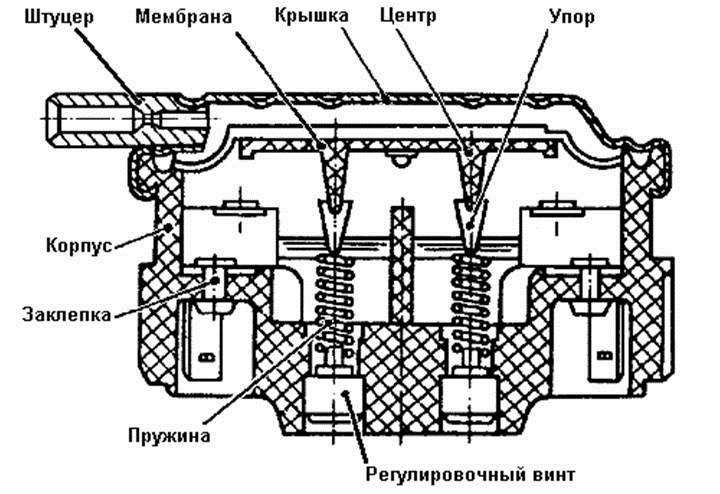
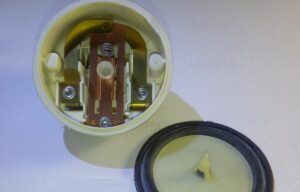
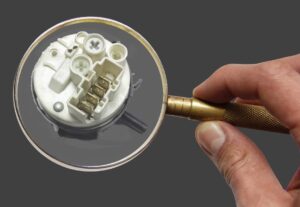
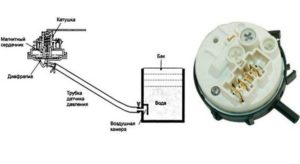 The liquid level switch controls the volume of water added to the tank. Each wash program requires a different amount of liquid to be added. The pressure switch is a rounded component with a plastic housing. A pressure hose and electrical wiring are connected to the sensor. Inside the element is a switch and a thin membrane.
Air passing under high pressure through the hose is transferred to the membrane surface, which changes shape, closing the switch. Then, via connected wires, a signal to stop water intake is transmitted to the control module. This is how the liquid level sensor in the tank works.
It's also worth mentioning the location of the pressure switch in an Indesit washing machine. It's located under the top cover, near the side wall of the unit.
Symptoms of a faulty water level sensor
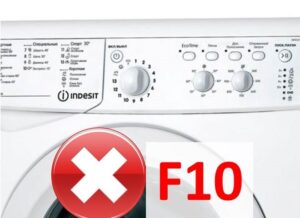
How can a user tell if a faulty liquid level switch is the cause of a washing machine malfunction? Most Indesit washing machines are equipped with a self-diagnostic system for detecting potential problems. If the pressure switch is found to be faulty, the washing machine will immediately display the error code on the display. Using the washing machine user manual, deciphering the code will not be difficult.
If the machine doesn't display an error code, a signal of a problem with the pressure switch will be a lack of water in the drum after starting the wash cycle. However, you may notice that the washing machine still turns on the heating element. Another sign of a faulty water level sensor is uncontrolled, continuous water intake into the tank. Finally, a faulty relay is indicated by poorly spun laundry, water not being able to completely drain through the drain hose, and clothes remaining wet.
However, these symptoms may also indicate a failure of other washing machine components, such as the main control module or inlet valve. The machine may simply be incorrectly connected to the utility lines. To be sure the problem is truly with the pressure switch, it's important to understand how to test the level sensor in the machine.
Finding and checking the level sensor
 Testing a pressure switch doesn't require any specialized knowledge. Even a novice can handle this task. The steps are as follows:
- unplug the washing machine;
- close the valve that supplies water to the tank;
- remove the top cover of the case by unscrewing the screws holding it;
- find the liquid level switch;
- prepare a tube of a size similar to the diameter of the fitting;
- Disconnect the pressure hose, insert the prepared tube into it and blow lightly into it.
If the pressure switch is working properly, you should hear one or three soft clicks.
Then inspect the part for damage. Inspect the hose for blockages; if necessary, clear it with running water from the faucet.
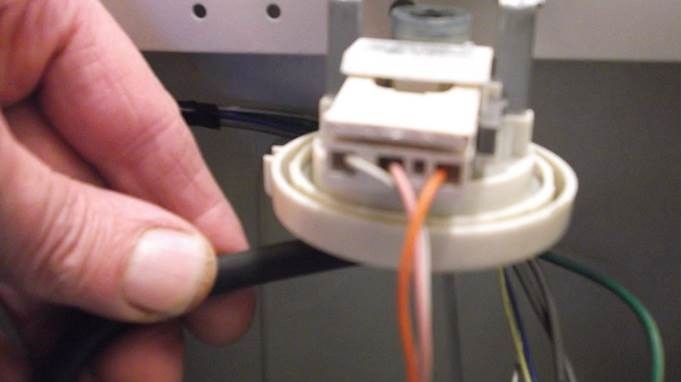
If no defects are detected after an external inspection, a multimeter will have to be used for further diagnostics of the sensor. Switch the device to resistance mode, connect the tester probes to the pressure switch contacts. If the value on the multimeter screen changes after the procedure, it means the contacts are working fine; if the resistance value remains the same, the relay needs to be replaced.
Adjusting the part
In some cases, replacing the pressure switch can be avoided if it is adjusted and configured correctly. To adjust it, you need to know the volume of water required by your Indesit machine to complete the wash cycle. Depending on the number of screws, there are 1 to 3 screws on the relay.
These screws are adjusted according to the required amount of liquid for each mode. Properly adjusting the level sensor can save you the expense of purchasing a new one.
It is not easy to select precise adjustment coordinates, so this type of work is usually carried out by professionals.
Changing the level sensor
You can replace a faulty pressure switch with a new one yourself, without the help of a professional. The first step is to purchase a part similar to the faulty relay. To help the salesperson select the correct part, simply tell them the exact model of your washing machine, or you can bring the faulty pressure switch with you to the store.
Once the pressure switch has been purchased, you can begin replacing it. The faulty level sensor must be removed.
- Disconnect all hoses and connections leading to the part (be sure to take a photo of the wiring diagram).
- Unscrew the screws securing the pressure switch to the washing machine body.
- Remove the device.
As you can see, the job is straightforward. To install a new liquid level switch, simply follow the steps described above in reverse order. Use the mounting bolts to install the new sensor, attach the pressure hose, and secure the clamp. Next, connect all the contacts and wires. Finally, replace the machine cover. Once you've completed all the basic steps for replacing the pressure switch, you can start your Indesit washing machine and test its functionality.
Interesting:

Readers' comments
Headings
Washing machine repair




For buyers




For users


Dishwasher




Add a comment