
Socket for a washing machine in the bathroom
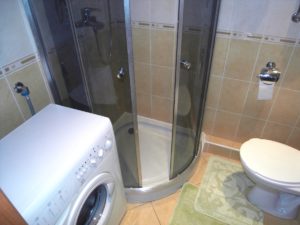
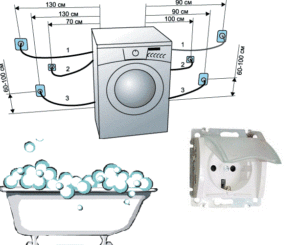 If you've decided to install a washing machine in your bathroom, you need to plan ahead for all the necessary plumbing. The washing machine requires a cold water supply, a sewer line, and, of course, a reliable electrical outlet. Electrical connections require special attention, as any bathroom is very humid, and electricity and water, as you know, don't mix. We'll discuss how to install a washing machine outlet and the associated plumbing.
Planning and calculations
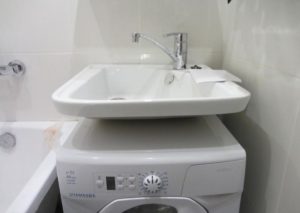
Even during the rough-in phase of a bathroom renovation, you need to consider where to place utility-dependent furnishings, such as the sink, bathtub, shower, or washing machine. This can be challenging, as many people have very small bathrooms that don't have much room. However, if you're really looking to accommodate large items, read this article for more information. Washing machine in a small bathroom – design features.
Once you've decided where to place the washing machine and drawn a bathroom sketch reflecting your ideas, you can begin planning the electrical connections. Start by figuring out where you'll install the outlet, on which wall, and where it will be located relative to the washing machine. It is better to have the socket away from the sink, shower stall or bathtub and heated towel rail, so there is less chance of water getting on it. Ideally, it is better to place the socket in the most ventilated part of the room – at the entrance.
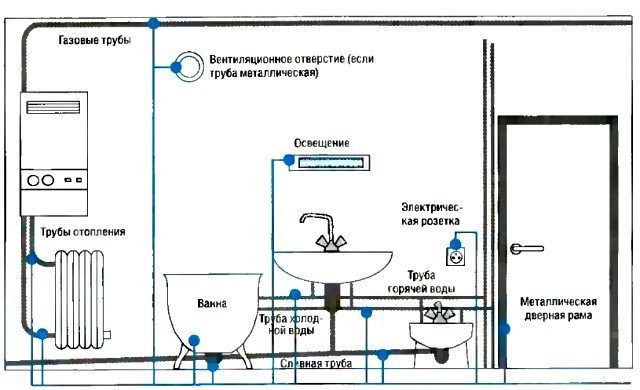
The planned location for the outlet should be on the wall, at least 25 cm above the floor. The outlet height in the bathroom can be 40 cm, 50 cm, or 75 cm, depending on your preference.
On the sketch itself or nearby, draw a diagram of the wiring and circuit breaker installation. Indicate all necessary dimensions and calculate the wire length. Speaking of wires, It is necessary to calculate not only its length, but also its cross-section, because washing machines put a considerable load on them. It is very easy to make calculations in this case.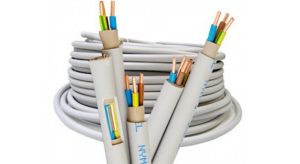
- Determine the power rating of your automatic washing machine. This isn't difficult, as this information is usually included in the instructions or on the machine itself.
- We are considering what other devices we could potentially connect to the outlet.
- We find information on the power ratings of copper cable strands of various thicknesses. We find that a 1.5 mm thick cable can handle 4.1 kW and is, in principle, sufficient for a washing machine. However, we recommend choosing a cable with a larger rating—2.5 mm—and enclosing it in silicone or plastic conduit.
Once you've calculated the length and cross-section of the copper cable for your bathroom outlet, you need to carefully plan the route. There are many factors that can influence the route.
- When laying out the route, you will have to avoid the wettest areas of the walls near the sink, bathtub and shower stall.
- It is also better to avoid particularly strong, load-bearing walls. In addition to solid concrete, they have a reinforced mesh inside, which will significantly complicate chasing.
- It is better to lay the cable along the shortest route in order to save material.
- It is better not to cross other branches of the electrical wire and not to install boxes, since boxes are not needed in such a humid room - it can be dangerous.
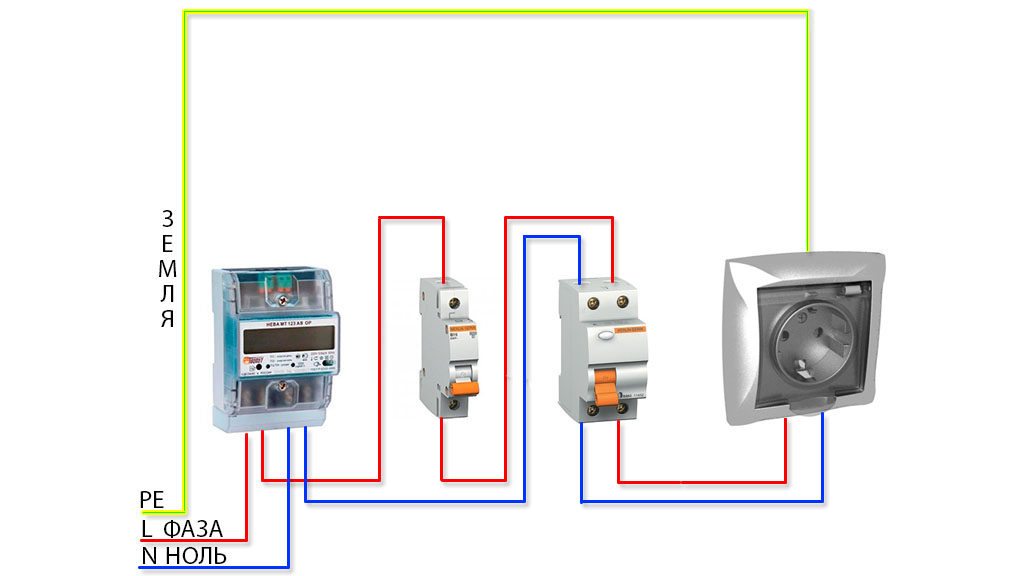
Once you've mapped out the electrical wiring route, determined the location of the washing machine outlet, and calculated the wire size, you'll need to consider protecting the outlet with a circuit breaker. At the calculation stage, you only need to determine the required cutoff current. Experts recommend a 10 mA, 16 A RCD.
Preparing tools and materials
Now let's gather everything we need to ensure the bathroom outlet for the automatic washing machine is installed in the best possible way and as quickly as possible. For this project, we'll need the following tools and materials:
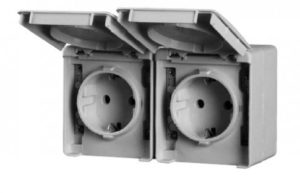
- moisture-resistant socket (single or double);
- copper wire of a certain length with a cross-section of 2.5 mm;
- RCD or residual current circuit breaker rated at 16A;
- rubber or silicone cable channel;
- terminals;
- plastic socket box;
- plastic brackets for fastening cable channels;
- 1 kg bag of cement.
- hammer drill;
- crown for socket box;
- grinder with a disc;
- chisel;
- hammer;
- tape measure and marker.
The materials are pretty clear, but the tools require a bit more detail. Almost all of the tools listed above are needed for chasing the wall for wiring and creating a recess for the electrical box. If you have a brick wall, you can get by with just a chisel and hammer; if it's concrete, you can cut out the channels with a grinder or a hammer drill. An angle grinder is neater, but it's not as safe to use as a hammer drill..
A tape measure and a marker are needed to determine the route of the wiring on the wall and mark it.
Socket installation instructions
Let's begin installing the outlet and wiring. First, we need to refer to our installation plan and mark the wall with a marker. The outlet's height and location should be noted. We also need to draw bold, clearly visible lines on the wall where the wiring recess will be. Next, we'll do the following.
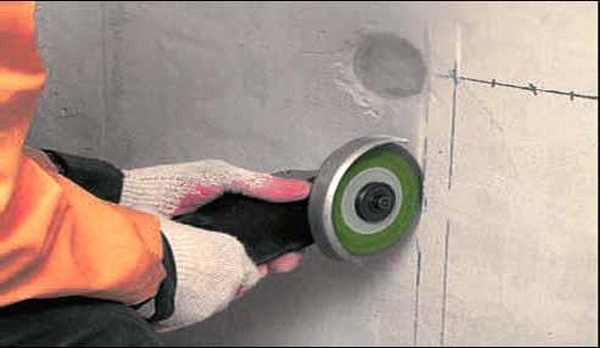
- We insert the socket box bit into the hammer drill and drill a perfectly round hole in the place where the washing machine socket will be installed.
- Using a hammer drill or grinder, we punch grooves in the wall deep enough to accommodate the wiring and cable channel.
- We install a residual current device (RCD) in the electrical panel at the outlet intended for the bathroom. The output must be de-energized.
- We begin pulling the wire, first placing it in the cable channel and connecting it to the RCD. We run the wire along the groove in the bathroom to the outlet location.
- We place a small amount of cement mortar into the niche under the socket, onto which we place the plastic socket box.
- We attach the cable channel together with the wire to the wall, and then lead the wire cores into the socket box.
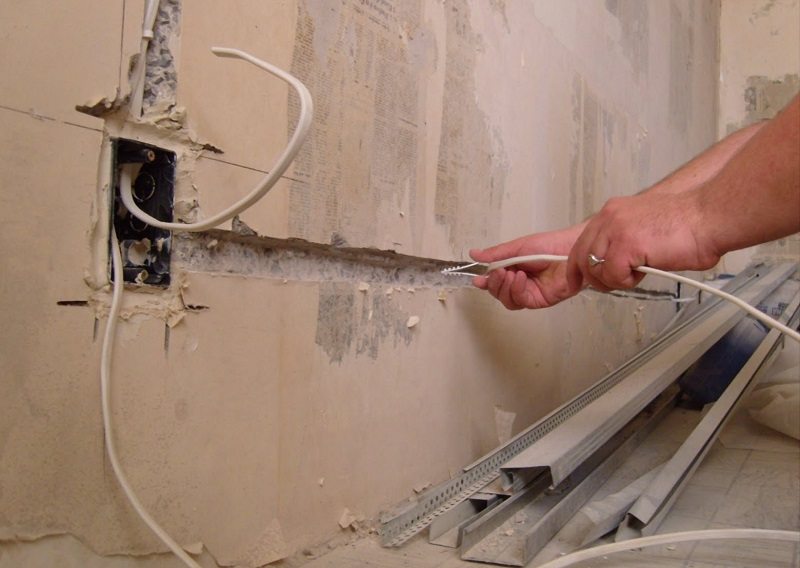
Bring the wire into the wall box with some extra space so that you don’t have any problems if you need to replace the washing machine socket later.
- We insert the insides of the socket into the socket box and secure it. By this time, the cement should dry and set the socket box.
- We connect the wire cores to the socket contacts, and then install the outer part of the socket.
Now all that's left is to tidy up the walls and test the new outlet. That's it, the job's done.
Interesting:
Readers' comments
Headings
Washing machine repair




For buyers




For users


Dishwasher




Add a comment