
Top-loading or front-loading washing machine – which is better?
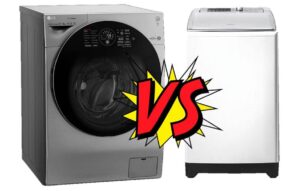
 As we know, all washing machines are divided into two broad groups: front-loading and top-loading. Front-loading and top-loading washing machines differ significantly; in fact, they don't even look alike. In this article, we'll thoroughly compare the two types of washing machines and answer a long-standing consumer question: which "home helper" is better.
How do these washing machines work?
The fundamental difference between a top-loading washing machine and a front-loading washing machine is the location of the loading door, hence the name. Front-loading washing machines have their door on the front wall of the washing machine, while top-loading washing machines have their door on the top. This is the main difference, but not the only one.
Front-loading washing machines, like top-loading machines, have drums that rotate vertically. While accessing the drum of a front-loading machine requires simply opening the hatch, accessing the drum of a top-loading machine requires opening the hatch and special metal doors. If the drum of a top-loading washing machine does not position itself automatically, you will need to manually tighten it, then open the doors, and only then load the laundry. Besides that.
- A top-loading washing machine, like a front-loading machine, has a panel
 Control panels. The panels are generally similar, but they are located in different places: in front-facing cameras, above the sunroof, and in vertical-facing cameras, above.
 - A front-loading washing machine has a larger drum. While top-loading machines rarely have a maximum load capacity of more than 6-7 kg, front-loading machines can hold 12-15 kg of laundry.
- Vertical machines have a lesser load on their drive mechanism, meaning it lasts longer. Bearings, for example, fail much less frequently, and the machine itself is much more resistant to the negative effects of centrifugal force.
- The shock absorbers and counterweights of vertical washing machines are arranged differently. It’s not that this makes the washing machine with a vertical load more stable, but the design difference is obvious.
- Top-loading washing machines, thanks to the hatch location, do not have problems with stopping the wash at any time. Even the oldest models can be stopped and laundry can be added. Front-loading washing machines can only be stopped when this option has been provided by the manufacturer.
- Front-loading washing machines come with a wide range of integrated functions, including drying, bubble wash, steam wash, and more. The latest top-loading machines also feature some of these features, but they lack drying, at least in the models sold in Russia.
A front-loading washing machine has a seal—a rubber gasket that prevents water from leaking through the closed door. There are also a bunch of other minor technical differences, which we'll be sure to cover when the time comes.
How much space does it take up?
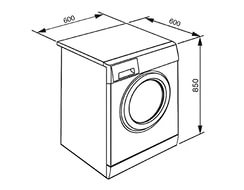
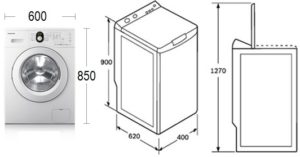 Many users are very concerned about saving space, so they are often willing to pay extra for more compact equipment. In this sense, a front-loading washing machine is better because it is produced in as many as 4 sizes. Washing machines come in slim, super-slim, standard, and compact sizes. There's a choice for almost every situation.
Top-loading washing machines are virtually all identical. If you place all models of this type next to each other, you'll see virtually no difference, although slight variations in size do occur. For example, height varies by up to 10 cm (from 80 to 90 cm), although height doesn't play a significant role here. Depth variation is even less, at 5-7 cm, and width is usually standard at 40 cm.
When comparing a standard-sized front-loading washing machine to a top-loading washing machine, a top-loading washing machine takes up less space. When comparing a compact front-loading washing machine to a top-loading washing machine, the former gains a good 10 centimeters in depth and a few centimeters in width. Some front-loading washing machines are quite unusual. wall modelsThey are apparently specially made for people who want to solve the problem of saving space radically.
When it comes to the overall dimensions of the two types of washing machines, front-loading washing machines win in almost every case – they are superior in this regard.
Convenience issues
 Now let's address the issue of convenience. Which of the two types of washing machines is more user-friendly? When answering this question, subjective factors cannot be ignored. Often, people simply prefer top-loading washing machines because they're used to them, and they can't quite explain why. The same applies to front-loading washing machines. We'll intentionally avoid discussing subjective factors and instead focus on the objective factors that make one type of washing machine more convenient than the other.
- Top-loading washing machines have a top-loading hatch, eliminating the need to bend over each time you load laundry. This is a valuable design feature for those with sciatica.
- Front-loading washing machines have a completely free top lid. Users place jars, bottles, bags of powder and other things on it like a shelf, finding it convenient.
- A front-facing unit can be built under a countertop, which is very convenient. A vertical unit, however, is inferior in this regard.
- Front-loading washing machines have easy-to-remove detergent drawers, making it easier to use and adding detergent and fabric softener. While experienced users of top-loading machines claim that their "home helpers" also have convenient drawers, they're in the minority.
Beauty and maintainability
 It's difficult to discuss the beauty of a washing machine, as each user evaluates its beauty differently. However, there are some fairly objective points. Top-loading washing machines are very similar to each other, with no discernible differences in design. The control panel, designed to individualize the washing machine model, is located on top and therefore does not attract attention.
Front-loading washing machines are different. The size and shape of the door, the shape and design of the detergent drawer, and the control panel elements give each washing machine model a unique personality and special beauty. Experiment with them. Visit a home appliance store and look at the range of front-loading washing machines. You're sure to be drawn to the design of a particular model.
If you look at the top-loading washing machine lineup the same way, you won't see anything remarkable—they're just washing machines. There's another important detail: if you buy a top-loading washing machine, you'll have to admire its appearance for the next ten years, because you won't be able to do anything about it. The front camera can be installed separately, and if you get tired of its appearance, the problem can be solved by building the equipment into the furniture.
A top-loading washing machine can only be customized by its body color. A front-loading washing machine can be customized by a number of elements. Which washing machine is better in this regard? Draw your own conclusions.
When it comes to repairability, front-loading washing machines are also generally preferred. The reason is simple: there are more front-loading washing machines available, and more spare parts and accessories are also available.
Repairmen working in various cities across our vast country are more familiar with front-loading washing machines. Consequently, components and spare parts for front-loading machines can be purchased more cheaply, and repairmen are generally better at repairing them, although this varies from person to person. In terms of reliability, front-loading and top-loading washing machines are roughly equal; much will depend on the country of assembly, the manufacturer, and many other factors.
Why is the vertical one a little more expensive?
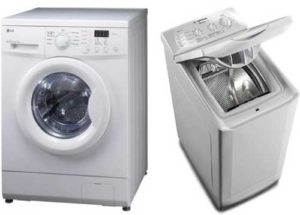 According to the manufacturer, top-loading washing machines are slightly more expensive to produce, which inevitably impacts the final price of this type of home appliance. But we believe this isn't the only reason. The fact is that top-loading washing machines are less popular; there are fewer of them, meaning less demand for them. Demand, as we know, creates supply, and the more manufacturers offer front-loading washing machines, the fiercer the competition.
What does this lead to? It forces manufacturers, competing with each other, to lower prices to maintain their competitive advantage. This effect is more pronounced in some places, less pronounced in others, but ultimately, front-loading and top-loading washing machines with roughly identical technical specifications are priced differently. Moreover, the price difference is clearly not in favor of top-loaders.
What is the conclusion?
Based on the totality of positive features and the opinion of the majority of consumers, we make Conclusion: Front-loading washing machines are slightly better than top-loading washing machines. Although, of course, vertical ones also have a right to exist, moreover, in a number of cases their use is more justified.
In principle, our general opinion is quite consistent with the market situation. If we look at the automatic washing machine market, we see the following picture: front-loading washing machines account for approximately 80%, while top-loading machines account for only about 20%. Further discussion is pointless, as the numbers speak louder.
Interesting:



Readers' comments
Headings
Washing machine repair




For buyers




For users


Dishwasher




Add a comment