
My Samsung washing machine doesn't heat water.
 One of the most common problems with Samsung washing machines is the inability to heat the water in the tank. This problem can arise for several reasons. You can identify the root cause yourself, without the help of a technician. To do this, you need to familiarize yourself with the main factors that could cause your Samsung machine to not heat the water.
Typical causes of failure
Before starting any troubleshooting, it's worth double-checking that the machine is indeed washing with cold water. To do this, run any wash cycle (Quick Wash, Cotton, Synthetics, etc.) and after 15 minutes, touch the glass door with your hand. The viewing window should be slightly warm. If it's cold, there's definitely a problem.
What are the main reasons that could lead to this situation? There are three typical factors.
- Incorrect washing mode selection. Samsung appliances are equipped with a huge number of different programs and functions, and the manufacturer predetermines a specific water heating temperature for each washing mode. Therefore, before panicking, it's worth double-checking that the program is selected correctly and that the set water temperature actually requires heating.
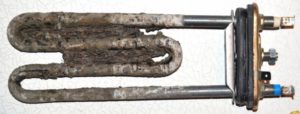
- Heating element failure. A faulty heating element is likely the cause of the machine not heating the water during a wash cycle. The tubular electric heating element can fail due to scale buildup on its surface, a manufacturing defect, or improper operation of the washing machine. To fix the problem, remove the element from the washing machine, check it with a multimeter, and replace it if necessary.
- Damage to the water heating sensor. The purpose of the temperature sensor is to ensure the timely switching on and off of the heating element. If it breaks, the washing machine simply won't heat the water. To diagnose the temperature sensor, remove it from the washing machine and test its resistance with a multimeter. Then, place the element in water heated to 40-60 degrees Celsius for a few seconds and test it again with a multimeter. If the resistance readings differ significantly between the first and second tests, the heating sensor is functioning properly. If the readings are roughly the same, the element will need to be replaced.
Very rarely, a problem with water heating can be caused by a faulty triac on the control board responsible for the heating function. In this case, the machine's intelligent control fails to activate the heating at all, or the process runs uncontrollably.
Important! While typical causes can be identified and resolved independently, a specialist should be called in to work on the control board.
How to find the heating element and temperature sensor
To find these two crucial components of your Samsung washing machine, you'll need to do some disassembly, or more specifically, remove the front panel. To do this, follow these steps:
- ensure free access to the equipment from all sides;
- Disconnect the waste filter, this will allow you to drain the remaining water in the tank, and at the same time, remove the detergent drawer;
- go around the back of the washing machine and start unscrewing the bolts holding the top cover of the housing;
- unscrew the two fastening screws located under the washing machine tray and one located on the side, on the right side of the control panel;
- carefully move the control panel aside, do not remove it yet;
- Using a flat-head screwdriver, hook the plastic clamp that runs around the entire circumference of the hatch and slowly remove it;
- tuck the hatch cuff deeper into the drum;
- Using a flat-head screwdriver, carefully pry up and remove the decorative front panel from the housing, exposing the steel frame of the unit;
- unscrew the 4 bolts located at the bottom of the front wall, they were not visible before, but after removing the decorative panel they can be easily unscrewed;
- Return to the control panel that you moved earlier, lift it up and place it on the top cover of the washing machine. There are 3 more screws hidden under the panel holding the front part of the case, unscrew them.
Important! When lifting the control panel, pay attention to the electrical wires connecting it to the body. Do not damage them under any circumstances!
The bulk of the work is complete; the front wall is now attached to the body with just a couple of hooks. Grasp it by the lower right and left corners, lift it up slightly, and carefully remove it. Don't pull too hard, as this will inevitably pull the wires that control the hatch door lock.
It's best to carefully lower the main control panel of the washing machine to prevent it from accidentally falling while you're replacing components. Once you've completed this sequence of steps, you can begin diagnosing the heating element and temperature sensor. After all, they're now literally right before your eyes!
Replacing the heating element
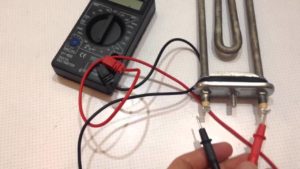 What should you do when you finally get to the heating element? You need to check the element with a multimeter. Carefully place the first probe on one contact of the heating element, and the second probe on the other contact. Then, observe the readings displayed on the screen. When the resistance value is within 25-30 Ohms, it means the heater is working properly and is functioning normally; if the multimeter display shows 0 or 1, it means the heating element is not working.
After purchasing a new, identical heater, you'll need to replace the part. To do this, you'll need a socket wrench. Take the tool and unscrew the nut located between the two heating element contacts. This will release the main fastener holding the heater in place. However, in addition to the nut, the unit also contains a spacer, so the following steps are necessary:
- remove the nut;
- Take hold of the heater contacts with your hands and gently rock it in different directions;
- using a small hammer, lightly tap the stud from which the nut was unscrewed, the stud should fall slightly into the housing;
- pry up the heating element with a flat-head screwdriver, this way you can slightly move the heater from its place;
- Grasp the contacts and pull the element out.
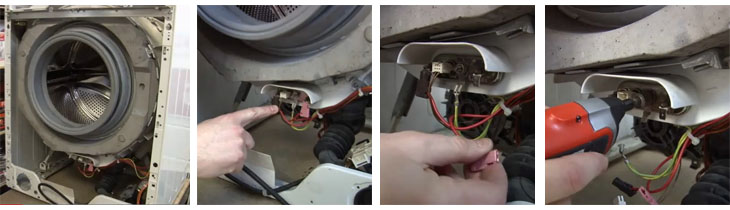
Important! Be extremely careful when removing the heater by the contacts. It's not because you don't want to damage the non-working part, but because if the contacts break off accidentally, removing the non-working part from the housing will be quite difficult.
After removing a burnt-out heating element from your washing machine, you will likely see that the part is covered with a layer of deposits and scale, and you may even notice the presence of black spots on it. Take a new heater and test it using a multimeter. Once you've verified the element is in good working order, you can begin installation. To do this, lubricate the heating element's rubber seal with a drop of machine oil and place the element in the tank. Then, install the temperature sensor, connect all the wires to the terminals, and reassemble the washing machine in reverse order and test it for functionality.
Interesting:



Readers' comments
Headings
Washing machine repair




For buyers




For users


Dishwasher




Add a comment