
How to choose a cabinet and install a dishwasher in it
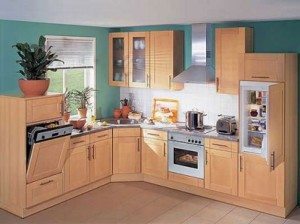 Often, buying a dishwasher doesn't coincide with remodeling the kitchen and ordering new cabinetry. This is because the kitchen may already be remodeled, and a dishwasher was unimaginable at the time. Or, conversely, having kitchen cabinetry built to accommodate a dishwasher would require considerable investment, which is simply not available. But that's no reason to forgo a helping hand in the kitchen.
This is where the question arises: how to integrate a dishwasher into an existing kitchen, whether it is old or new, and which cabinet to choose for this?
What a wardrobe should be like
So, the situation is quite clear: you have a kitchen with cabinets and a 60 or 45 cm dishwasher. Typically, there's no extra space for a separate dishwasher. In this case, no matter how tempting it might be, you'll have to sacrifice one of the kitchen cabinets. There are several options:
- Build a dishwasher into the cabinet under the sink, in other words, into the sink.
- Install the dishwasher in one of the cabinets that you used for storing pots or cereals and other necessities.
- Build the machine into a wall cabinet above the sink.
The first option is quite good, because the size of the sink can just fit the size of a compact dishwasher with a height of 50 to 60 cm and a width of 45 cm. The downside is that the dishwasher will be small, holding only 4 to 6 place settings. You'll also have to redesign the siphon so that the water inlet and outlet are behind the dishwasher, not above it.
We believe the second option is more optimal. A standard kitchen cabinet can accommodate either a compact or a floor-standing dishwasher, 45 or 60 cm wide and no more than 60 cm deep. Everything will depend on the size of the chosen cabinet. And, of course, in any case, such a cabinet will require some modernization, which we'll discuss below. Furthermore, you'll need to optimize your food and dish storage in the kitchen. We often store things we don't need in cabinets, so we'll eventually have to part with them in favor of a dishwasher.
Note! Keep your stocks of cereals, sugar, flour, and other long-life foods to a minimum. There's no need to stockpile dozens of kilograms if you don't have room for them, especially since they're always readily available.
Installing the machine in a wall cabinet has more disadvantages than advantages. Firstly, the wall cabinet must be securely fastened to the load-bearing wall to support the load. Secondly, the communications connected to the machine will be visible on the wall, which is clearly not aesthetically pleasing.Thirdly, it's inconvenient to load a dishwasher hanging over the sink, and its size and load capacity are limited. However, such installations do occur, which is why we mention them in our article.
What should a wardrobe be like?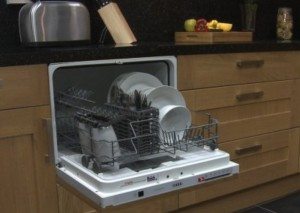
- The cabinet should be positioned so that the drain and fill hose can be easily connected without an extension. This means no more than 1.5 meters from the water supply.
- If possible, the cabinet should be located close to an electrical outlet. Otherwise, wiring and a separate electrical connection for the dishwasher will have to be installed.
- The cabinet size must be compatible with the dishwasher's width, depth, and height. For example, if the cabinet dimensions (WxDxH) are 60 x 60 x 85 cm, a dishwasher with dimensions (WxDxH) of 60 x 58 x 82 cm will likely not fit. The dishwasher's width should be no more than 58-59 cm.
Cabinet preparation
Before installing a dishwasher in a cabinet, it will need to be dismantled and upgraded. Each specific case will have its own nuances, but we'll describe everything using the example of installing a 60cm or 45cm floor-standing dishwasher. Here's what to do:
- Using a screwdriver or a drill, unscrew the screws that secure the cabinet to the countertop;
- we tighten the fasteners between the cabinet being dismantled and the adjacent cabinets;
- We make sure that all the retaining fasteners are removed and pull the cabinet towards ourselves to remove it from its place;
- We remove the shelves, the back and top covers of the cabinet, leaving only the sides with doors or one door.
- we remove the front and rear base, leaving only the side parts of the base;
- Using a drill with a special attachment, we drill a recess in the rear part of the side wall, at the bottom, for the hoses and electrical wire;
- Next, we install the side walls and the base, securing them with ties to the side walls of the adjacent cabinets.
This completes the preparation. You can also glue a metallized film to the inside of the countertop to prevent it from being damaged by steam from the dishwasher when the door is opened.
Installing a dishwasher
All that's left to do now is install the dishwasher into the prepared cabinet. The process is simple:
- lower the dishwasher feet;
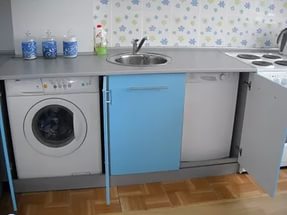
- push the equipment into the cabinet, while simultaneously threading the hoses and electrical wire through the holes made;
- Now you tighten the feet of the dishwasher so that it rests against the countertop, If necessary, you can secure the unit to the countertop with metal corners to prevent it from vibrating, but this is for built-in models;
- further connect the machine to the water supply and drain;
- put the front base back in place.
Thus, the process of installing a built-in or freestanding dishwasher in a cabinet is complete. All that remains is to test its functionality. You can do this by running a test wash. We hope this has given you a general idea of what cabinet to choose for a 60 or 45 cm dishwasher, so it can be easily integrated.
Interesting:

1 reader comment
Add a comment
Headings
Washing machine repair




For buyers




For users


Dishwasher




Thank you. I'm just about to install a dishwasher in my finished kitchen.