
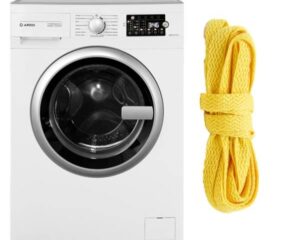
A cord got stuck in the washing machine drum.
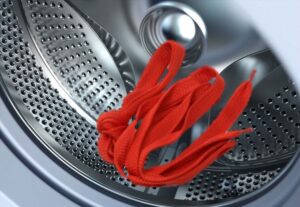 It's no coincidence that manufacturers recommend washing small items, such as children's socks, belts, and underwear, in specially designed bags. Otherwise, at the end of the wash cycle, you'll be in for a surprise: something you've placed in the machine will disappear. More precisely, it will fall into the drum when the cylinder spins. If a shoelace gets stuck in the washing machine drum, don't leave it there—the system could clog and break. It's best to go looking for the lost item.
Is it true that the lost cord is in the drum?
If you don't see laces among your washed items, don't panic and immediately disassemble the washing machine. It is not always the case that the rope gets stuck in the tank or drum – it may get caught in another place. First, we proceed as follows:
- we feel the drum cylinder (sometimes the cord sticks to the wall or gets caught on the rib punch);
- We carefully check the items taken out of the drum (often the rope “hides” in pockets or folds);
- We inspect the hatch cuff (we bend back the elastic and look for the cord).
If the missing cord isn't found in the aforementioned locations, it must have fallen into the tank. Typically, due to its light weight, the cord doesn't stay there, but instead "disappears" with the water into the drain system. More precisely, it gets wrapped around the debris filter or pump housing. To retrieve the cord, you'll need to disconnect the machine from the utilities, open the access door, lay down some rags, and unscrew the drain nozzle. Then, inspect the cleared hole and find the "lost cord."
Operating a washing machine with an object stuck in the drum is dangerous – the item could clog the drain or cause the heating element to break.
Things get more complicated when the cord remains in the tank. There are several ways to get it out, but it's best to start with the simplest: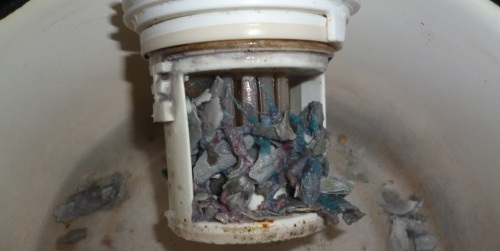
- run the rinse program with an empty drum;
- wait until the machine is “washed”;
- At the end of the cycle, check the debris filter and snail.
There's a high chance that after a second rinse, the stuck cord will leave the tank with the water, remaining on the filter or the coil. If this doesn't work, consider more effective measures. Leaving the cord inside the machine is strongly discouraged, as it may become stuck to the heating element and cause damage.
The pipe between the tank and the "snail"
In washing machines without a tray, you can remove a stuck cord through the bottom. Simply unhook the drain hose from the drum and pull the cord out. Here's how:
- disconnect the machine from communications;
- remove the powder receptacle;
- carefully lower the washing machine onto its left side;
- look under the bottom and find a black or gray hose on the tank;
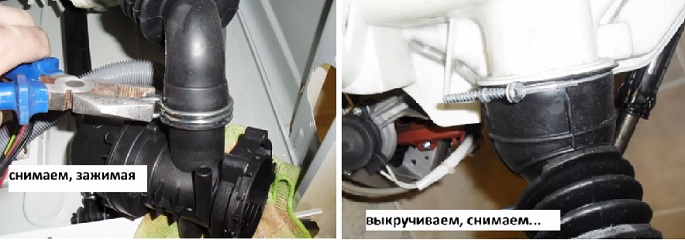
- loosen the clamp that secures the pipe;
- detach the hose from the tank.
Afterwards, all that's left to do is shine a flashlight through the hole and inspect the tank. Sometimes the cord will fall out on its own, but often it needs to be pulled out forcibly. In the latter case, you'll need to use your fingers or a bent wire.
You can remove the cord from the tank through the hole in the drain pipe or heating element, depending on the model of the washing machine.
If your washing machine has a drip tray and leak protection, it's best to avoid this method. Disabling the Aquastop system is a complex task that only professionals can handle. It's best to avoid risks and access the drain pipe another way, or avoid attempting to "hack" it yourself. The ideal option is to contact a service for professional help.
Through the heater socket
In washing machines with a heating element located at the rear, under the drum, the stuck item can be removed through the heating element opening. Furthermore, this is where "lost" items tend to become stuck and become stuck to the hot coil. Leaving a rope or other small item here is a bad idea, as the machine will stop heating fully, and the element itself will quickly burn out.
Before carrying out any repairs, make sure that the washing machine is disconnected from the water supply and electricity!
To remove the cord from the tank, you'll first need to remove the heating element. Follow these instructions:
- de-energize the washing machine;
- turn off the water supply tap;
- turn the machine with the back panel facing you;
- remove the back by unscrewing the bolts holding it;
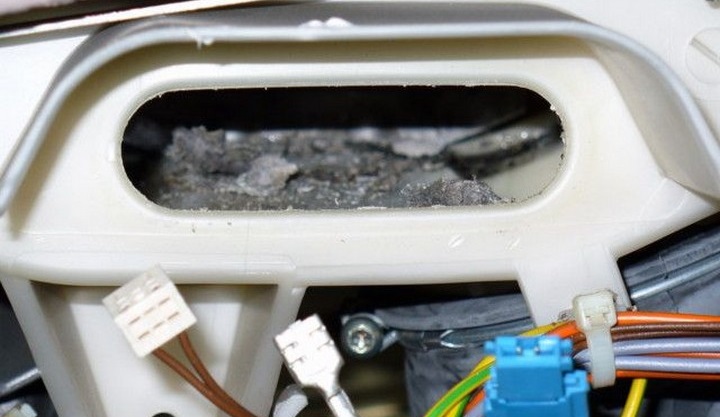
- find the heating element "chip" under the tank;
- remove the wiring from the heater;
- loosen the central nut without unscrewing it completely;
- press the rod inward until it is level with the nut;
- Use rocking movements to remove the heating element from the “nest” (do not pull the heater by the connected wires, as this can damage the power circuit);
- Treat the heating element with WD-40 cleaner if the heating element does not budge.
Typically, the cord pulls out along with the heating element, as the string gets caught in the coil. If the heating element is clean, shine a flashlight through the hole to find the missing element. You can remove the element by inserting your hand, a screwdriver, or a bent wire.
After "releasing" the cord, it is recommended to carefully inspect the heater for defects. It is possible that even short-term contact with a foreign object damaged the heating element. If there is visible damage, cracks, or chips on the surface of the element, it must be replaced. Ideally, the entire device should be tested with a multimeter. A replacement is selected based on the washing machine's serial number.
After all the work, the washing machine needs to be reassembled. Follow the instructions in reverse order. Finally, be sure to perform a test wash, checking that the heating element, drain hose, and debris filter are installed correctly. Don't forget to "correct your mistakes": from now on, it's best to wash small items in special protective bags.
Interesting:



Readers' comments
Headings
Washing machine repair




For buyers




For users


Dishwasher




Add a comment