
LG washing machine makes noise during spin cycle
 LG direct-drive washing machines are well known among consumers in the CIS countries. They are affordable, reliable, and wash clothes well. However, these machines do have one serious drawback: they are quite noisy and vibrate during the spin cycle. This is typical even for brand-new, properly installed machines. In this article, we'll discuss why an LG washing machine might make noise and vibrate during the spin cycle and how to resolve this issue.
Causes of increased noise
One of the main reasons for excessive noise in an LG washing machine is its design. We've already discussed this, but we'll clarify what we mean by "design flaw" later. For now, let's talk about other causes of noise, of which there are quite a few.
- Installing the washing machine on an uneven surface without leveling it.
- Using the washing machine without removing the transport bolts.
- A foreign object gets into the tank and jams the rotating drum, causing the latter to make loud noises.
- Deformation or complete destruction of bearings.
- Damage or complete destruction of one of the counterweights.
- Damage to shock absorbers or springs.
- Incorrect placement of laundry inside the drum, as well as underloading or overloading of the latter.
Don't underestimate the overloading of your LG washing machine drum. If this happens regularly, it can lead not only to noise, but also to serious damage that won't be so easy to fix.
Design problems and their solutions
The vibration of an LG washing machine during the spin cycle irritates many owners, but most tolerate this inconvenience and eventually get used to it. Why is this happening? Where did the Korean manufacturers go wrong in their calculations, so we now have to listen to every detail of the rattling and humming noise emitted by the LG spin cycle?
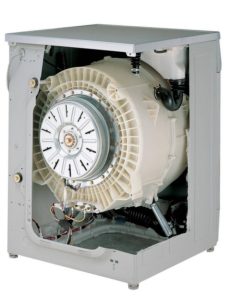 It's all my fault, oddly enough. direct drive technology, which is used in all LG washing machines. Understandably, the technology itself is good, and our specialists have no complaints about it, but the way it's implemented and how the load is distributed within the washing machine's body raises questions. The fact is that in a conventional washing machine with a drive belt and a commutator motor, the motor is mounted under the drum. The motor itself is quite heavy, so it acts as another counterweight, adding weight to the lower part of the machine.
What about an LG washing machine? These machines have a virtually empty space underneath the drum; you won't find any other components there except for a lightweight pump and a hose. The inverter motor weighs less and is located in the middle of the body, in the center of the rear wall of the tank. This leads to the fact that all heavy parts, including counterweights, are located either in the middle of the body or in its upper part, and this is, to put it mildly, not good at all.
In this regard, everything is absolutely clear. How can a washing machine effectively resist centrifugal force and, consequently, produce less noise and vibration when its lower part is much lighter than the upper part, when it should be the other way around.
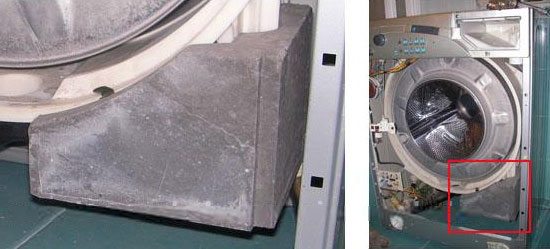
If the manufacturer couldn't or didn't want to make the washing machine more stable, the user can do it themselves. You'll be surprised, but it's not difficult; just place a counterweight under the bottom of the drum. Here's how:
- We purchase a standard lower counterweight from an Indesit washing machine;
- we straighten it a little with a hammer and chisel so that it fits under the bottom of the LG washing machine tank;
- we put the washing machine on its left side;
- unscrew the pump and drain pipe so that they don’t get in the way;
- There are fasteners under the bottom of the LG washing machine's drum that were apparently previously intended for the motor, but are now still there. We need to bolt the counterweight to these fasteners.
Make sure to screw it securely to prevent the counterweight from accidentally coming loose and damaging the pump hose. Place wide-brimmed steel washers between the bolt head and the nut to prevent the counterweight from becoming loose or being damaged by vibration. Once the counterweight is secured, you can test the washing machine—it will be quieter during the spin cycle.
Noise-causing faults
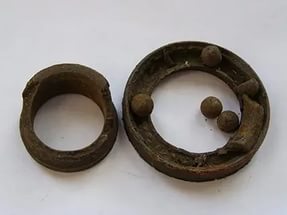 One of the main problems causing noise during spinning is bearing failure. It's not that bearings are a weak point in LG washing machines; however, in many cases, bearings "suffer" and need to be replaced. About that, How to change bearings in a washing machineYou can read about this in the article of the same name; we won't go into detail here. Just remember: LG washing machines, unlike many others, have inverter motors, which require careful handling.
The noise can be caused by a broken shock absorber or spring. When the washing machine is running at low speeds, the shock absorbers barely have to work, as the centrifugal force is low and doesn't need to be compensated for. But during the spin cycle, when the drum speed reaches 1,000 rpm or more, the shock absorbers and springs are under heavy strain. As a result, they can break. A broken shock absorber will make itself known during the next spin cycle with a loud creaking and rattling sound.
Repairing a shock absorber at home is virtually impossible, and not advisable. The problem is solved by replacing the broken part with a new one. This article describes how to do this. How to check and repair shock absorbers on a washing machine.
Which washing machines are noisier?
Not all LG washing machines are equally noisy. Some models are louder and vibrate more than others, depending on the load balance within the machine. Standard freestanding LG washing machines are the quietest. Built-in models are considered slightly noisier, and slimline models are rightfully considered the noisiest. So if you're sensitive to noise, avoid a slimline LG washing machine—you'll be disappointed.
In conclusion, LG washing machines have many advantages, but they also have a drawback – they're quite noisy. Noise can be caused by various malfunctions, but there are no problems that skilled users can't solve, albeit with the help of specialists. We hope you can figure out how to fix your noisy LG washing machine. Good luck!
Interesting:



11 reader comments
Add a comment
Headings
Washing machine repair




For buyers




For users


Dishwasher




A very interesting solution regarding the lower counterweight. However, the article doesn't specify the weight of the homemade counterweight. For example, my LG F1096ND3 washing machine weighs 6 kg.
LG Inverter Direct Drive 6kg. There's an unpleasant noise when draining water.
Something has gotten into the pump and is hitting the impeller blades or in the pipe immediately after the pump.
It's the same with me.
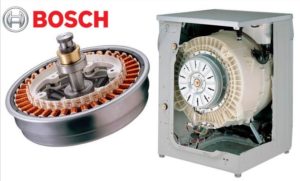
I won't swear, but do you even understand what you're talking about? LG engineers with more education and experience than you created such flaws in the direct drive? And how do you justify the advantages of a Bosch washing machine with a direct drive, on your own website, by the way? You're contradicting yourself! And now, from my seven years of daily use of the LG F1039SD (by the way, it's narrow – only 36 cm) – the machine is very quiet and stable. Only a few times did I experience strong vibration due to poor distribution of laundry (it would bunch up); otherwise, you can put a glass of water on it and not a drop will spill. So, instead of adding additional counterweights, simply place the machine on a flat, hard surface and level it. The author of this article could have read the articles on his own website so as not to contradict himself and not give advice on how to improve something that has already been in production for a good ten years and does not need improvement.
Now, if you had a car that jumped around the bathroom like a mountain goat, I'd see what you'd say about those engineers.
Evgeny, don't swear. The point is, engineers' time is over. Machine design is now handled by salespeople. Consequently, any new washing machine has a weak point.
Regarding the LG, after 10 years of use, noise and knocking have only just started, and the bearings need replacing. You're being unfair about them; there's been vibration and minimal noise throughout the entire period, but it's not a problem.
It's been bouncing and rattling for ten years! I replaced the drum. I should change it...
The described solution involves increasing the drum's static inertia to reduce the disturbing effects of the unbalanced mass of laundry and water within. I believe this is the correct approach. Equally correct is the desire to position the center of static mass as close as possible to the center of rotation of the unbalanced masses. There is only one small but important caveat: this method will increase the mass of the drum, laundry, and water within it. The drum, under the force of gravity, will shift downward, causing the seal between the drum and the door to become distorted, causing the center of the drum to be permanently lower than the center of the door. To compensate, either install stiffer suspension springs or install additional springs parallel to the factory springs, adjusting their strength based on the position of the drum containing laundry and filled with detergent solution.
LG F12A8HDS washing machine. During the spin cycle, it makes a noise like the circulation pump is straining.
There's a water supply. It washes normally, drains water, but there's this noise during the rinse cycle.
I inspected the pump at the bottom of the washing machine, the hoses are clean, the filter in front is clean.
Where else could this sound be caused?