
The washing machine is noisy during the spin cycle – what should I do?
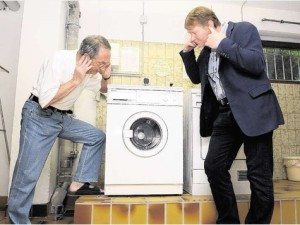 If your washing machine hums during the spin cycle, it's important to understand why. It's possible you simply purchased a model that's too noisy, or it could be a serious malfunction that could ultimately lead to appliance failure. In any case, it's important to investigate and take steps to eliminate the noise, and in this article, we'll explain how.
Common causes of washing machine noise
A washing machine's design is relatively simple. Experts have empirically identified several main causes of noise during spin cycles, which are caused by malfunctions. We'll list these causes below.
- The bolts used for transporting the vehicle have not been removed from the tank mountings.
- The drum drive bearings are damaged.
- Objects are stuck in the space between the walls of the tank and the drum.
- The pulley of the drum drive system is loose.
- The tank counterweights are poorly secured.
- The rubber seal on the hatch cover is not the correct size.
- The washing machine is not installed correctly.
Please note! Be sure to note when the loud noise occurs. This includes when the washing cycle begins, when the spin cycle begins, or during the draining process – this is crucial for proper diagnosis.
Description of the causes of noise and ways to eliminate it
The causes, characteristics, and nature of washing machine drum noise vary from case to case. It all depends on the washing machine model, the nature of the problem, the degree of wear on its parts, and so on. Therefore, we cannot guarantee that our description will accurately diagnose the cause of the problem. If in doubt, it's best to consult a specialist.
Objects are stuck in the space between the walls of the tank and the drum. According to experts and consumer surveys, this is the most common cause of loud noise emitted by the drum during the spin cycle. When we thoughtlessly throw items into the drum containing loose change, paper clips, pins, and other small items, there's a high risk of these items ending up in the washing machine's tub. What are the risks?
At low speeds, the washing machine barely vibrates, and small items sit quietly in the drum, not coming into contact with the rotating drum. However, during the spin cycle, the machine begins to vibrate heavily, causing small items to bounce and eventually become lodged between the drum wall and the moving parts. As a result, the moving parts begin to whistle, squeak, and make other noises.
To get to the objects that have fallen into the tank, you need to unscrew the heating element, put your hand into the tank and pull out everything that has fallen in, the problem will be solved.
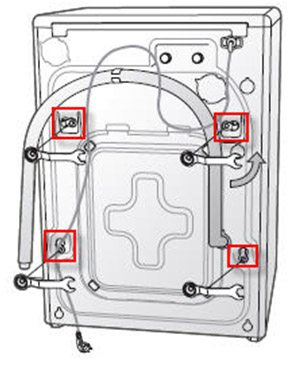 The bolts used for transporting the vehicle have not been removed from the tank mountings. A serious but common mistake washing machine installers make. To ensure safe transportation, the manufacturer has provided special fasteners that secure the drum's shock-absorbing springs. If these fasteners are not removed, the washing machine's drum will spin with a loud bang when starting a cycle. This can be resolved by removing four mounting bolts located near the center of the rear panel of the machine.
The drum drive bearings are damaged. The moving parts of a washing machine are equipped with several bearings. If one of the bearings fails, it will cause loud noise, especially during intensive use. How can you identify a bearing failure? Unplug the washing machine, reach through the door, and spin the drum first clockwise, then counterclockwise. If the drum makes a creaking and knocking noise as it spins, the problem lies with the bearing.
You can read about how to properly change bearings in a washing machine. hereBut it's still better to entrust this work to professionals, especially if you've never repaired household appliances yourself.
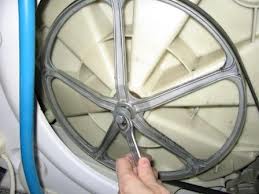 The pulley of the drum drive system is loose. To diagnose a problem with the pulley, run the washing machine in test mode. In this case, the drum will rotate slowly, making about ten revolutions in one direction and then another. Listen to the machine; if you hear clicking sounds, check the drum pulley. To fix it, you'll need to remove the back panel of the machine and, using a suitable tool, tighten the pulley retaining nut.
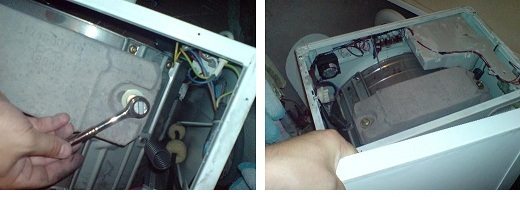
The machine's counterweights are poorly secured. Counterweights located around the washing machine's tub serve to dampen the centrifugal force that inevitably causes it to swing violently. Counterweight problems typically arise after extended use or due to a manufacturing defect. To fix the problem, tighten all loose connections holding the counterweights together. This requires removing the back panel of the washing machine. For the best way to do this, read the article. Disassembling the washing machine.
The washing machine is not installed correctly. In this case, we mean placing the machine on the floor, not connecting it to the water supply or sewer system. When the drum rotates rapidly (800-1000 rpm), centrifugal force naturally creates an imbalance. If the machine is not level, or if it is on an unstable or sagging floor, this will lead to:
- to the beat of the drum;
- strong vibration;
- rocking of the washing machine body.
The problem is solved by reinforcing the floor and installing the machine strictly level. A perfectly level floor isn't necessary for leveling the machine. Simply unscrew the washing machine's feet until the body is level. This takes a bit of work, but it's worth it.
The rubber seal on the hatch cover is not the correct size. If you hear a characteristic creaking or whistling sound when the drum rotates, and rubber shavings are visible on the drum walls and door lid after washing, the problem lies with the door seal. Unfortunately, the assembly of some budget washing machine models leaves much to be desired, and the seals are probably the last thing assemblers pay attention to.
The problem is easily solved. Simply insert a piece of sandpaper between the drum seal and the front wall of the machine and run a wash cycle without any laundry. The sandpaper will smooth the seal in 20-30 minutes, as needed, and all you have to do is remove it and remove the rubber shavings from the drum by running the extra rinse cycle and cleaning the filter.
Please note: If a loud, unusual noise is heard while the machine is draining, the problem may lie with the drain pump.
Read the article to learn how to change it yourself. Replacing the drain pump.
The machine makes a lot of noise during the spin cycle. Maybe it’s not a malfunction?
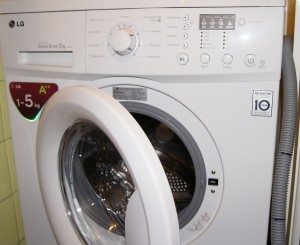 If your washing machine starts making a lot of noise during the spin cycle immediately after purchase and installation, this may be due to the model's factory specifications. In other words, the noise level during the most intensive phase of the machine's operation is preset by the manufacturer. Therefore, if you're experiencing loud noise with a new washing machine, check its specifications. In the passport, the manufacturer often indicates the noise level measured in dB, which the machine makes during its most intensive work.
This raises the question: even if a washing machine is noisy during the spin cycle and the manufacturer specifies a noise level of, say, 75 dB, how do we know our machine produces a similar level of sound? Indeed, the only way to accurately measure the noise level produced by a washing machine is with a special device—a sound level meter. If you have access to one, that's great, but most homeowners don't have access to such equipment. So what should you do in this case?
Important! You can order an inexpensive Chinese sound level meter online. Incidentally, it might come in handy later when dealing with noisy neighbors who like to listen to loud music at 2 a.m.
The easiest way to measure the noise level of a washing machine is by the so-called associative method. The internet provides many examples of common, well-known sounds with their sound levels in dB. For example, the sound of a typewriter is 50 dB (at a distance of 1 m), a subway train is 95 dB (at a distance of 7 m), a jackhammer is 120 dB (at a distance of 1 m), and so on. Roughly compare the sound levels of familiar sounds with the noise emitted by a washing machine, and you'll understand whether the numerical values listed in the data sheet correspond to reality.
Besides Be sure to pay attention to the nature of the sound. If a loud, monotonous noise is interrupted by clanking, metallic scraping, or knocking, it most likely means there is a malfunction in the washing machine and measures must be taken to eliminate it.
How can I prevent noise-causing faults in the future?
To ensure your washing machine lasts a long time and doesn't periodically experience "noisy malfunctions," it's essential to follow the operating instructions. The more carefully and mindfully you treat your "home helper," the less likely you'll encounter such problems. What operating instructions are we talking about?
- Do not put more laundry into the drum of the machine than its design allows.
- Excessive use (several times a day) can lead to wear and damage to machine parts (especially the rubber seals). Allow the machine to dry between washes.
- Use washing programs that require washing items in very hot water and at high speeds less often.
- Remove dirt from the drain filter as often as possible.
- Before washing items, check pockets for foreign objects, turn items inside out before placing them in the drum, and use laundry bags.
- Add water softeners before washing to prevent limescale deposits on washing machine components.
To summarize, if your machine suddenly starts making noise during the spin cycle and restarting the wash cycle doesn't solve the problem, there's likely a problem that needs to be identified and fixed. Our experts can help with this. Happy repair!
Interesting:



14 reader comments
Add a comment
Headings
Washing machine repair




For buyers




For users


Dishwasher




Thank you, useful information!
Thanks for the information. But there's a slightly more convenient way—to completely remove the drum from the washing machine body. I think it's more convenient that way.
Thank you.
Hello, please tell me why my Grand washing machine finishes the wash cycle without spinning after draining completely. What should I do?
Thank you, very useful.
During the spin cycle, the letters UE appeared on the display. What is this?
Thank you, this is a very useful guide!
Hello, please tell me! What should I do if the washing machine is humming? I don't know how to explain it. This never happened before. I started noticing it when I wash at 60 degrees or 90 degrees.
Thanks for the info, I'll have a look!!!!))
Thanks for the information
The engine is noisy. It sounds like dirt has gotten in there.
Even when turning it by hand, it sounds like something is catching and rubbing. Can you tell me what the problem is?
God bless and protect you! You really helped me out with $10. That's how much it costs to clean out the garbage disposal. Thanks to your recommendations, the machine started working again, I easily cleaned the garbage filter, and the drain is working!
Merry Christmas to everyone! I wish peace, love, and goodness to your families, and I wish you a happy Christmas Eve and Epiphany! Amen and glory to God!
Hello, it worked for a year, then when washing it was fine, but when spinning it hummed like an airplane, what should I do?