
Siemens washing machine does not spin laundry
 Any automatic washing machine, whether Samsung or Siemens, is valued for its comprehensive cleaning performance: throw dirty laundry in the drum, start the cycle, and pull out semi-dry laundry. If your Siemens machine isn't spinning, the drum is full of water, and your laundry, although clean, is still wet, you need to address the problem immediately. Without timely diagnostics and repairs, you could lose your "home helper" forever, so read this article and fix the problem yourself.
Why does this happen?
The pump, motor, and control board can all cause a "surprise" with insufficient drum rotation and inadequate drainage. Before troubleshooting, it's best to double-check the diagnosis. A lack of spin can manifest itself in ways that are obvious to the naked eye:
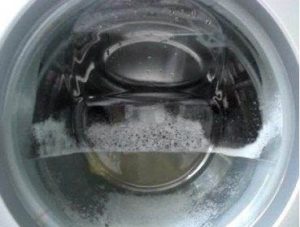
- there is still water left in the tank even after the cycle is completely finished;
- the drain doesn't work;
- the items being removed are unusually wet;
- the drain is too noisy;
- the cycle is increased by very slow water drainage;
- the machine “resets” the mode several times on its own;
- The "Spin" button is not activated.
- The machine makes a characteristic humming sound when spinning, but the laundry is still not spun.
Any of the listed signs indicate problems with the electric motor and drain. With such problems, the washing machine is unable to operate at maximum speed. The reasons for switching to a gentle mode can be due to a variety of details.
- The pump and the drainage system as a whole. Most often, water remaining in the drum is caused by a malfunctioning drain due to a clog or a broken pump.
- Pressure switch. When the water level sensor is faulty, the electronic control board does not detect the presence of water in the tank and does not initiate the drain.
- Control module. Unable to send tank-draining commands, either a broken module or short-circuited triacs. Each triac is responsible for a specific part of the machine, and a lack of communication leads to malfunctions.
- Electric motor. Another cause is a problem with the washing machine's motor, which prevents the drum from spinning fast enough to perform a high-quality spin at the specified power level. Worn-out brushes or overheated wiring can limit the rotation speed. If the problem is more severe and the motor is damaged, the machine may not start at all.
- Tachogenerator. The sensor that monitors the motor speed also prevents spinning. If the tachogenerator fails, the board no longer receives a signal about the motor's acceleration force and disables it to prevent overloads.
Many different problems can lead to wet items in the drum, but you shouldn't put up with residual water, wring out your laundry by hand, or purchase a separate centrifuge. It's easier and faster to contact a service center, and cheaper to fix the problem yourself. All you need to do is conduct a thorough diagnosis and identify the underlying problem.
Diagnostics step by step
Even if you regularly find unspinned items in the drum, don't immediately disassemble the machine down to the pump. The spin cycle often doesn't work without serious machine problems. Therefore, first, check:
- Was there an accidental cancellation of the mode? If the washing machine does not have a child lock, then it is possible to change the program or switch to soaking by accident;
- If a delicate wash is selected, the gentle cycle excludes spinning for gentle fabric care.
Important! It is recommended to run the test cycle again, selecting the standard mode and adjusting the RPM.
- Check if the laundry is clumped. Not all washing machines have an imbalance control feature, and if the laundry is unevenly distributed across the drum, clumps form and the proper balance is disrupted. To prevent serious damage, the system automatically stops the cycle. In this case, remove any excess laundry or spread it out along the walls.
There are no other reasonable explanations for the non-functioning spin cycle of a Siemens washing machine. If the situation has not changed after the checks, we begin diagnostics. The sequence depends on the nature of the problem. Step-by-step instructions for each possible solution are provided below.
Water remains in the tank
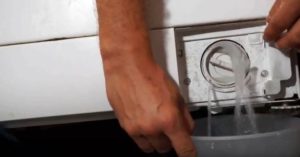 Most often, a malfunctioning spin cycle is indicated by water remaining in the drum. This "symptom" clearly indicates a problem with the drainage system. To resolve the issue, it's necessary to carefully inspect each element of the drainage system.
- We find the drain hatch in the lower right corner of the body.
- We release the latches by prying the cover with a flat-head screwdriver.
- We lay down some rags and put a bucket underneath.
- We take out the trash filter.
Be prepared for water to spill onto the floor.
- We check the pump's functionality by running the spin or drain cycle. Ideally, the pump impeller should spin vigorously—the system will function properly.
A static impeller indicates a problem with the pump—a clogged, jammed, or burnt-out mechanism. Disassembling the part will help determine the extent of the problem. To do this, loosen the clamp on the connected pipe, disconnect it and the existing wiring from the housing. Disassemble the pump and carefully inspect the interior. It's quite possible that a blockage of hair, dirt, or fur is blocking the drain. After cleaning, return everything to its original position, start the spin cycle, and shine a flashlight on the impeller. Rotation indicates that the problem has been resolved, and its absence requires a complete replacement of the pump.
A malfunctioning pressure switch can slow down the tank's drainage. It ensures timely drainage by signaling the system about the water level in the drum. To test it, you need to:
- drain the water through the filter using the method described earlier;
- wait until the hatch door is unlocked and unload the laundry;
- unscrew the two screws located at the top of the rear wall;
- pull the top cover towards you and remove it;
- find the pressure switch near the wall;
- Disconnect the pipes and check for blockages.
Next, carefully inspect the contacts and the integrity of the wiring. If there are no obvious issues, perform a final test using a multimeter. To do this, attach the probes to the corresponding connectors and evaluate the results. Fluctuating readings are normal, and if there are no sudden jumps in the readings, a new sensor will need to be installed.
Washes but doesn't spin
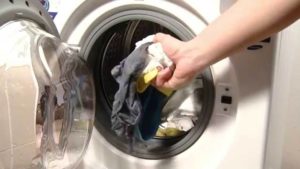 If there's no water left in the drum at the end of the cycle, but the laundry is still wet, the problem lies in the motor. A faulty motor will prevent spinning or will only spin at the minimum speed, which isn't enough to dry clothes thoroughly. It's easy to prove that the washing machine has stopped spinning due to insufficient spinning. Unscrew the screws on the back cover and remove the panel.
- We pull off the drive belt.
- We loosen the bolts holding the motor and take out the motor.
- Pay attention to the brushes installed on both sides of the housing. Remove them from their grooves, take them out of their cases, and measure the length of the carbon tips. If the length is less than 0.7 mm, replace them with new ones.
- We check the integrity of the wiring.
- We test the coils with a multimeter. If there's no resistance or voltage, you'll have to install a new motor.
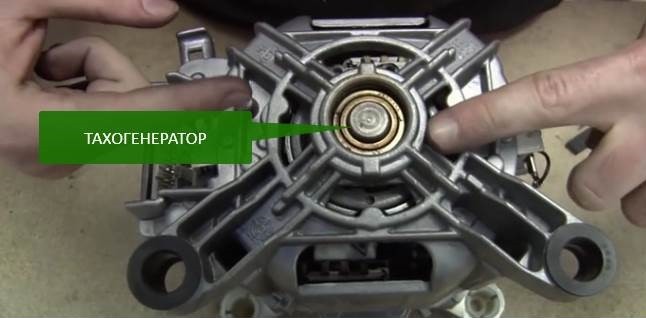
Often the tachogenerator, also called the Hall sensor, is to blame for poor drum rotation. If it breaks or burns out, it stops controlling the engine speed and the system loses control over the shaft rotation. In this case, the required speed isn't reached, and the laundry isn't spun properly. We can test this assumption by finding the indicator on the motor housing and measuring it with a multimeter.
The machine "freezes" during the spin cycle
Less commonly, problems arise with the washing machine's "brain"—the control module. In this scenario, the machine begins to behave unpredictably: it "forgets" to rinse the laundry, cancels the spin cycle, or simply freezes mid-cycle.
It is not recommended to repair the board yourself, as one careless move will worsen the situation to the point of causing irreparable damage.
You can only visually assess the module's condition. To do this, unplug the machine, remove the top cover, pull the powder compartment toward you, and carefully unscrew the screws holding the front panel. Release the wiring and check the circuit board for visible damage. If there is none, contact a service center.
Useful tips for using the machine
To avoid searching for instructions on what to do if the spin cycle doesn't work, you need to prevent the situation from reaching a tragic end. It is easy to prevent problems with the motor and drain by following basic operating rules of the machine.Let's outline these rules.
- Carefully inspect your pockets for heavy or metal objects.
- Sort items before loading.
- Do not exceed the maximum laundry load.
- Install and connect the machine to utilities according to the user manual.
- Don't forget to regularly rinse the washing machine, running it on "empty" mode after finishing work.
- Leave the door open after each wash.
The sooner you notice problems with the spin cycle, the faster and more cost-effectively the problem will be resolved. The most important thing is to remember safety precautions and, if in doubt, contact specialized repair centers.
Interesting:




Readers' comments
Headings
Washing machine repair




For buyers




For users


Dishwasher




Add a comment