
Where and how much salt should I add to the dishwasher?
 A dishwasher does a great job of cleaning dirty dishes, but it requires various cleaning products, so be prepared to constantly invest in them, which can cost you a certain amount of money. All the cleaning products used can be divided into two groups: those needed to remove dirt, and those that soften hard water, or more specifically, salt. How much salt to use, where to add it, and how often will be discussed later.
Variety of salts – how much to add
Before answering the question of how much salt to add to the dishwasher, let's decide what kind of salt you're using. There are several options:
- special regenerating salt (for example, Finish, Somat, Calgonit, etc.);
- special tableted salt (Topperr);
- A substitute for special salt is "Extra" evaporated salt. We already talked about the pros and cons of replacing salt in the article about What can I use instead of salt?;
- Tableted salt based on "Extra" salt.
The instructions on the packaging for specialized salt indicate that the container should be filled to the top. Depending on the dishwasher model, the capacity of the salt compartment may vary, so the amount of salt it can hold may vary. Most machines can hold 2/3 of a 1.5 kg pack of regenerating salt.
As for regular salt, one kilogram pack is sufficient. Tablets should also be added until the container is full. The dishwasher will tell you how often to add salt by flashing the salt indicator. When it lights up, add more salt.
Salt compartment
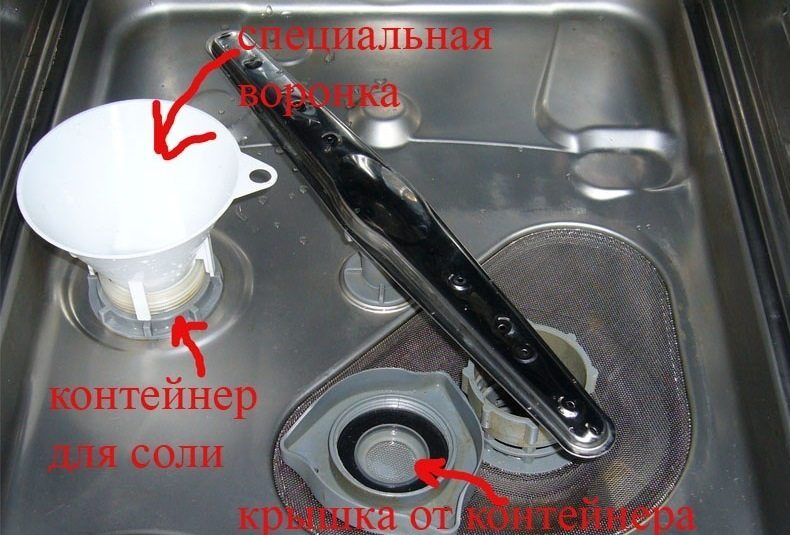
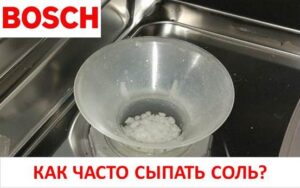
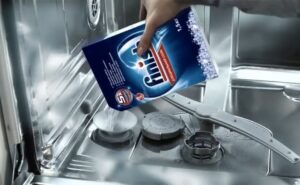
The question of where to put salt in the dishwasher should not be difficult. In all dishwashers, the salt compartment is located on the bottom of the dishwasher under the bottom tray. To pour granulated salt into it, you need to use a funnel.
Important! When adding salt to your dishwasher for the first time, you must first fill the salt compartment with water. As you add salt, excess water will drain down the drain.
As for the 3-in-1 salt tablets, there's a special compartment for them. It's located on the inside of the door.
Water hardness and salt consumption
To soften the water in a dishwasher, there's a special device in the form of a tank called an ion exchanger. Inside the ion exchanger is a resin with negatively charged chlorine ions. These ions attract magnesium and calcium impurities in the water, making the water softer. Without this, at high temperatures, magnesium and calcium form scale, which settles on the heating element. Furthermore, dishes are less likely to clean properly in hard water.
But if the water in the dishwasher already becomes soft after passing through the ion exchanger, then why do you need special salt? It's to restore the amount of chloride ions in the resin, which is why this salt is called regenerating salt. And the more hard the water, the more salt will be consumed.
To determine water hardness, you can use one of the following methods.
- The "eyeball" method involves taking laundry soap and lathering it or lathering it on a rag. If it doesn't lather well and doesn't rinse well, your water is hard. Also, pay attention to how quickly limescale builds up on faucets, toilets, and other surfaces. The faster it builds up, the harder the water.
- The second method involves using a special device or test strip. This is the most accurate and simple option.
Important! Water hardness varies seasonally, so it's best to measure it yourself several times a year.
- And the last method suggests that we look at the hardness in a table by region, compiled by experts.
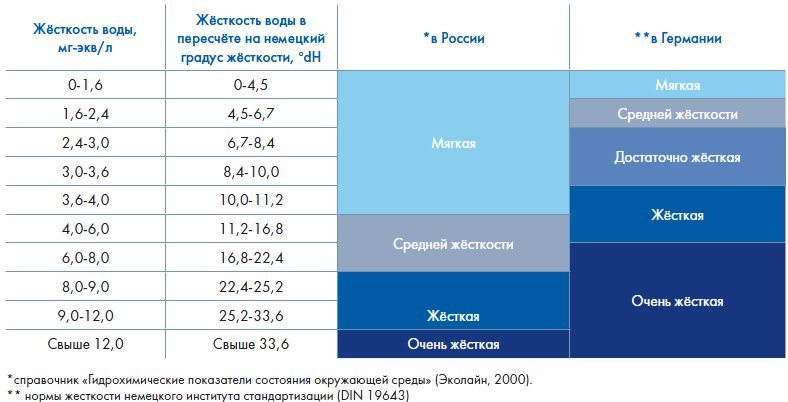
According to hardness, water is classified into:
- soft;
- medium hardness;
- tough;
- very tough.
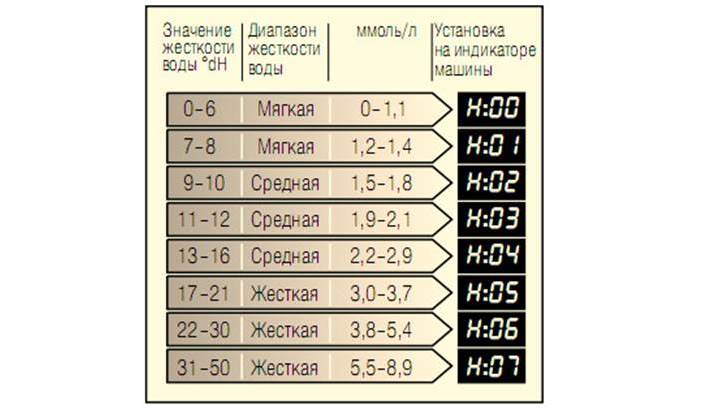
How do you properly adjust your dishwasher's salt consumption based on water hardness? First, read the instructions; they usually describe the entire process. So, For example, in Bosch dishwashers you can set 7 levels of water hardness. When the salt level is low, an indicator light on the panel will light, indicating that it's time to add more salt. If you use salt tablets, you can disable the low salt indicator by setting the water hardness to 0.
However, it's worth noting that even among Bosch models, when the water hardness is set to 0, water may flow through the ion exchanger rather than bypass it. And if you don't add salt, but only use salt tablets, this can lead to the ion exchanger becoming clogged, preventing water from flowing at all, ultimately requiring replacement. Therefore, salt is needed not only to soften water and improve the quality of washing, but also to maintain the dishwasher's ion exchanger in working order.
Important! Bosch dishwasher manufacturers recommend using 3-in-1 tablets only for water hardness levels below 21.0dH, if the hardness is higher, then you need to add salt and detergent separately.
So, it's not so much how much salt you add to your dishwasher's salt dispenser, but making sure it's always there is. How often you need to do this will depend on the water hardness in your region and whether the dishwasher's settings are set correctly. We hope you found this article helpful.
Interesting:


22 reader comments
Add a comment
Headings
Washing machine repair




For buyers




For users


Dishwasher




I unscrewed the cap from the salt compartment, and water literally poured out under pressure. Moreover, the dishwasher is now washing dishes very poorly. Is something broken or clogged? Please advise.
Hello, I have the same story and don’t know what to do…
There should always be water in the salt compartment; simply add salt and let the water drain out. Without salt and rinse aid, washing will always be poor.
The dishes aren't washing, what should I do? There's water up to the brim in the salt compartment, how do I add salt?
Just add salt, and the water will flow down the drain! That's how it's supposed to be.
If your dishes aren't washing well and your dishwasher is covered in a layer of grime, I read that you need to buy a cleaner. For example, Finish. Peel off the sticker on the lid and place it in the dishwasher, lid down, using the highest temperature setting.
It's called wax cleaner.
Somehow, the water leaked out of the tank, leaving only salt. Do I have to add water before loading the machine, or will it fill it up automatically?
I accidentally poured dishwasher powder into the salt compartment. What should I do now? Will this ruin the machine?
The articles say this is bad. It could break. Be sure to take it to a repair shop. They'll come by or give you advice over the phone.
Where do I put the gel? In the same compartment as the tablet?
Yes
The first time I ran the dishwasher, it didn't fill with water, just added salt. After half an hour of washing out of a 3-hour cycle, it started beeping and displayed the E4 error code. I read that I needed to add water to the salt, so I did. Now, when I open the lid, water is standing up to the brim of the salt compartment. Could this error be related to not adding water?
The salt ran out after 6-7 washes. The low salt indicator came on. Before the first load, I added 1 kg of salt, as stated in the instructions, along with water. Did it run out that quickly? My Electrolux machine has 10 hardness levels. The hardness level is 8. How often do you add salt?
Natalia, I have the same thing.
I still haven't figured out how much salt to put in the container. I've washed dishes without salt before, but it still stained the dishes, especially the Teflon ones. The instructions say to "fill the container," but the water will be forced down the drain. That's exactly what happened. My entire 1.5 kg pack of Somat went in, and I couldn't see the top. It feels like it could have held more. I have a Bosch SMV47L10 dishwasher, and I still can't find the salt container capacity in the instructions. Next time I'll buy two packs and see how much I can fit.
I'm not entirely clear: should I always set the salt level when adding it to the compartment? Or only when I first start the machine? Then just add more as needed?
Alena, the water hardness level is set only once. There's no point in changing it if your water quality hasn't changed.
Hello. Could you please tell me how often I should add salt? I added water and salt during the first load. The water hardness was set to 4. It's been over 40 wash cycles, but the low salt indicator still hasn't come on. I use 3-in-1 tablets in my Candi machine. Should I force-feed the salt?
Thank you.
I have a Hansa dishwasher. The instructions say to fill the compartment with loose salt. I can't find the correct amount of tablet salt. Can anyone tell me?
Natalia, open the salt compartment lid, stick your finger in, and feel for salt at the bottom. There should be some. If you don't feel any salt in the water, or if there's only a little, be sure to add more, and let the excess water drain out of the salt compartment.
Hansa dishwasher. We haven't used it for about three months, and the salt indicator came on after turning it on. I bought a 1.5 kg pack of Finish. After the first wash, the salt literally disappeared from the compartment. I couldn't find it. The indicator came on again, and I called the technician. He came, looked, was surprised, and told me to buy more salt. I bought 3 kg of salt, added 1.5 kg, and after the wash, the indicator came on again. All the dishes were covered in heavy deposits, but the salt was gone. What could be the problem? Can anyone tell me?