
How many grams of washing powder are in a glass?
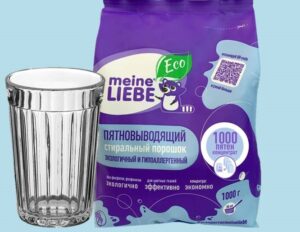 Some housewives use regular cups to measure laundry detergent. That's why it's important to know exactly how many grams of detergent a cup holds. It would seem that if a regular faceted cup holds 200 milliliters and 250 milliliters, counting to the smooth edge, it should hold 250 grams of detergent. However, this calculation is incorrect, which is what we'll explore today.
About the amount of powder in a faceted glass
First, let's define exactly what we mean by a cup of laundry detergent. If you count the volume right to the brim, it's already a full 250 milliliters. In our calculations, we will measure only up to the rim, where the edges of the glass end, that is, 200 milliliters.
Bulk products have different weights, even though they occupy the same volume. That's why we should keep a few basic rules in mind when making calculations.
- When measuring, don't pack the powder tightly or try to shake it to fit more product into the glass. Simply pour the powder to the rim and stop.
- Washing powder absorbs moisture from the air very well, so for measurements you need to take dry detergent from a freshly opened package.
- Be mindful of the rim of the faceted glass and do not add the product above the point where the edges end.
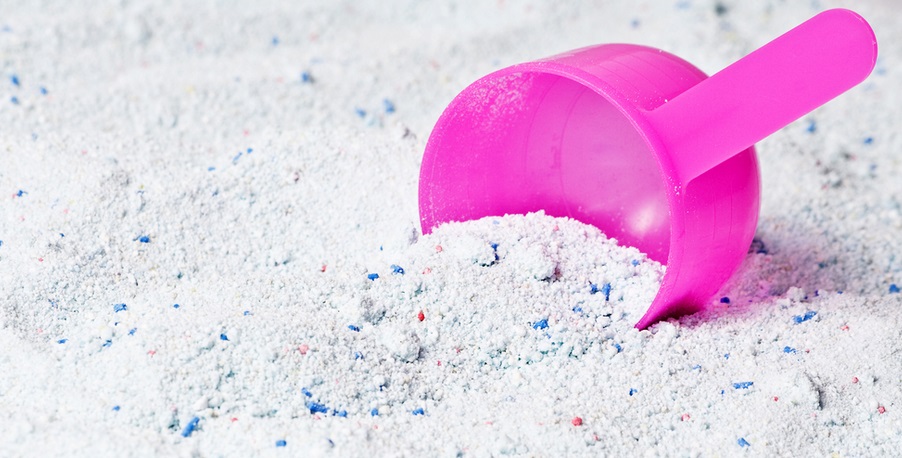
But these aren't the only specifics of measuring, as it's important to remember that laundry detergents have different compositions and different granules, which can be larger or smaller. If you've used different laundry detergents, you've probably noticed that some products have granules larger than 1 millimeter, while others are more like dust. This is why it's impossible to determine the weight of a complete laundry detergent; we can only analyze specific examples.
As part of the test, a cup of Amway brand powder was carefully measured on an electronic scale. Instead of the expected 200 grams, our faceted container held only 170 grams. Chaika brand powder was also weighed, weighing slightly more at 190 grams.
As you can see, there's no point in general measurements, as to accurately determine the weight, you need to test the specific product. It's also advisable to use precise methods, such as a regular kitchen scale.
How much powder do you need for one wash in a washing machine?
Now let's look at the required amount of powder for one working cycle in an automatic "home assistant". Typically, this information can be found not only in the washing machine manufacturer's instructions, but also on the packaging of the washing powder itself. On average, manufacturers of household chemicals of the brands "Tide", "Ariel", "Persil", "Sorti", "Myth", "Ushasty Nyan" and many others write the following:
- If the clothes are lightly soiled, then it is enough to use only 150 grams of washing powder for washing;
- If the contamination is severe, then you will need 225 grams of powder.
If your region has poor-quality tap water that is very hard, it is recommended to add an additional 20 grams of powder for each working cycle.
However, don't take household chemical manufacturers' recommendations at face value, as they benefit from consumers using significantly more detergent and thus buying it more often. Experts believe that just 1 tablespoon of detergent, or approximately 25 grams, is enough to wash 1 kilogram of dirty clothes. This means that for a standard wash of 5 kilograms of laundry, you can add only 125 grams of detergent.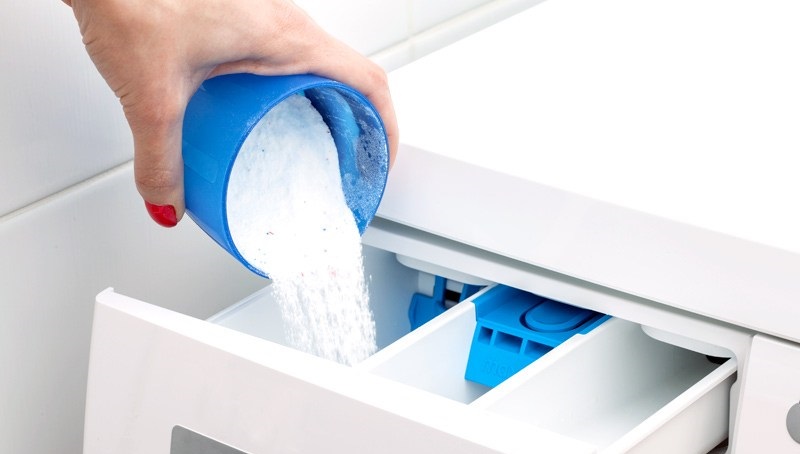
As for old, stubborn stains, it's best to simply pre-treat them with detergent or soak them, as too much detergent won't remove the stain. You can also use a little trick if your tap water is too hard: simply add a few tablespoons of baking soda to soften the water and speed up the detergent's dissolution. Just remember not to use baking soda on silk or wool items.
Why do some machines use less detergent?
Thanks to modern developments and new technologies, household appliances use less electricity, water, and household chemicals. Among the most advanced technologies, the following are worth highlighting:
- Eco Bubble;
- Steam wash.
The first differs from standard cycles in that the washing powder is effectively mixed in the washing machine's tank with the help of a powerful foam generator even before the water enters the drum. Therefore, due to the supplied bubbles, absolutely every granule of detergent dissolves and does not remain on clothes. This way, the foamed powder penetrates into the fabric fibers more effectively and removes dirt better.
It is believed that "home helpers" with the Eco Bubble function are able to save washing powder so well that they require approximately half as much as usual to operate.
Steam treatment is a mode in which the machine releases steam onto the laundry, breaking down all ingrained stains and dirt. Steam also helps the detergent dissolve better in water, resulting in more effective washing, eliminating the need to add more detergent to the detergent dispenser or use the prewash function for heavily soiled items. Steam washing also has a disinfecting effect, killing over 90 percent of allergens.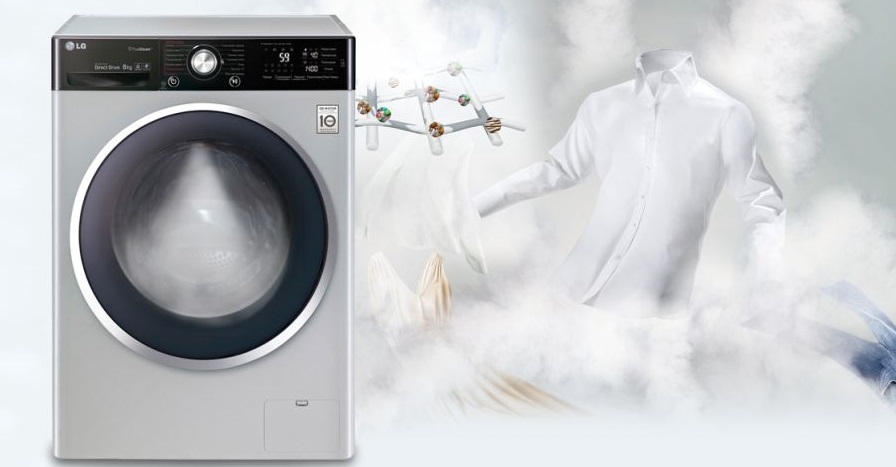
Every day, more and more devices with such modes appear in stores. Here are some examples of highly rated washing machines.
- The Samsung WF1802XEC is a front-loading washer with a capacity of 8 kilograms and EcoBubble technology. It also features a special ceramic-coated water heater that protects the heating element from scale buildup.
- LG F12U2HCS2. Another front-loading washing machine. It can wash up to 7 kilograms of clothes at a time, features a steam wash program, a drum weighing option, and automatic cycle settings.
- Daewoo Electronics DWD-UD2413K. Another front-loading washer with a foam generator. It holds a whopping 10 kilograms of laundry.
Of course, such household appliances are more expensive than regular "home helpers," but they are still often purchased, as they allow you to save on utility bills and household chemicals.
Interesting:



Readers' comments
Headings
Washing machine repair




For buyers




For users


Dishwasher




Add a comment