
A crackling sound is heard in the washing machine when the drum is spinning.
 If you hear a metallic grinding noise while your washing machine's drum is spinning, don't delay. You need to forcefully stop the cycle, unplug the machine, drain the water, empty the hatch, and call a technician. You can resolve the issue without a technician: just follow the instructions carefully. A grinding noise while the drum is spinning can be a symptom of several problems. All possible causes must be checked sequentially.
Where does this sound come from?
Determining the cause of a metal grinding noise isn't always easy—this sound can accompany several problems at once. To localize the problem, it is necessary to conduct an extensive diagnosis. Spin the reel slowly to the right and left, gradually accelerating. Then, pay attention to the following:
- what is the nature of the crackling sound (is it constant or intermittent);
- does the drum jam;
- is there a clanking or crunching sound heard at the same time;
- how difficult is it to spin the drum;
- is there any displacement of the cylinder downwards or to the side?
Do not operate a clunking machine – it is unsafe!
It's important to thoroughly assess the situation by constantly rotating the drum. The louder the clunking and the more difficult the cylinder is to turn, the more serious the problem. Based on the inspection, we correlate the symptoms with possible faults. For example, a machine may rattle in the following situations: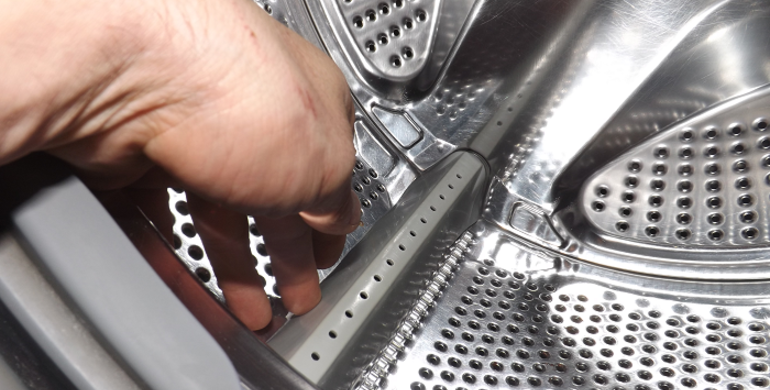
- a foreign object got stuck in the tank, jamming the drum;
- the drive belt has come off or broken;
- the bearing unit has failed;
- the crosspiece was deformed.
Don't delay repairs—any of these problems is very serious. It's best to get a diagnosis and find the source of the clunking noise right away.
We remove the back panel of the case
Rotating the drum is only the first step in diagnosing the problem. Afterward, you'll need to partially disassemble the machine yourself, checking for all possible malfunctions one by one. This will narrow down the problem and pinpoint the source of the clunking noise. The following procedure is recommended:
- de-energize the washing machine;
- free access to the back of the machine (turn the unit around or move it away from the wall);
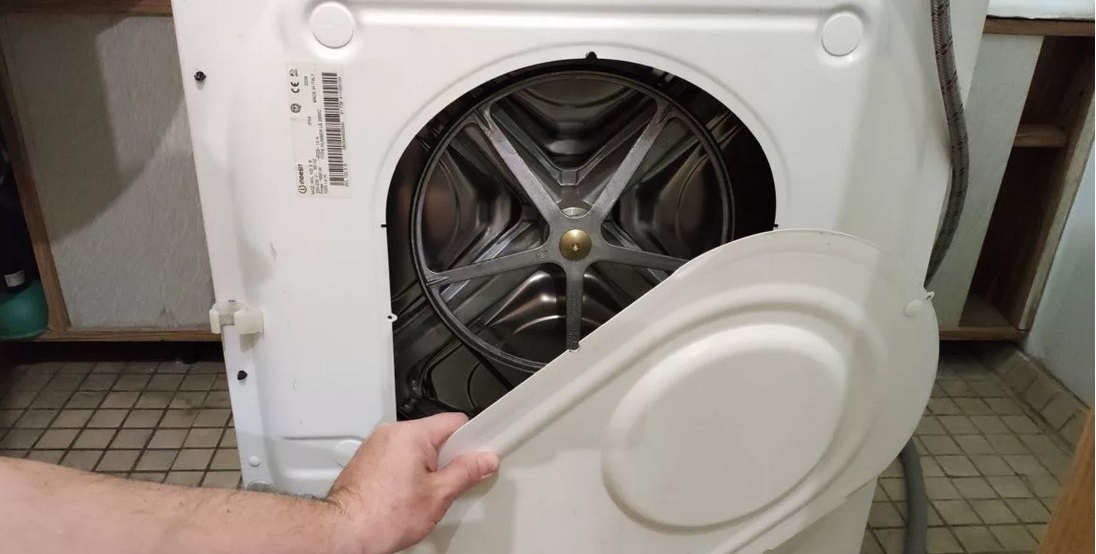
- remove the back wall by unscrewing the holding bolts around the perimeter of the panel;
- inspect the drive and the rear surface of the tank.
Drive problems are immediately noticeable—a broken belt will be found lying at the bottom of the machine. A misaligned rim is also easily visible, as the rubber will "fall out" of its grooves. In this case, the solution is simple: adjust the position of the "ring" or find a replacement and tighten the rubber back down.
When searching for spare parts for repairs, you need to focus on the serial number of the washing machine.
Is the drive belt intact? Then carefully inspect the back wall of the washer. Rusty stains there indicate damaged bearings. A damaged seal begins to leak water, which eventually gets inside the bearing assembly, washes out the lubricant, and causes corrosion. When the drum rotates, the shaft moves with difficulty, causing knocking and clunking sounds.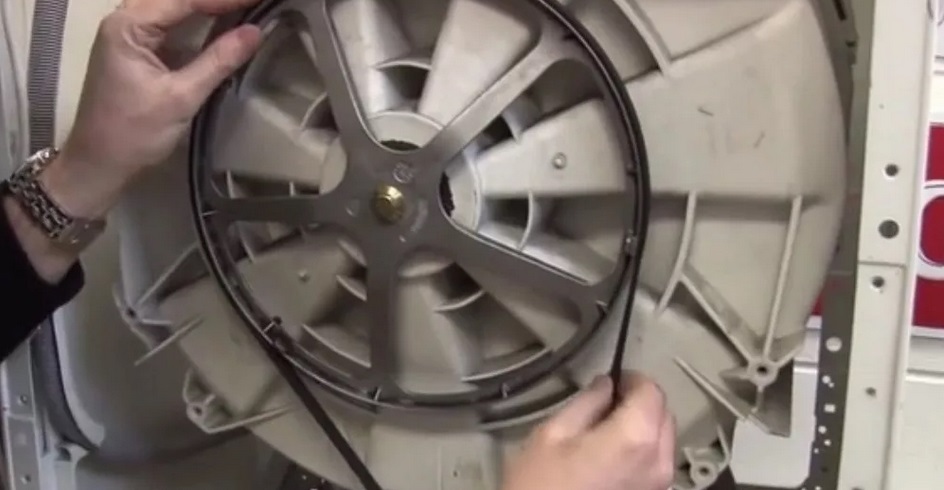
Broken bearings and leaky seals must be replaced with new ones. It's best to leave the repairs to a professional. To replace it, you will have to almost completely disassemble the machine, which is quite difficult to do.
It's all about the foreign object
Often, the cracking sound is caused by a hard object lodged in the drum: a metal bra underwire, keys, or a hair clip. The "lost object" sinks to the bottom and, when the cylinder spins, catches on its walls. In the worst cases, the foreign object jams the drum, causing the drum to slow down and tilt.
There are two ways to remove a foreign object from the tank:
- through the heating element hole;
- through the drain pipe.
The first option is simpler, but only works for washing machines with the heating element located at the rear. This applies to front-loading machines from LG, Candy, Beko, and Indesit. On Bosch and Siemens machines, the heating element is located at the front, making removal much more difficult.
To pull an object out through the heating element hole with your own hands, you need to:
- de-energize the machine;
- ensure free access to the back of the washing machine (turn the appliance around or move it away from the wall);
- open the rear service hatch by unscrewing the fixing bolts, or, if there is none, the entire rear panel;
- find a metal or plastic tank behind the drive pulley, and under it, a “chip” with wires;
- disconnect the wiring connected to the connector;
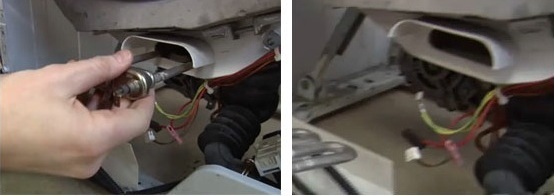
- loosen the central nut holding the heater;
- Take hold of the heating element with your hands and, swinging it to the sides, pull it towards you.
We remove the object from the tank through the newly cleared hole. You can insert your hand or tweezers, but it's better to use a hook—a thick piece of wire bent into a loop. At the same time, it is recommended to clean the heating element itself and its seat from plaque and dirt.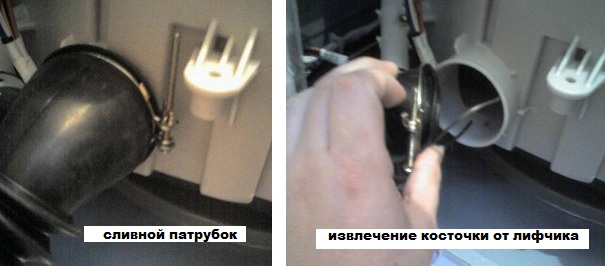
To access the "lost" item through the drain pipe, you need to completely empty the machine. Then, lower the machine onto its left side and peer inside through the housing. If the model has a drip tray, access it through the rear wall.
Next, we find the snail and the hose leading from it to the tank. Loosen the clamps holding it in place and detach the hose. After that, all that's left to do is remove the item from the hole by rotating the drum, and reassemble the machine.
Interesting:

Readers' comments
Headings
Washing machine repair




For buyers




For users


Dishwasher




Add a comment