
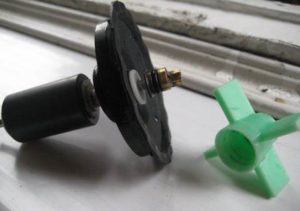
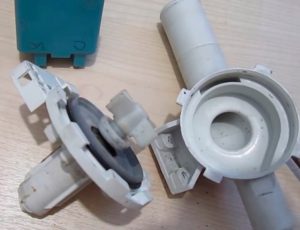
The impeller of the washing machine drain pump is falling off.
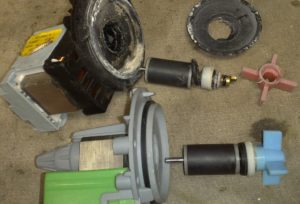
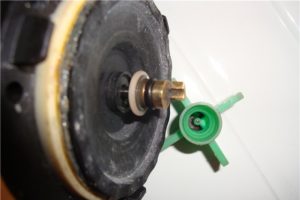 If, while diagnosing your washing machine, you discover that the drain pump's plastic impeller has come loose, you can repair it yourself. This can be done in two ways: by refurbishing the old impeller and reinstalling it, or by completely replacing the pump.
Refurbishing the impeller itself will be ineffective, as its failure occurs due to wear of the seat rather than the plastic part itself. A more reliable option is to replace the pump. We'll discuss both troubleshooting methods and explain how to do it yourself.
We are changing the pump
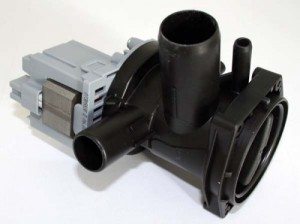
If your washing machine's drain pump impeller has come loose, the best solution is to install a new pump. We'll explain in detail how to remove the old part and install a new pump yourself. The procedure is quite simple and can be applied to washing machines from LG, Whirlpool, Ariston, Candy, Samsung, Beko, and Ardo.
- Carefully lay the automatic machine on its side; it is better to place a soft blanket underneath it to avoid damaging the wall of the case.
- If your washing machine has a bottom, remove the bolts holding it in place and move the tray to the side.
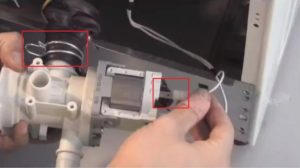
- Remove the back panel of the washing machine body.
- Use your hands to inspect the drain hose for foreign objects and blockages.
- Loosen the ring securing the hose and disconnect the hose from the drain pump.
- Unscrew the screws holding the pump, disconnect the power wires connected to it, and remove the element from the housing.
- Install a new pump by securing the part in the housing, connecting the wiring and drain pipe.
If you own a Bosh, AEG or Siemens washing machine, the procedure will be slightly different.
- Unscrew the bolts holding the top cover of the unit and remove it.
- Remove the detergent drawer from the housing.
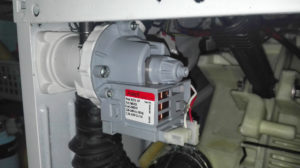
- Unscrew the bolts securing the washing machine's control panel, then, using a flat-head screwdriver, unfasten the special plastic latches around its perimeter.
- Carefully place the control panel on top of the case without disconnecting the power wires.
- Remove the false panel located at the bottom of the washing machine, under the hatch door.
- Loosen the clamp holding the hatch cuff, remove it and tuck the sealing rubber inside the drum.
- Disconnect the wires leading to the hatch locking device.
- Unscrew the screws holding the front wall of the case and move the panel to the side.
- Locate the drain pump and remove it.
- Install a properly functioning element, connecting the drain hose and power wires to it.
- Assemble the machine in reverse order.
This repair method is the most effective. A complete drain pump replacement will last for several years, whereas replacing a broken impeller risks recurring problems after a few more washes.
We install the impeller in place
If you can't quickly find a new drain pump, a simpler, but less reliable, option is to try to reinstall the impeller using waterproof glue or sealant. This method of securing the plastic part may fix the problem, but only for a few washes. You won't be able to use the machine for long, as the impeller will soon fall off and the waste liquid drainage system will fail again.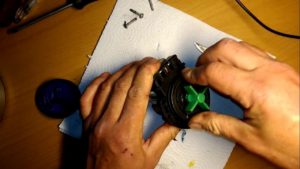
So, if the impeller is broken and there is no time for a full pump replacement, you can do the following:
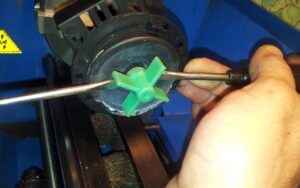
- gain access to the impeller mounting location;
- Dry the shaft on which the plastic part is mounted thoroughly;
- degrease the shaft with a special agent;
- apply anaerobic sealant or moisture-resistant glue to the seat;
- "plant" the pump impeller on the shaft.
Please note that this method will not solve the problem, but will only help to deal with it temporarily.
Replace your faulty drain pump with a new one as soon as possible. This way, you can avoid drain problems for years to come.
If the impeller turns?
In this situation, the washing machine begins draining the waste water from the drum, but the pressure then becomes very low, and eventually the water either takes a very long time to drain or doesn't drain completely and remains in the drum. The drain pump may appear to be fully functional, and the impeller is firmly in place, so what's the problem?
Most likely, the impeller is turning. When operating normally, if you spin it with your fingers, the impeller should spin jerkily, indicating that the pump magnet is overcoming the resistance. When the impeller rotates freely, without stopping, and spins on the axis, it means that the device is not working perfectly. This scrolling can be caused by foreign objects periodically getting into the drainage system or a banal manufacturing defect.
There's only one solution: a complete replacement of the washing machine's drain pump. You can purchase one at specialized retailers or online using your machine's model number.
Interesting:

Readers' comments
Headings
Washing machine repair




For buyers




For users


Dishwasher




Add a comment