
The belt on my Indesit washing machine is coming off.
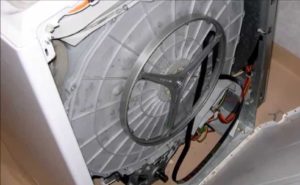 For the drum to spin while the motor is running, something is needed to connect the two. In a washing machine, this element is the belt. It's an integral part of almost any washing machine, and the Indesit is no exception. Therefore, if the belt slips off the drum of an Indesit washing machine, it's important to figure out how and why this happens and fix the problem.
Why doesn't it hold?
First, you need to look inside the car and make sure the problem is with the belt. If so, here are the most common causes of belt slippage:
- If the machine regularly operates under loads beyond its intended capacity, the belt will eventually fall off. If this is the first time this has happened, simply tighten the belt back down and enjoy your washing machine.
- If the belt comes off more than once while the drum is running fast, it may have stretched. There is only one way out - replace it with a new one;
- Drive slippage can occur not only because of the drive itself, but also because of a loosely mounted motor: the motor will periodically shift its position, thereby weakening the belt. To fix this, secure the motor more securely;
- A loose pulley mount is also a cause of belt slippage. All that's required is to re-tighten the pulley;
- The pulley or shaft may be deformed (often the belt itself, slipping off, bends them). In this case, you need to buy a new part;
- The shaft is connected to the washing machine body via a crosspiece. Therefore, if the crosspiece is damaged, the belt will fall off. The solution is to buy a new crosspiece.
- worn bearings can cause the drum to move skewed, which will first cause the belt to weaken and then become disconnected;
The belt may break if the machine is turned on after a long period of inactivity; this happens because the drive dries out due to inactivity.
Or maybe we should turn to the experts?
If tightening the belt seems like an impossible task, and any repair or disassembly of equipment makes you shudder, you can take your machine to a service center. This option is better than hiring a private mechanic, and here's why.
- All work performed comes with a guarantee.
- Large service centers have a large "base" of parts, so if replacement is necessary, they will use "original" spare parts.
- The technicians at service centers have more experience.
It's worth noting, however, that a belt problem isn't so serious that it can't be fixed on your own. Even if you've never repaired a household appliance yourself, try it with our tips.
Before disassembling the machine, make sure the warranty period has expired. For Indesit machines, this typically ranges from 1 to 3 years.
DIY installation
Replacing and installing a belt requires more physical strength than experience and skill: the belt is very difficult to tighten. If you're confident in your abilities, follow these steps:
- Unplug the washing machine.
- Remove the bolts from the back panel to remove it.
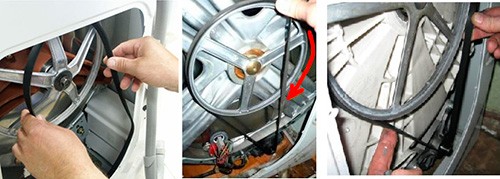
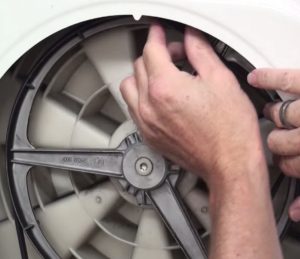
- If the belt has really fallen off, we will put it back. First, we install it on the shaft, and then on the pulley. First, tighten the belt only partially, not the entire circle. Then, rotate the pulley and carefully adjust the belt to the entire circle. Afterward, ensure the belt is tight by rotating the pulley several times.
- If the drive is torn or stretched, you'll need to buy a new one. Just write down your washing machine model and go to your nearest appliance parts store or service center. After purchasing, tighten the belt as described in step 3.
- After repair, put the back panel back and tighten the bolts again.
If the problem persists
Repeated belt slippage may indicate problems with other parts of the vehicle. For example, if the pulley is deformed, resetting the belt won't help—it will slip again sooner or later. The problem is further complicated by the fact that the deformation isn't always visible to the naked eye. Here's a tip: if the belt is slipping repeatedly, consult a professional.
Since one of the most common causes of belt failure is excessive load, try not to exceed the washing machine's maximum load. Read the instructions and all attachments included with the appliance to ensure all safety precautions are followed (and don't throw them away immediately after installation). With proper use, your machine will serve you faithfully for many years.
Interesting:

Readers' comments
Headings
Washing machine repair




For buyers




For users


Dishwasher




Add a comment