
The water won't drain from the washing machine - how do I drain it?
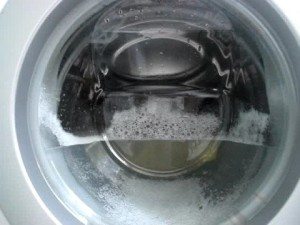 Modern automatic washing machines impress with their functionality and capabilities. However, even the most expensive models aren't immune to breakdowns. One of the most common problems involves draining the water. But don't panic if the machine won't drain, as it might be something else entirely. Let's explore all the possible causes of this malfunction and find out how to fix it and drain the water.
Reasons why water does not drain from the tank
Why does water remain in the washing machine drum and not drain? The reasons can vary in complexity. Let's list them all:
- the drain hose or the siphon to which the drain hose is connected is clogged; water does not pass through the debris plug and, as a result, remains in the drum;
- the drain hose is kinked;
- perhaps the program does not provide for draining water, so be careful when choosing a washing mode, for example, this happens when you select the “Wool” program;
- the drain filter is clogged with various small objects (coins, paper clips, pins, buttons, etc.);
- the drain pump is faulty or clogged (there is debris on the impeller);
This type of malfunction is also accompanied by a humming sound from the washing machine before draining and spinning, so if there is an extraneous crackling sound, you will have to deal with the pump.
- the pipe between the drum and the pump of the washing machine is clogged;
- the control module (programmer) of the machine is broken;
- the pressure switch is faulty (water level sensor), that is, the water level is determined to be lower than it actually is, so some of the water remains in the drum and drainage does not occur.
Some users have noticed a similar problem when overloading the washing machine drum with laundry.
Many machines display an error code when a malfunction occurs. In this case, the display on this brand's machine:
- Indesit and Ariston will show code F05 or F11;
- Bosch and Siemens code F18,d02 or d03 will be displayed;
- Electrolux and Zanussi will receive the code EF1;
- LG will display the OE code;
- Samsung you will see the code E2;
- Beko will display code H5;
- Whirlpool — F03.
Drain the water
The first thing you should do in this situation is to turn off the machine and drain the water. In such cases Most cars have an emergency water drain.To implement this, you need to:
- Open the bottom panel of the washing machine body or open the door, if there is one.
- Get a small hose for emergency drain.
- Place a shallow container of water underneath.
- Unscrew the valve on the hose and drain the water.

This is not the only way to drain waste water from your machine.
Some machines may not have such a hose, in which case the drain will have to be done as follows:
- Tilt the washing machine body back a little so that it does not slip and fall; you can ask someone to hold it.
- Place a small container under the machine.
- Open the drain filter cover and drain the water.
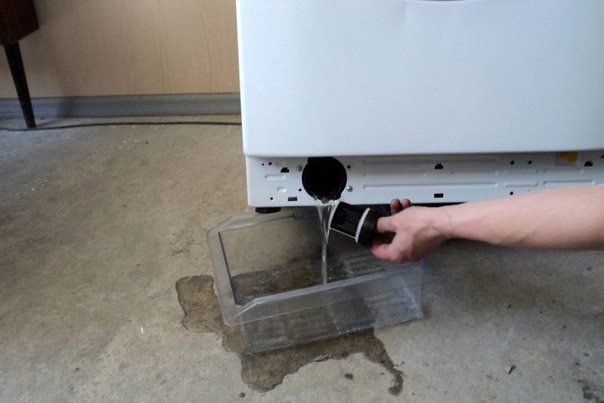
In very rare cases, the drain filter is so clogged that it won't open, and excessive force can cause damage. Therefore, water will have to be drained through the drain hose. This is also the only way to drain the water if it is heavily clogged. This type of draining is labor-intensive, as you must first disassemble the machine, access the drain pump, disconnect the hose from the pump housing, and place a container underneath. But, again, This type of wastewater drainage is used extremely rarely.
Troubleshooting
Once the water has drained, you can move on to identifying the cause of the problem and fixing it. What's the best order to follow, and where should you start? A good place to start is with the drain filter, which you already removed when draining the water. Inspect it for debris and rinse it under running water.
Next, inspect the pump impeller by shining a flashlight into the drain filter hole. At this point, you can already determine whether there's debris in the pump. If everything is fine, you can replace the filter.
Next, you can check the drain hose and trap. To do this:
- disconnect the hose from the siphon;
- lower the hose into the bucket;
- select the "Spin" program or the special "Drain water" function.
If the water comes out, it means that the siphon and drain pipe are clogged. If the water remains in the machine, we move on to looking for a breakdown inside the washing machine.
Caution! If water doesn't come out through the filter, something is stuck in the pipe between the drum and the pump. You'll have to disassemble the machine and remove the drain pump, cleaning all the connecting pipes along the way. The entire repair process is described in detail in article about pump repair.
When you reach the pump, you'll see the hose running from the drum to the pump. In an Indesit washing machine, it looks like this:

Using pliers, you can loosen the clamp and check if there is a blockage inside.

 If all previous faults have been ruled out and the pump is completely functional, or cleaning it doesn't help, you'll need to check the control module's functionality. You'll need to determine if the module is receiving 220V voltage; this requires a special multimeter. If there is no voltage, the module needs to be replaced. It's best to have this work done by a professional.
So, by checking all possible faults for why your washing machine isn't draining, you'll likely find something. And if you can't resolve the issue yourself, a service center and technician will definitely help resolve the problem.
Interesting:
Readers' comments
Headings
Washing machine repair




For buyers




For users


Dishwasher




Add a comment