
How to drain water from a Bosch washing machine?
 Repairing a machine that's frozen during a wash cycle should only be attempted after the drum has completely emptied. It's crucial to remain alert, drain the water from the drum, and only then begin inspection and repairs. Otherwise, tampering with the machine could result in flooding, a short circuit, or worse.
Let's figure out how to drain a Bosch washing machine that stopped mid-cycle. We'll outline all the methods, their advantages, and risks.
What methods exist?
The safest way to empty the machine is through the dedicated "Drain" program. However, the machine often freezes, and the control panel doesn't respond, so you need to force the water to drain manually. There are four ways to do this:
- through the drain hose, without turning on the pump;
- by unscrewing the drainage filter - "garbage can";
- forced opening of the hatch;
- disconnecting the drum pipe.
Before performing an emergency drain, the Bosch washing machine must be de-energized and disconnected from the water supply.
The forced data dump method is chosen based on the situation and the user's capabilities. Each option requires preparation and carries its own risks. Having decided on the method, disconnect the washing machine from the power supply, turn off the water and begin working.
Through the trash can
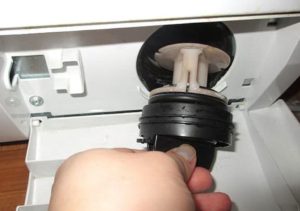
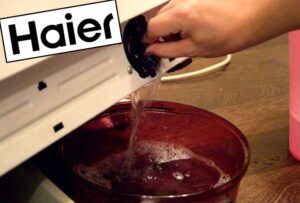
If your washing machine breaks down during a wash cycle, it's easier to empty the drum using the drain filter. This is a spiral-shaped plastic attachment located in the lower right corner of the machine behind the access door. The name "dustbin" refers to its function: water draining from the drum passes through the spiral, and debris and foreign objects that enter the machine are caught in the plastic. This protects the system from clogging the pump and impeller.
It's easy to drain water through the "trash can":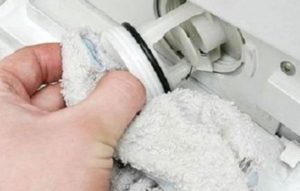
- We use a slotted screwdriver to pry up the false panel;
- we press the latches and remove the door;
- we find the plug of the “garbage can” – a dark “washer”;
- we tilt the machine back, lean it against the wall and place a basin underneath to collect the water;
- we cover the space around the washing machine with oilcloth and rags;
- holding the “handle” of the plug, slowly unscrew it until water flows out of it (you don’t need to completely remove the coil – the pressure will be too strong!);
- We drain all the water from the tank.
Do not unscrew the debris filter after the high-temperature cycle - there is a risk of scalding from boiling water.
This method has only two drawbacks. First, it can't be used if the water in the tank is hot—a jet of boiling water can seriously scald you. Second, you'll have to put up with a dirty floor, as even a basin and plenty of rags won't save you from a small soapy flood. However, draining through a "trash can" is the fastest, easiest, and safest—the main thing is to follow all safety precautions.
Will it work through a hose?
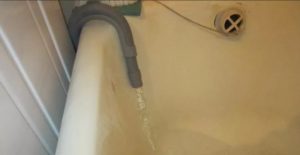
In some cases, you can quickly drain the drum using the drain hose. It's important to have clear access to the drain and a suitable drainage area—a large basin, sink, or bathtub. The drainage process looks like this:
- disconnect the hose from the riser by loosening the fixing clamp;
- detach the sleeve from the back of the housing by removing the plastic latch from the base of the hose;
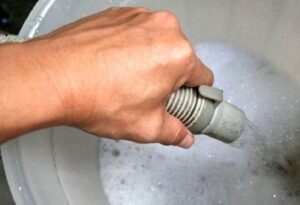
- lower the corrugated pipe below the washing machine tank, placing the end disconnected from the sewer in the sink or a prepared container;
- drain the water until the flow dries up.
It is not possible to empty a Bosch produced after 2015 through the drain hose.
The simple method has a significant drawback: not all Bosch washing machines can be emptied this way. The fact is that modern machines are protected from the "siphon effect," spontaneous leakage or intake from the sewer, for which a special loop or check valve is built into the system. With such equipment, it will be impossible to empty the washing machine through a hose.
A check valve is typically installed in Bosch units manufactured in 2016 and later. Consult the user manual to confirm the presence of a check valve.
The risky way through the hatch
If you can't empty the drum using the hose or debris filter, you'll have to take drastic action: open the door and scoop out the water manually. But first, you should assess how full the drum is and, as a precaution, tilt the machine back. Typically, the liquid level in the washing machine exceeds the bottom of the door, and opening the door suddenly and abruptly will result in a flood.
So, we proceed as follows:
- tilt the machine back;
- we open the door;
- Using a mug or ladle, gradually empty the tank.
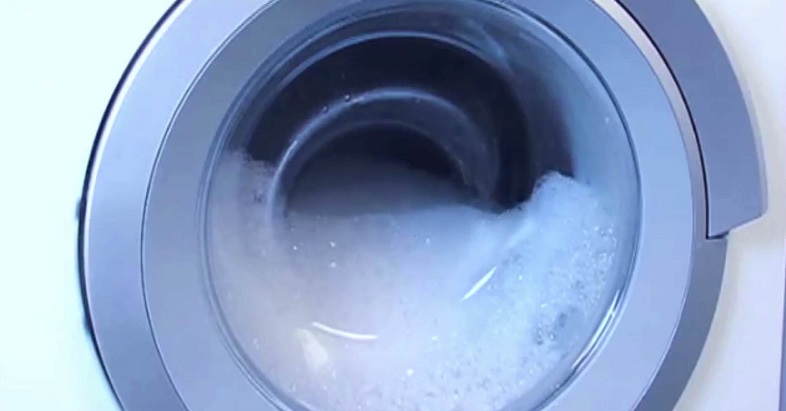
The simple instructions are complicated by just one thing: opening the door of a frozen machine isn't easy. When the cycle starts, the electronic lock is automatically activated, making it impossible to unlock the door using the standard handle. You'll have to resort to a different method:
- prepare a long and thin cord;
- thread the rope through the hole between the hatch and the body of the washing machine where the locking mechanism is located;
- pulling the ends, place the twine as deep as possible;
- Pull the loop until you hear a click from the lock opening.
You should only open a full-water machine if, for some reason, other drainage methods are not possible. It's important to understand that manually emptying the drum is very time-consuming and arduous—you'll have to spend a lot of time on monotonous work. Also, this method won't drain everything; some liquid will remain in the tank and pipes.
Dismantling the branch pipe
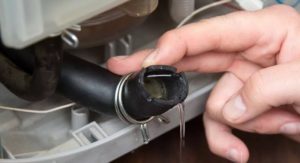 Another option for forced draining is disconnecting the drum hose. This is best used only as a last resort, if all other options have failed. It's more difficult to use, but the effect is more powerful: you can not only drain the machine but also eliminate the cause of the jam. There is a high probability that the machine broke down due to a clogged hose.
Water drains through the pipe like this:
- the top of the washing machine is removed, followed by the back;
- there is a pipe going from the drum to the pump;
- a container is placed under the hose, and rags are placed for safety;
- Use pliers to loosen the clamp that secures the hose to the pump;
- The pipe is detached from the pump and lowered into the basin.
If water does not drain through the pipe, it means it is clogged - you must first clean the hose.
The difficulty with this method is that the outlet is difficult to reach: you have to move the housing away from the wall, partially disassemble the machine, and crawl under the drum. However, the water will completely drain from the tank.
Interesting:


Readers' comments
Headings
Washing machine repair




For buyers




For users


Dishwasher




Add a comment