
Sparks under the washing machine during washing
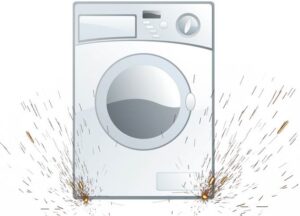 Any washing machine, like a vacuum cleaner, can't be completely silent, so it's natural for the appliance to make some noise during washing. Furthermore, a slight plastic smell from the washing machine immediately after purchase is also normal. However, if the washing machine sparks from underneath, as if it's about to take off like a rocket, this is a sign of a major malfunction that shouldn't be ignored. In this case, a thorough diagnosis is necessary, and if a breakdown occurs, the appliance must be repaired.
How does this technical anomaly manifest itself and when is it normal?
If you hear sparks under your washing machine during a cycle, the first step is to unplug it as quickly as possible. In this situation, it's dangerous not only to use the machine but even to leave it plugged in. After disconnecting the power, you can begin troubleshooting. Sparks are usually a sign of problems with the washing machine, and they can manifest in various places.
- Sparking almost always occurs during active washing or spinning. Sparks will then appear under the drum at the rear of the washing machine, where the electric motor is located. Not only will the crackling sound be louder than in a normally functioning machine, but if the lights are turned off, a small fireworks display will even be visible. In addition to the crackling sound, the phenomenon may be accompanied by a pungent smell of burning plastic, and sparks may even appear behind the drum, visible through the glass door.
- Much less frequently, sparks can appear at the top of the "home assistant," where the control panel is located. After this, the device most often shuts down, stops responding to any commands, and an unpleasant burning smell fills the room.
Sparking can occur due to natural wear and tear of parts, damage to wiring, or short circuits in electronics.Due to the numerous possible causes, only a home appliance repair specialist can accurately determine the problem, so if sparks occur, it's best to call a technician immediately.
Never use a washing machine that produces sparks – this can permanently damage the appliance, damage the wiring in your home, and even cause a serious fire.
You can understand on your own that there is nothing scary about sparks and crackling, but only in two cases.
- If the automatic washing machine has recently been repaired, the electric motor or its brushes have been replaced;
- The washing machine is new, so it is just beginning to enter normal operating mode.
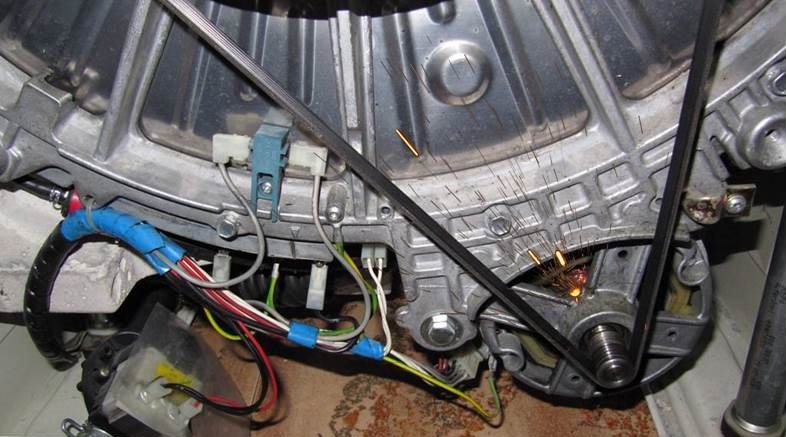
Both of these situations indicate that sparking is caused by the brushes of the motor being ground. While the parts are installed correctly during assembly and repair, the commutator and brushes require a short period of bedding in, during which time the notorious sparks and crackling noises occur.
To speed up the break-in process, wash with a partial load and spin only at medium speed.
Usually, the bedding is completely completed within a few washes, but occasionally up to ten working cycles may be required under light conditions. But if sparks appear during washing on an old household appliance that has not been repaired and the motor and brushes have not been replaced, then there is definitely a breakdown in the machine.
There is a problem with the motor brushes.
Most washing machines are equipped with commutator motors with graphite brushes that ensure contact with the fins. The faster the rotation and the greater the load, the faster the brushes wear. Due to heavy use, they wear down and stop making proper contact with the commutator, eventually starting to spark.
When a washing machine sparks from underneath, producing an audible crackling sound, and in the dark, the sparks resemble fireworks, the problem is most likely with the brushes. If you remove the back or side cover during the sparking process (depending on whether your washing machine is a top-loading or top-loading model), you'll be able to see sparks coming from the motor.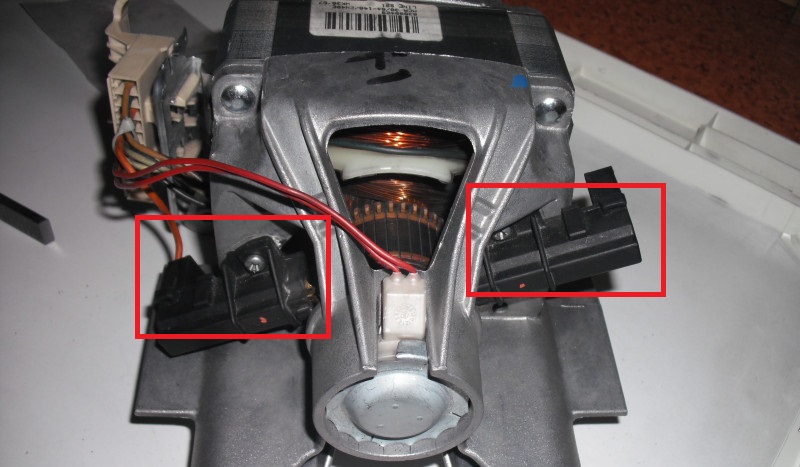
To fix this problem, you'll need to purchase new brushes and then replace the damaged parts. It's best to call a service center technician to replace the machine's components. Doing this yourself can be challenging, as if your old washing machine is sparking from underneath, you'll have to disassemble the motor, which contains the brushes. Newer models are less of a hassle, as you can do this without disassembling the motor.
Engine lamella delamination
The contact surface of the commutator that comes into contact with the brushes is called the lamellas. During washing, they rotate, become very hot, and gradually lose their smoothness. Washing without breaks, especially with an overload of laundry, causes serious overheating of the contact surfaces of the slats, after which the parts begin to deform and fail.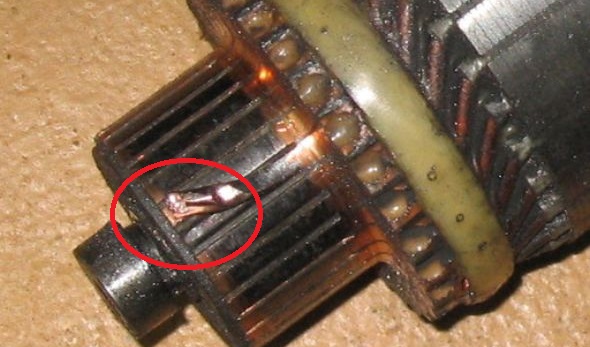
These fins can not only wear out but also become coated with a layer of carbon. These problems can cause poor contact between the brushes and the commutator, causing the washing machine's motor to spark and the brushes to knock against the fins. The problem is easy to diagnose—just spin the motor shaft. If the fins are severely damaged, you'll hear clicking and other unusual sounds that wouldn't be heard in a normally functioning washing machine motor.
If the slats are the cause, the machine will spark, crackle, and even knock loudly at high speeds during washing and spinning when fully loaded.
This problem can be resolved by replacing the motor completely or cleaning the fins. If the damage is minor, the fin surfaces can be gently sanded first with sandpaper and then with felt. This will restore the smoothness of the parts and a uniform contact surface. If the fins are severely damaged, they cannot be repaired, so you will need to purchase a new washing machine motor, as manufacturers do not sell spare parts for repairs.
Problem with the heating element
If the heating element is at fault, the sparking is caused by a short circuit. The problem could then be a poor connection in the wires due to oxidation or carbon deposits, or damage to the heating element itself. If it burns out, the washing machine will immediately stop heating the water. However, if the heating element is slightly shorted, it will continue to operate, but with sparks. At the same time, the RCD, residual current circuit breaker, or circuit breaker in the washing machine's power line may also be activated.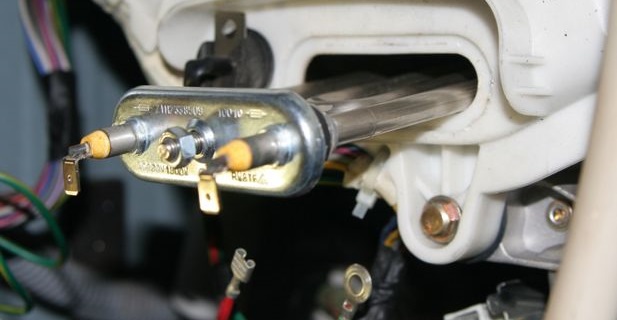
To determine if the problem is with the heating element, simply look for sparks or a glow at the bottom of the washer's drum, visible through the glass hatch. An unpleasant smell of burning plastic or wiring may also develop. In rare cases, the machine will automatically activate the residual-current device or circuit breaker.
A damaged heating element cannot be repaired, so replacing the part is necessary to resolve the issue. As with brush replacement, we recommend calling a technician to replace the heating element so they can diagnose the problem and determine whether the part needs to be replaced. In rare cases, sparking can occur due to poor wiring connections to the water heating element. In this case, a technician will clean the connections and tighten the heating element fasteners.
Interesting:




Readers' comments
Headings
Washing machine repair




For buyers




For users


Dishwasher




Add a comment