
Can I install a washing machine next to a refrigerator?
 When operating, a washing machine draws water, is susceptible to overheating, and vibrates heavily, so its installation requires special attention. This primarily concerns its neighbors—not all appliances are safe to install next to a washing machine. Otherwise, they will fail prematurely. It's definitely not safe to place a washing machine next to a cooktop or microwave, and is it acceptable to place a washing machine next to a refrigerator? Let's consider the pros and cons.
Recommendations from equipment manufacturers
The feasibility of arranging a refrigerator and washing machine depends on several factors. Three, to be precise: the built-in nature of the appliances, the planned distance between the appliances, and the strength of the existing flooring. Let's examine each in detail.
- If the appliances are built-in. The easiest option is when both the refrigerator and the washing machine are mounted in the kitchen cabinetry. In this case, all danger is eliminated, and any "neighborhood" becomes acceptable. This is due to the design – such units are designed with the necessary ventilation, vibration resistance, heat and water drainage. Simply leave 2-5 cm between the appliances, install and adjust them correctly.
- Minimum distance. It is better to space regular models apart from each other, following the manufacturers' recommendations. Typically, restrictions apply to the refrigerator: it must be installed 30 cm away from other appliances and not placed close to walls. Larger refrigerators generate more heat, requiring a minimum of 50 cm.
It is advisable to place the refrigerator at least 30 cm away from other appliances.
- Flooring durability. Much depends on the flooring in the room. A refrigerator isn't designed to absorb vibration, so a washing machine placed next to it can unbalance the structure. A concrete base will help absorb vibration, but a wooden one won't. Hence the restrictions: on concrete and tile, the washing machine can be moved no closer than 10 cm, and on wood and laminate, at least 30 cm.
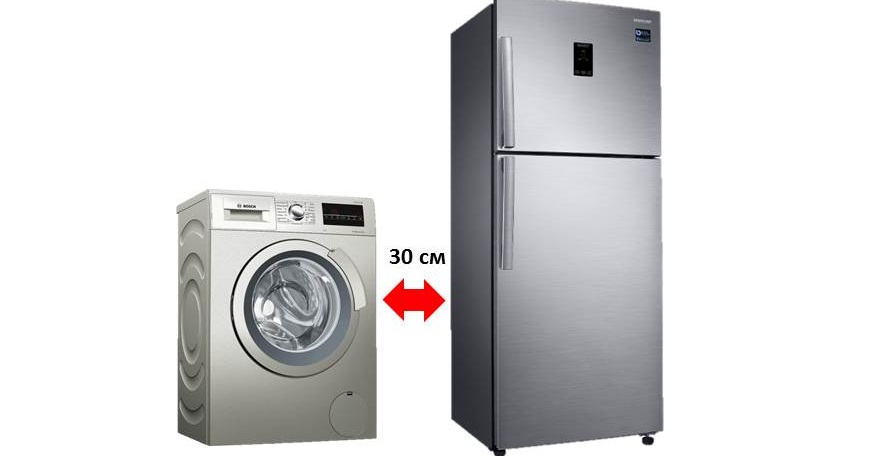
A compromise can be found. The main thing is to adhere to the limits specified by the manufacturers. We also make sure to leave the other side of the refrigerator free from neighbors and install the washing machine as level as possible. Don't forget about vibration dampening and place the machine on special anti-slip pads.
Advice from practitioners
In practice, adhering to all the standards and limits set by manufacturers can sometimes be difficult, especially if the kitchen is limited in space and built-in appliances are unavailable. In this case, it's recommended to aim for a "golden mean"—minimal safety precautions. This saves space without compromising the washing machine and refrigerator. Experts recommend the following:
- avoid placing equipment wall to wall – at least 5 cm (for concrete floors, if the floor is wooden, the distance between the equipment increases);
- arrange a stable, level and durable base for the washing machine;
- Avoid spinning at high speeds, choosing a maximum of 800 rpm (this will help reduce outgoing vibration and protect the machine's components from rapid wear);
- do not place a partition between the refrigerator and the washing machine, as vibration can be transmitted through it;
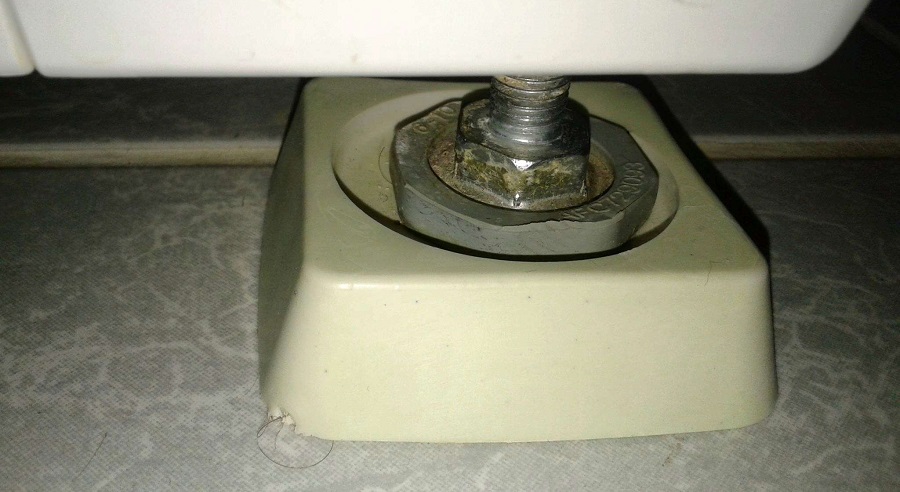
- purchase special anti-vibration stands for the machine;
- leave one side wall of the refrigerator free of cabinets and appliances.
Ideally, all kitchen appliances should be spaced at least 30-50 cm apart, separated by cabinets. If space is limited, the washing machine can be placed closer to the refrigerator. The key is to provide a stable base and leave a gap of 5-10 cm.
Interesting:
Readers' comments
Headings
Washing machine repair




For buyers




For users


Dishwasher




Add a comment