
My Samsung washing machine isn't draining properly.
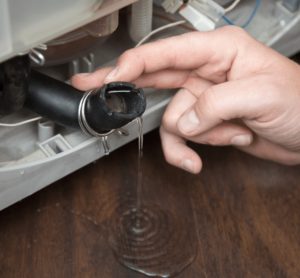 If your Samsung washing machine isn't draining properly, your scheduled wash cycle will likely be interrupted. Drainage that's too slow or completely stopped is a serious issue that requires immediate attention. Regardless of the scale of the problem, you can resolve it yourself at home. We recommend you don't delay and begin troubleshooting using the step-by-step instructions.
Why is drainage difficult?
Drainage problems can occur for a number of reasons. Some are simple and easy to fix, while others are more complex and require significant effort and additional investment. Therefore, before any repairs, we conduct a preliminary diagnosis and isolate the problem.
The following faults can cause the drain to stop or slow down.
- Clogged waste filter. The plastic spiral of the waste filter is the first obstacle water encounters as it flows from the washing machine drum into the drain. This is where most of the dirt and debris settles: keys, coins, and paper left in the laundry, as well as stuck-on hair and torn buttons. If the filter has not been cleaned for a long time, the hole becomes completely clogged, and the equipment stops draining the waste liquid. Avoiding trouble is easy – you need to carry out preventative cleaning regularly.
- A clogged drain hose. This is caused by a thick layer of scale and soap on the walls of the corrugated hose. Drainage is often obstructed by the hose being pinched when moving the appliance to a new location.
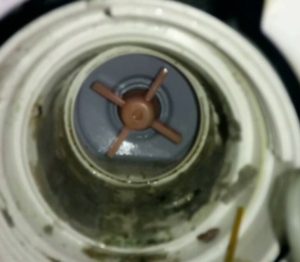
- Pump failure. The "heart" of the drainage system is the pump, which forces water out of the drum and through the pipes, first into the hose, and then into the sewer. If the pump fails, the liquid remains static. Malfunctions can be caused by a manufacturing defect, a worn part, or a blocked impeller (hair or threads often become tangled around the blades). Troubleshooting involves inspecting the entire unit, starting with the impeller and debris filter.
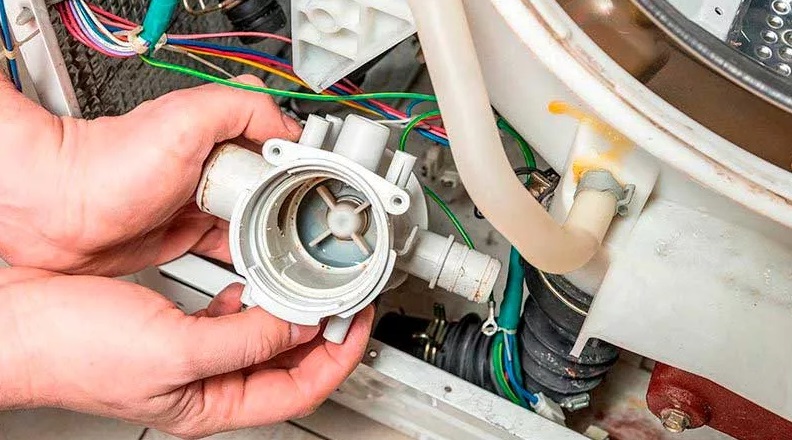
- Control board failure. The drum won't empty if the control module, due to burned-out microcircuits or a system failure, is unable to transmit a signal to the pump to begin draining. The solution is to repair or replace the electronic unit.
- The pressure switch is faulty. The level sensor often malfunctions, failing to indicate how full the drum is. In this case, the board doesn't receive a signal to drain and doesn't start the pump.
- Incorrect hose installation. To ensure water drains smoothly, the drain hose must be properly attached to the washing machine. Failure to do so can result in a "siphon effect," where a cushion of air prevents liquid from exiting the drum, despite the pump's efforts. The hose length is also important: exceeding the recommended 1.5 m will result in difficulty with proper drainage.
- Faulty wiring. Sometimes, improper installation of the washing machine can prevent drainage. For example, placing the washing machine on an uneven surface can cause strong vibrations, which can damage the internal wiring. In this case, professional intervention is required.
Typically, most problems can be fixed on the spot by lifting the hose or cleaning the drain filter. However, you should empty the washing machine's drum first. Our step-by-step instructions will help.
How to remove water from the tank?
If the water does not drain from the drum automatically, you will have to do it yourself. On Samsung machines, the forced (emergency) drain procedure is no different from the standard one. Instructions on what to do are as follows.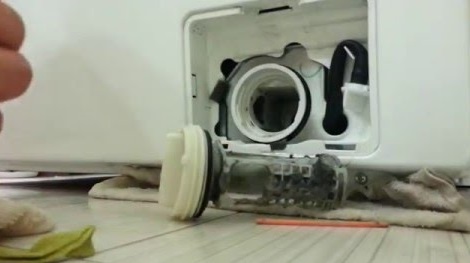
- Find the technical hatch in the lower right part of the machine body.
- Bend the door, place a container under the hole and unscrew the “trash can”.
- Tilt the machine forward and hold it until all the water has drained from the machine.
Emergency drainage in Samsung washing machines is carried out through the opening of the waste filter.
If the water doesn't drain, you should first clean the pipes leading to the filter. It's possible the hoses could be clogged. If this doesn't help, you'll have to insert a hose into the drum and pump out the liquid using a third-party pump.
Is DIY repair justified?
Before attempting to fix the problem yourself, you should assess the scope and extent of the problem. Almost any Samsung washing machine owner can clean the debris filter and adjust the hose, and many can replace and repair the pump and impeller, but diagnostics of the control board and wiring should only be performed by professional repairmen. Remember that modern washing machines have complex software that can be easily damaged by careless intervention.
When repairing a Samsung washing machine, remember safety precautions: disconnect the machine from the power supply and water supply!
It's better not to take risks or experiment, and at the first sign of a breakdown, contact a Samsung service center for advice.. It is prohibited to open the case and carry out repairs if the washing machine is under warranty or under voltage.
Interesting:
Readers' comments
Headings
Washing machine repair




For buyers




For users


Dishwasher




Add a comment