
Can you mix different washing powders?
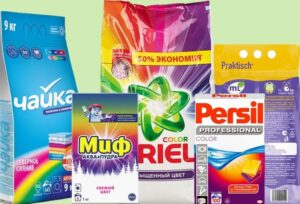
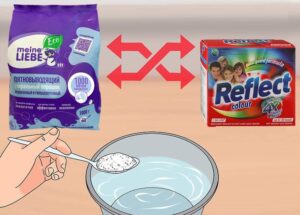 From time to time, housewives wonder whether it's possible to mix laundry detergents from different brands. Sometimes, several nearly empty packets accumulate in the closet, but if you pour all the granules into one package, there's just enough detergent to start a cycle. On the one hand, what's so special about that? On the other, users worry about whether such a combination will harm their clothes. Let's explore the nuances.
Will a mixture of different powders harm the fabric?
Most experts agree that mixing laundry detergents is not a good idea. This applies specifically to household chemicals of different brands and with different performance characteristics. Some manufacturers conduct such experiments when creating laundry detergents to protect consumers from unexpected results.
Experiments have shown that when using powders of different brands and for different purposes at the same time, washing efficiency usually decreases.
What explains this? Particles in powders designed for different purposes can neutralize each other. For example, this would happen if you mixed a light-duty laundry detergent with a product designed for tough, stubborn stains. In such a situation, it would be difficult to remove heavy stains.
When combining detergents from different brands, it's impossible to accurately predict the final result. At best, you'll make a "discovery," and your ratio will remove even the most stubborn stains. At worst, you could ruin the item. Another possibility is that the laundry simply won't be cleaned because the ingredients neutralize themselves and fail to work.
What conclusion can be drawn? It is definitely not worth mixing powders designed for different types of fabrics. After all, you often see the following warning on the packaging: "Not recommended for use with other laundry detergents." And it's worth heeding the manufacturer's advice.
Let's look at the ingredients carefully
Some ordinary people disagree with the experts' opinion. They claim that mixing laundry detergents with identical ingredients is safe. In fact, many housewives do this periodically, and nothing serious happens. Laundry is washed properly, fabrics are not damaged, and clothes retain their shine.
According to the general public, mixing detergents from different brands but with the same composition is possible—such a “collaboration” does not harm clothes in any way and does not reduce the effectiveness of washing.
This seems logical, but how likely is it to find detergents with identical ingredients? Let's take a look at the ingredients in the most popular laundry detergents. By looking at the list of ingredients, it will become clear whether mixing is acceptable or not.
For example, the composition of the powder "Sarma Avtomat":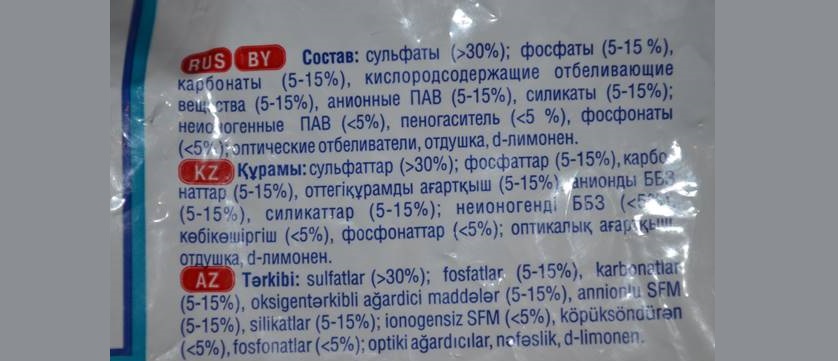
- sulfates up to 30%;
- phosphates from 5 to 15%;
- carbonates 5-15%;
- active oxygen based bleaching particles up to 15%;
- APAV 5-15%;
- Nonionic surfactants up to 5%;
- silicates 5-15%;
- foam neutralizer;
- phosphonates;
- optical brightener;
- flavoring agent.
The equally popular Ariel Color Machine consists of: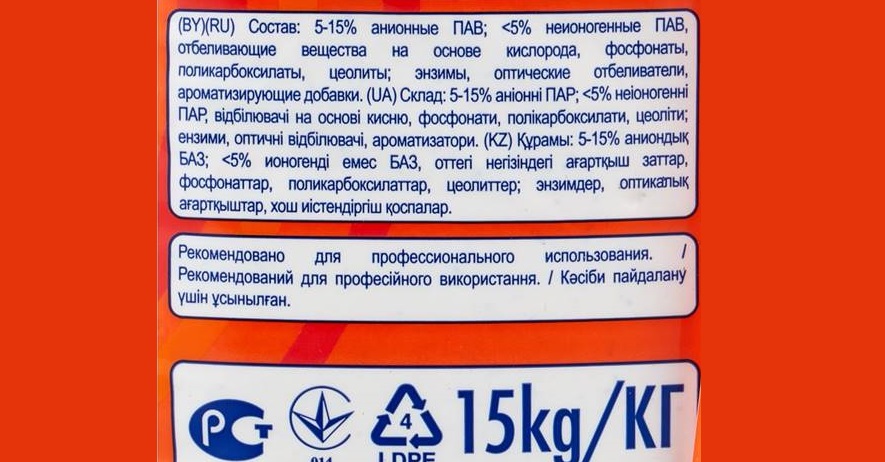
- APAV 5-15%
- Nonionic surfactants up to 5%;
- phosphonates;
- polycarboxylates;
- zeolites;
- enzymes;
- flavoring additives.
The composition of Tide for automatic machines includes:
- 5-15% anionic surfactants;
- up to 5% nonionic surfactants;
- oxygen bleach;
- phosphonates;
- zeolites;
- enzymes;
- polycarboxylates;
- optical brighteners;
- fragrance.
A look at the ingredients of Tide and Ariel laundry detergents reveals that they are completely identical. The only difference is that Tide contains bleaching agents. Otherwise, the similarities are obvious, so many consumers mix the granules without fear.
The next powder for comparison is Aistenok Avtomat. It contains: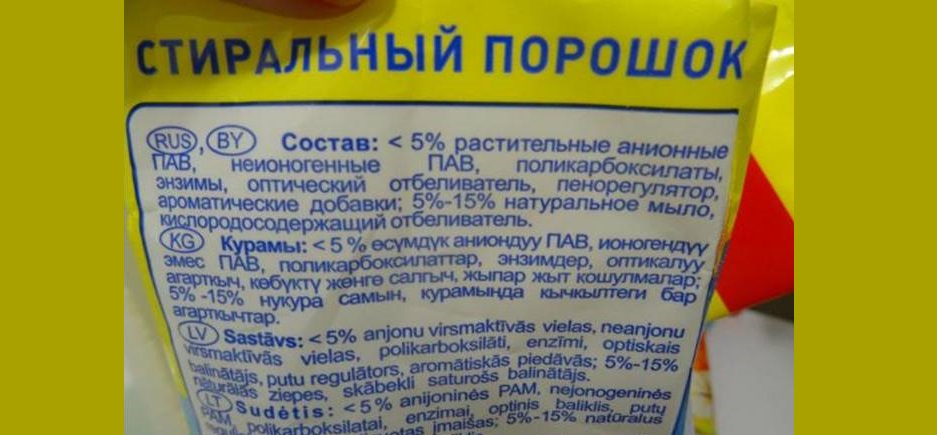
- up to 5% plant-based anionic surfactants;
- nonionic surfactants;
- polycarboxylates;
- plant enzymes;
- optical brightener;
- foam level regulator;
- fragrance;
- 5-15% natural soap;
- whitening particles with active oxygen.
Another popular powder is Losk Avtomat. Its main components are:
- 5-15% anionic surfactants;
- active oxygen bleach;
- up to 5% nonionic surfactants;
- polycarboxylates;
- phosphonates;
- enzymes;
- optical whitening particles;
- flavoring agent.
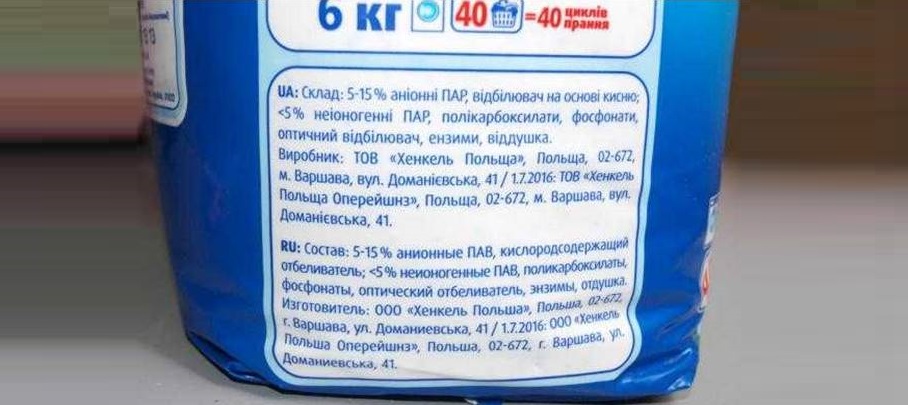
What conclusion can be drawn? Many mass-market washing powders have similar compositions. For example, Losk and Tide Automatic granules are 90% identical.
This is why most ordinary people disagree with the experts and periodically mix detergents from different brands. And if it's Tide and Lock Automatic, or Aistenok and Sarma, designed for machine washing, nothing bad will happen. Because the granules have very similar compositions.
But even ordinary people understand that you can’t mix powders with different spectrums of action, for example:
- for machine and hand washing;
- for cotton and silk products;
- for bleaching light-colored clothes and maintaining the color of bright linens.
The decision whether to mix detergents from different brands is entirely up to you. It's one thing to use a more powerful detergent for lightly soiled laundry. It's quite another to use a mixture with delicate wash granules to remove tough stains. In this case, the desired effect won't be achieved.
Many people mix leftover detergents into their laundry detergents, such as floor mats and pet bedding, without fear of damaging the item. In this case, there are no restrictions. The main thing is that the granules are effective in removing the existing stains.
Recommendations from experts and manufacturers differ from those of the average person. Still, many homeowners do things their own way, mixing granules. However, it's important to understand that the results of such a "collaboration" are unpredictable. Therefore, it's better to throw away the remaining 50-100 grams of powder than to risk your favorite items.
Interesting:

Readers' comments
Headings
Washing machine repair




For buyers




For users


Dishwasher




Add a comment