
How to remove the drum from a Samsung washing machine?
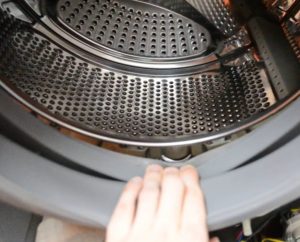 The drum of a Samsung washing machine may need to be removed if the machine is faulty and requires repair, or if it's irreparably broken and can be disassembled. In any case, disassembly must be performed carefully and consistently to avoid damaging the drum and other parts of the washing machine. To reduce risks and avoid any surprises, it's best to follow the instructions.
Don't rush into work
Removing the drum from a washing machine without damaging it completely is easy. The key is to proceed consistently and prepare thoroughly for disassembly. This preparation process necessarily includes the following steps:
- determine the location for disassembly;
- study the washing machine instructions, electrical diagram and other technical documentation;
- collect the materials and tools necessary for the work;
- prepare the equipment for the upcoming disassembly.
The first step is to find a suitable space for disassembly. It should be spacious, ventilated, and well-lit, with at least 4 square meters of free space. Ideally, it's recommended to move the washing machine to a garage or workshop. The floor must be covered with rags or old newspapers, which will help avoid “flooding” and severe contamination.
When disassembling your Samsung washing machine, remember safety precautions!
Next, we prepare the inventory required for dismantling and subsequent repairs:
- a screwdriver or a set of screwdrivers (slotted and Phillips);
- a set of wrenches and an 8 mm Allen key;
- pliers;
- pliers;
- multimeter;
- impact wrench;
- hammer;
- chisel;
- marker;
- WD-40 lubricant-cleaner;
- sealant;
- CV joint type grease;
- rag;
- a basin or other container.
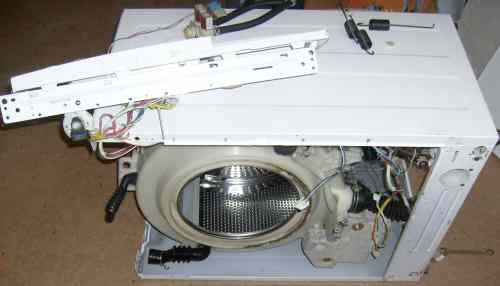
If you plan to reassemble the machine, it's best to take video or photographic documentation. This makes it easier to track your actions and restore the machine to its original condition by reversing the process. We'll discuss the disassembly process below.
Step-by-step instructions
Disassembling a Samsung washing machine and removing the drum is easy if you proceed carefully and consistently. Once you've gathered all the tools and materials, you're ready to begin. The key is to follow the instructions.
- Disconnect the washing machine from the power supply, water supply and sewerage system.
- Remove the cover. Using a Phillips-head screwdriver, unscrew the screws holding the top panel in place on the back of the case. Then, push the panel away from you and pull it up.
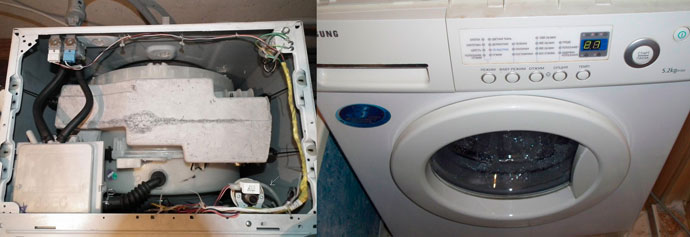
- Remove the dashboard. To do this, you need to loosen all the provided fasteners. The first are located under the detergent dispenser, while the others are located around the perimeter of the control unit. There's no need to disconnect the wiring; simply place the "board" carefully on top of the machine or hang it on the special hook on the side. However, if desired, you can label, photograph, and disconnect the wires.
- Remove the access door. It's located in the lower right corner of the case and conceals the debris filter. To remove it, simply pry the panel up with a flat-head screwdriver. Be prepared for residual water to leak out of the opening (it's a good idea to place a container or a rag nearby).
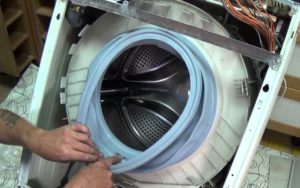
- Unhook the front panel. First, loosen the metal or plastic clamp on the hatch seal by prying it up with a screwdriver, then bend the seal toward the inside of the drum. Then, unscrew all the screws around the perimeter of the panel and unhook it from the machine body by 2-3 cm. Through the opened space, disconnect the line from the door locking system or remove the locking system completely.
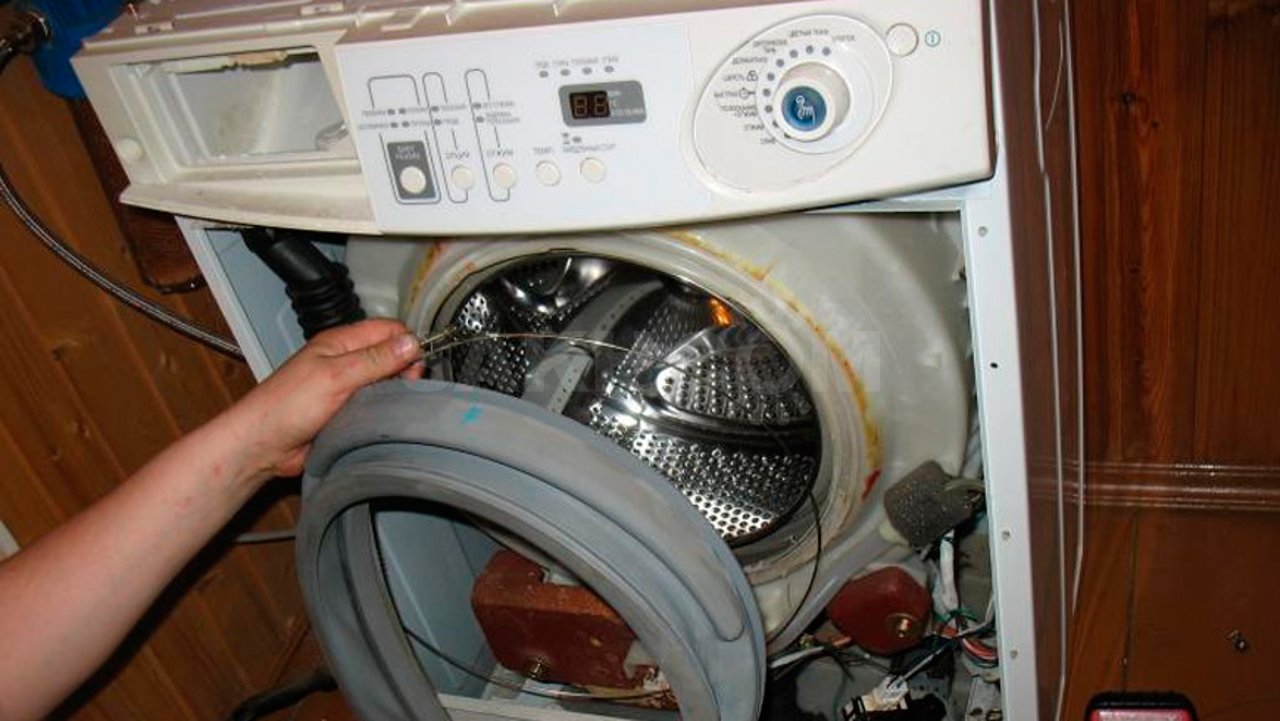
- Remove all remaining obstructions. Disconnect all wires leading to the drum from the heating element, electric motor, pump, and other sensors. Also, remove the inlet valve and pressure switch from the unit, and then remove the hose connecting the tank and the detergent drawer. It is necessary to act with the utmost care so as not to damage the elements.
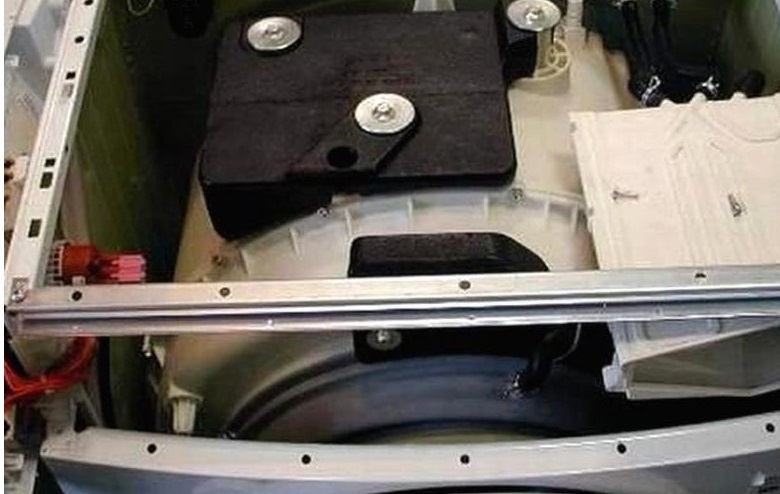
- Remove the counterweights. Most modern Samsung models have two concrete blocks located under the top cover of the machine. Remove the bolts holding them in place. Be careful—the concrete is extremely heavy.
- Remove the shock absorbers. First, unscrew the lower shock absorbers or dampers securing the tank. Second, remove the springs holding the drum from above.
Be prepared for the fact that the Samsung washing machine tub is heavy: it is better to enlist the help of an extra pair of hands.
After removing the tank from the unit, place it on a flat, dry surface with the pulley facing up. Then, loosen the motor clamp and remove the engine, disconnecting the drive belt.
When disassembling your washing machine, it's recommended to perform a comprehensive diagnostic and check all components for proper functionality. A multimeter can be helpful for this, as it can be used to test all electrical components. You can also clean components that quickly become dirty, such as the heating element, hoses, pump impeller, dispenser, and debris filter.
The final stage of work
Removing the tank is only half the job. Next, you need to open it and remove the drum from its "casing." But before you get started, you should determine the tank's connection method and the material it's made of. This will make disassembly faster and less likely to cause any unwanted consequences.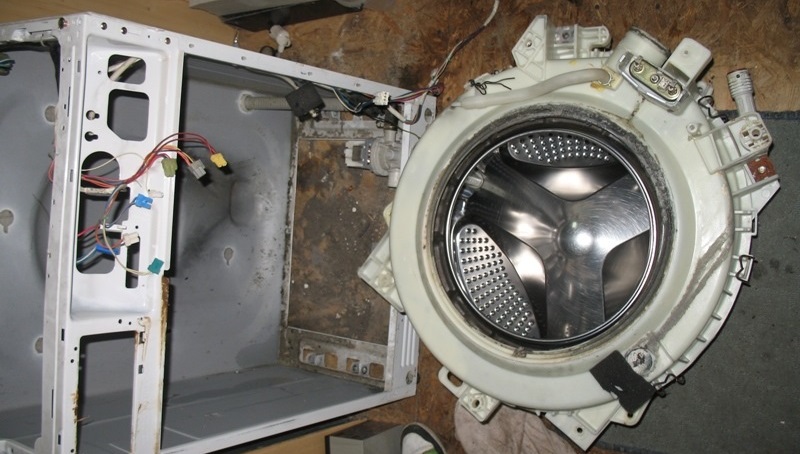
Samsung typically produces washing machines with plastic and detachable tanks, which simplifies disassembly. To separate the tank, you'll need to unhook the clamps or remove the screws around the perimeter. The former can be removed with a flathead screwdriver, while the latter requires a power drill.
Next we proceed as follows:
- we unhook the lower half of the tank (where there is no crosspiece and pulley);
- remove the pulley from the tank by unscrewing it with a suitable wrench;
- we insert a bolt into the vacated space and use a hammer to knock it out in the opposite direction;
- We generously treat the hole with WD-40 cleaner.
If you cannot knock out the shaft, then the joint must be thoroughly treated with WD-40 lubricant and left for 15-20 minutes.
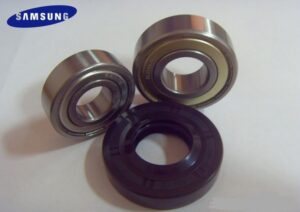
That's it, the drum has been successfully removed from the washing machine and tank. If the goal was to repair or replace the bearing assembly, then after the work it is recommended to replace the lubricant and treat all joints with silicone sealant. The container from the non-working equipment can be used for other purposes, turning it into something useful.
Interesting:

1 reader comment
Add a comment
Headings
Washing machine repair




For buyers




For users


Dishwasher




Great, thank you so much. I took it apart and will be replacing the bearing.