
How to remove the motor on a Bosch washing machine?
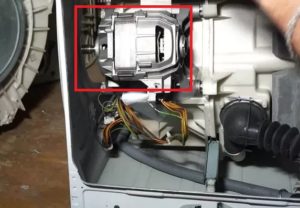 Knowing how to remove a Bosch washing machine motor is essential for every machine owner. Without this procedure, you won't be able to repair or replace the motor yourself; you'll have to hire a technician or buy a new one. However, the procedure isn't particularly difficult—even a novice can figure it out. Just prepare your tools in advance and follow the instructions.
Features of engine dismantling
Removing the motor from a washing machine is much easier than removing the bearings or disassembling the drum. But even this routine procedure requires knowledge and skill, as careless actions can lead to disastrous consequences. To avoid "surprises", it is recommended to act in a strictly specified order:
- disconnect the washing machine from the power supply and water supply;
- move the unit away from the wall or turn it so that the back is facing you;

- remove the back cover of the case by unscrewing the corresponding bolts;
- remove the drive belt by pulling it towards you and turning the pulley wheel;
- find the engine located under the tank;
- Use a T-20 socket head to tighten the two screws holding the electric motor;
- carefully place the washing machine on the side where the detergent tray is located;
- disconnect the ground and the terminal with wires from the engine;
- Use a screwdriver to pry the motor up, moving it forward;
- remove the engine from the grooves and, while rocking, remove it from the housing.
When disassembling a washing machine, observe safety precautions: wear gloves and disconnect the appliance from the power supply.
Be prepared for the electric motor to be heavy—it can weigh several kilograms. Remove the motor from its housing and place it in a dry, level area. It's now ready for inspection and repair.
Changing carbon brushes
Most often, motor repair involves replacing the brushes. They wear out faster; more precisely, their carbon tips wear down during the washing machine's operation, smoothing out the friction force emitted by the device. Replacing the old ones with new ones is easy—just find the rods, remove them, and replace them.
It is recommended to record all your actions with a photo or video camera to avoid mistakes and incorrect connections during reassembly.
There's no need to delve into the motor's internals. Carbon brushes are easy to find; they're located directly on the motor, on both sides of the housing, and have a simple design. It's hard to confuse them—they're rectangular casings with an electrical wire and spring attached.
Removing the brushes from the housing is easy. Here's how:
- Using a flat-head screwdriver, pry up the terminal of the connected wire and disconnect it;
- move the brush contact down;
- compress the spring;
- we take out the brush.
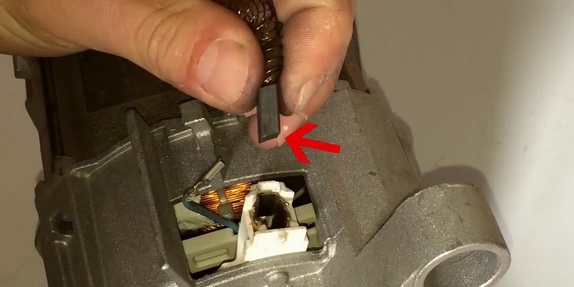
Don't rush to throw away the brushes; they're likely intact, and the problem isn't with them. To assess the condition of the rods, disassemble each case, inspect, and measure the carbon tips. If the tips are less than 1.5-2 cm long, they need to be replaced. Replace the intact ones.
Electric brushes are always changed in pairs, even if the second one has hardly worn out. A replacement is selected based on the serial number of the washing machine or motor. Ideally, you should remove the old brushes and bring them to the store for a sample. Don't just randomly select parts—the configuration, size, and design of the brushes depend on the Bosch model and vary greatly.
Electric brushes are always changed in pairs, even if one of them has a tip longer than 2 cm.
New carbon tips are installed in reverse order:
- we insert the first brush into the engine crossmember from where the old one was removed;
- compress the spring and insert it into the seat;
- we fix the terminal in the clamps of the upper part;
- we move the terminal towards the wire, securing the brush.
All that's left to do is attach the connector with the wire to the terminal. Then, take the second brush and secure it to the motor in the same manner. Finally, check the tightness of the contacts and fasteners, then reinstall the motor according to the instructions described earlier. Don't forget to start the washing machine to check the motor's performance. If the machine hums smoothly and the drum rotates, everything has been done correctly.
A washing machine's motor is a key component that requires proper testing and repair. This can extend the machine's lifespan and save you a significant amount of money.
Interesting:

Readers' comments
Headings
Washing machine repair




For buyers




For users


Dishwasher




Add a comment