The washing machine is protected from vibrations and bounces around the bathroom by large concrete blocks, which counteract the resulting centrifugal force and hold the unit in place. These heavy elements are called counterweights, and despite their rigidity and apparent stability, they often cause problems. For example, it's often necessary to tighten the retaining blocks, replace a cracked block with a whole one, or temporarily remove it while completely disassembling the machine. We'll explain how to do this in detail in this article.
How to get to the counterweight?
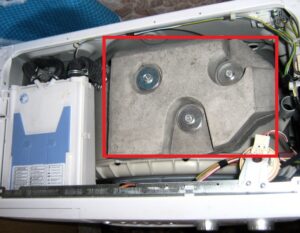
To tighten or remove the counterweight in a washing machine, you'll need to find it. Luckily, finding a solid concrete block or three separate pieces is easy. Just follow these instructions.
Turn the machine over with its back wall.
Unscrew the top cover of the machine.
Remove the back panel.
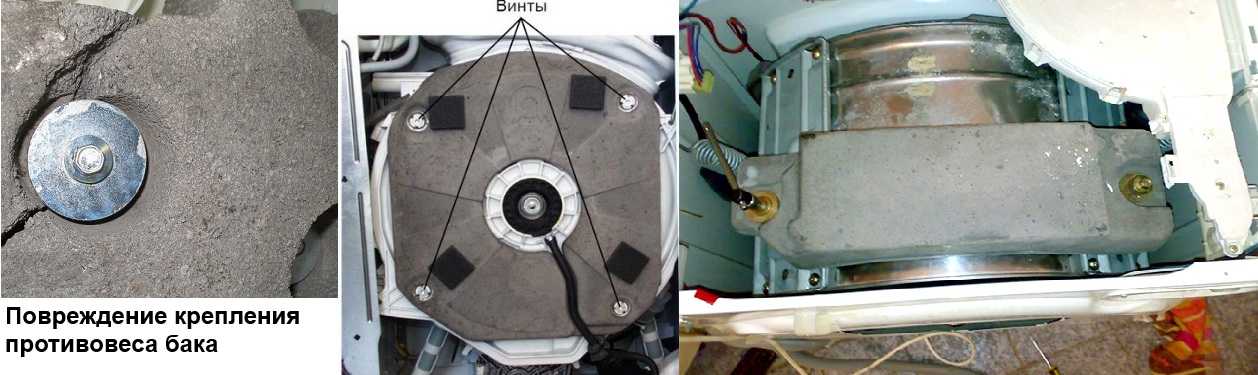
The counterweight may crack, split, or become loose, which will cause imbalance and lead to serious damage to the machine.
That's it, all that remains is to visually check the condition of the counterweights. In addition to a superficial inspection, you can pull on the stone inserts and check the tightness of the fasteners. It is recommended to conduct such “checks” at least once every 6 months in order to promptly identify any problems and carry out the necessary repairs.
Dismantling the part
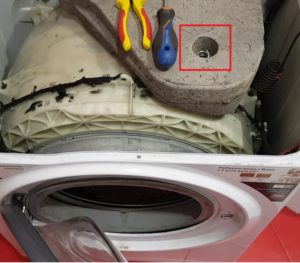
If you need to temporarily or permanently remove a stone from a washing machine, start by loosening the fasteners—two or three wide bolts on each concrete block. Find an open-end wrench or socket wrench of a suitable diameter and completely unscrew the fasteners from the block. Then, grasp the counterweight protrusions and carefully lift them out. Keep in mind that these blocks weigh between 5 and 15 kg, so consider bringing an extra pair of hands.
Owners of Indesit washing machines will have a slightly more difficult time. The counterweights are secured with special bolts that don't fit standard wrenches and sockets. But there's a solution: make your own tool. To do this, take a pipe with a cross-section of 20-22 mm and a length of at least 20 cm and saw a 5 cm deep hole in the middle of one end. Drill a 2 cm hole at the other end and screw in a 4 x 16 mm bolt, then weld a screw from the inside. This tool will easily hook onto the retainer and make removing the blocks easier.
If the counterweight is damaged
Counterweight diagnostics are crucial, as if it's damaged, the safe operation of the machine cannot be expected. Weak or cracked counterweights will not dampen vibrations from the drum's rotation and will cause imbalance with devastating consequences. Therefore, if any abnormalities are detected, repairs must be initiated immediately.
So, if the concrete-retaining bolts have sagged and tightening them doesn't help, check the grommet screws. These components compress and loosen over time, which affects the counterweights' stability. It's best to replace the tie rods and tighten the screws securely.
You should not continue to operate the machine with a cracked counterweight, especially if a large piece has fallen off. All components must be removed immediately, their dimensions precisely measured, and a suitable replacement must be found. There shouldn't be any problems finding a new "cargo": you can order it using the model's serial number in an online store, make it yourself based on your measurements, or contact specialized technical centers..
Finding the counterweight in a washing machine, inspecting it, and removing it if necessary is very simple. All you need is a suitable wrench and the strength to handle the heavy load.

 The washing machine is protected from vibrations and bounces around the bathroom by large concrete blocks, which counteract the resulting centrifugal force and hold the unit in place. These heavy elements are called counterweights, and despite their rigidity and apparent stability, they often cause problems. For example, it's often necessary to tighten the retaining blocks, replace a cracked block with a whole one, or temporarily remove it while completely disassembling the machine. We'll explain how to do this in detail in this article.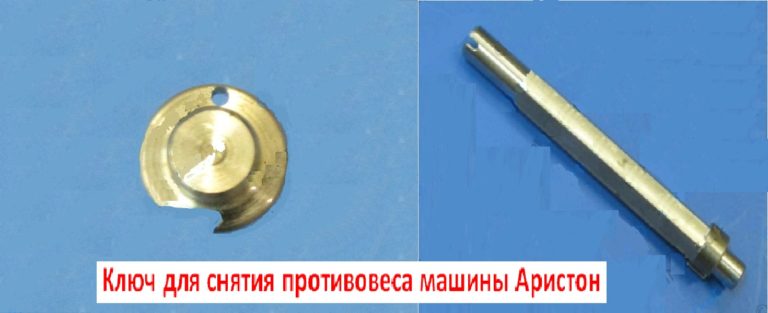














Add a comment