
Do I need to add salt if I use Finish dishwasher tablets?
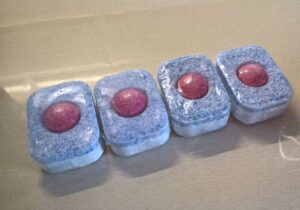 Many users are wondering whether they need to add salt to their dishwasher when using Finish tablets. The detergent packaging states that the 3-in-1 capsules already contain both salt crystals and rinse aid. Let's explore whether this saving is worthwhile and whether it will harm your dishwasher.
Should I add additional salt to the dishwasher tank?
To answer this question, we need to understand why salt is needed in the first place. It's needed to regenerate the resin in the dishwasher's ion exchanger. Salt crystals soften tap water, protecting the machine from scale and limescale build-up.
The harder the water in your pipes, the more intensively the dishwasher's ion exchanger works, and the more salt it will consume. You can find out your water hardness level by calling your local water utility. It's also easy to measure at home using special test strips.
Salt consumption is manually adjusted by the dishwasher user. Once you know the water hardness level, turn the mechanical switch on the dishwasher to the desired setting. The softener adjustment process is described in more detail in the equipment manual.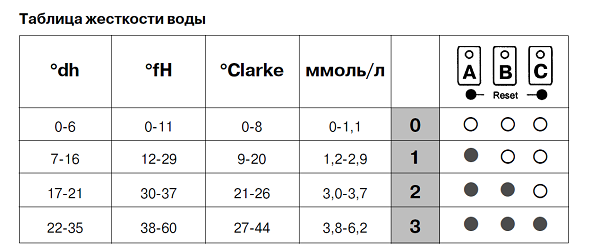
There are several regions in Russia with soft tap water. Those lucky enough to live there don't need to use salt at all. In this case, it's acceptable for the ion exchanger to not work. You can even skip the 3-in-1 multi-purpose tablets and buy the cheapest detergent and rinse aid—it won't hurt your machine.
If your water is moderately hard, using 3-in-1 salt tablets is sufficient. There's no need to add additional salt crystals to the dishwasher's water supply. The capsules will maintain the ion exchanger's functionality.
If your water has high water hardness, it's essential to use special salt in addition to 3-in-1 tablets. In this case, it's best not to skimp, as this will cause the dishwasher to malfunction more quickly. Users should properly adjust the dishwasher's softener and remember to periodically refill the salt dispenser.
You may not need to use salt in addition to 3-in-1 tablets in regions with low or medium water hardness.
If you live in a region with hard water, it's best not to skimp on salt. The salt granules contained in 3-in-1 tablets won't be enough to ensure the proper functioning of the ion exchanger. This will quickly cause it to fail, requiring costly dishwasher repairs.
An inexpensive replacement for special salt
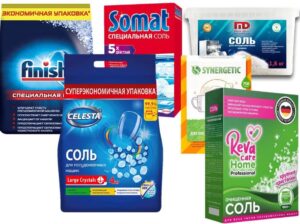
In principle, a special regenerating agent for dishwashers is inexpensive. One and a half kilograms of salt Finish can be purchased for $1.70–$1.80. A package of this volume will last, on average, six months.
However, many users are looking for any way to save money, so they try to find an even cheaper substitute for special regenerating salt for dishwashers. As an alternative, housewives choose:
- regular table salt;
- sea salt;
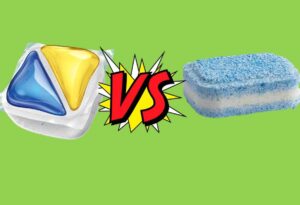
- table salt tablets.
Regular table salt is not the best substitute. It contains impurities that are harmful to the dishwasher's ion exchanger. Furthermore, it dissolves poorly and tends to cake in the dishwasher tray.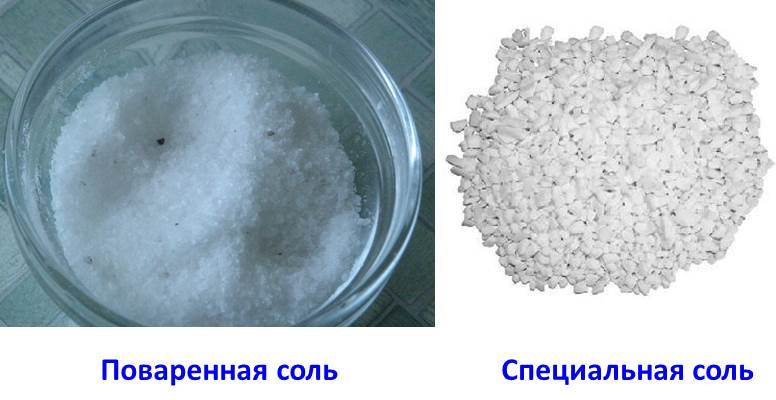
Sea salt is also not a good choice. It contains even more harmful impurities—about 80 minerals—that shouldn't be allowed into the dishwasher's ion exchanger. After just 1 kg of these crystals pass through the dishwasher's softener, it will lose 90% of its functionality and simply stop working.
Table salt tablets aren't the best option for dishwashers, but they're acceptable. They're very inexpensive—a 25-kg bag can be purchased for next to nothing—they don't cake in the tank, and there's no evidence that they're harmful to the ion exchanger. Since regenerating salt is relatively inexpensive, it's best to avoid shortcuts and instead buy a special dishwasher detergent.
Interesting:
2 reader comments
Add a comment
Headings
Washing machine repair




For buyers




For users


Dishwasher




How is the composition of tablet salt dangerous for the PMM ion exchanger, if tablet salt is intended for whole-house or cottage water softening stations, where it performs the same function—regenerating the ion-exchange resin?
While writing this article, the author made a semantic error in the text. The error has been corrected. Indeed, salt in water softening tablets is used in dishwashers, and dishwasher manufacturers have not proven that it harms the ion exchanger in dishwashers. Thank you for your attention!