
What is the resistance of a washing machine temperature sensor?
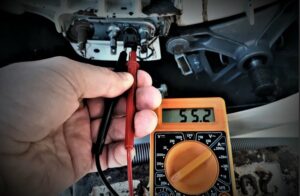 Washing machine repair technicians rarely have to replace temperature sensors. They rarely fail. However, if the machine breaks down, and all the signs point to this particular component, a thorough inspection is performed with a multimeter. Before adjusting it, it's important to check the temperature sensor's resistance; otherwise, identifying the cause of the failure will be difficult.
Normal readings of sensors of different CM
The range of models and brands of automatic washing machines is vast. Manufacturers equip them with various sensors. Here are the characteristics of the most common ones:
- AEG, Zanussi, and Electrolux appliances (EWM 1000 PLUS and 2000): the resistance of the temperature sensor should be maintained at 6.0 kOhm. After heating to +800 With it drops to 0.5 - 0.7 kOhm. For Electrolux machines produced in the EWM 1000 series, the indicators should be different: at room temperature - 17 kOhm, when it increases to +850 C – 2.1 kOhm – 2.5 kOhm.
Important! From here on, resistance values for temperature sensors for all appliance models are given at room temperature. For some brands, heating values are specified separately.
- Candy washing machines: the multimeter determines the resistance as 27.0 kOhm.
- Siemens, Hansa, Bosch devices: the temperature sensor resistance should normally be approximately 4.8 kOhm.
- Machines produced by the brands Atlant, Beko, Ardo have a temperature sensor resistance of 5.6 to 5.8 kOhm at a temperature of +220 C. At the same time, some Ardo brand models have higher values, around 21.5 kOhm.
- ASKO appliances typically exhibit the following characteristics: separately installed sensors have a resistance of 40 to 60 kOhm, while some devices have a resistance of 20 kOhm. Temperature sensors integrated into heating elements differ from previous models; their resistance should be around 13 kOhm.
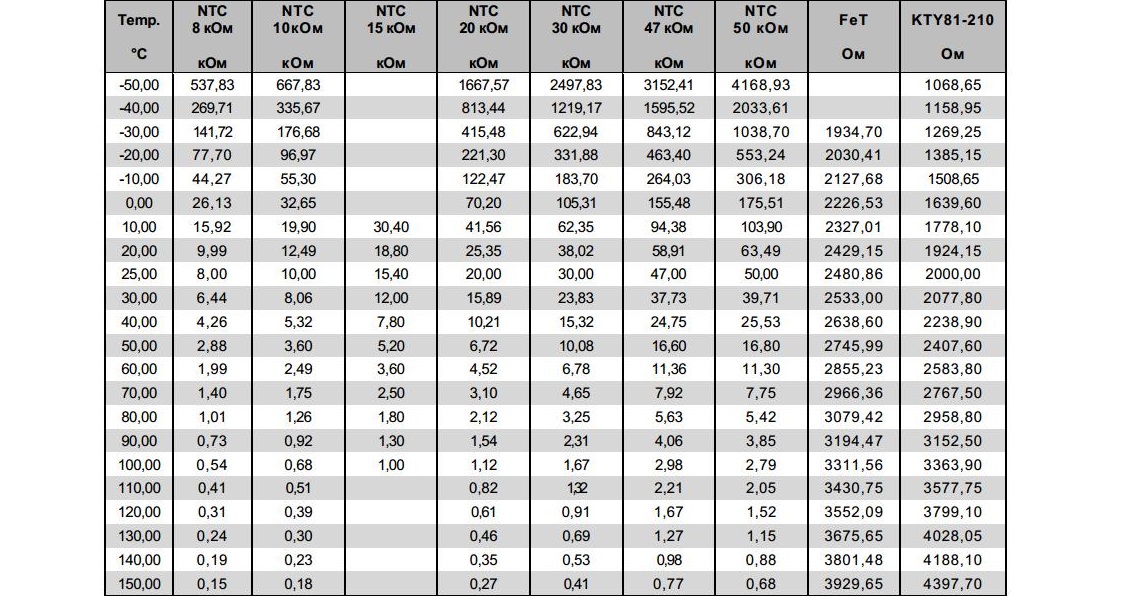
- For most Samsung washing machine models, the manufacturer specifies 12 kOhm.
- Ariston and Hotpoint/Ariston appliances, as well as Indesit, have different temperature sensor resistance values. For these models, a resistance of approximately 20 kOhm is considered normal. Standalone appliances can be installed at 200 kOhm.
- Whirlpool automatic machines should show a resistance reading of 35.9 kOhm when measuring the resistance of their temperature sensors. Some models show different readings, sometimes around 12 kOhm.
- Models produced under the Brandt and Thomson brands have sensor resistance at a temperature of +200 At 50 kOhm level.
- The manufacturer of LG appliances also produces temperature sensors with readings of about 50 kOhm.
The parameters given here characterize the most common brands and models. However, when replacing a sensor, you cannot be completely sure that a part with the specified resistance is suitable for a particular washing machine.To make the right choice, you should contact an experienced specialist.
Where to look and how to test the sensor?
To check if the sensor in the washing machine is working properly, you need to determine its location.
As with any dismantling, repair, or replacement work, you should begin by disconnecting the device from the power supply.
Now you can begin disassembling the machine. The easiest way to remove it is the thermistor. It is located inside the heating element. In most popular models of automatic machines, the heating element is located in the lower part of the body, near the base. To remove the thermistor, follow these steps: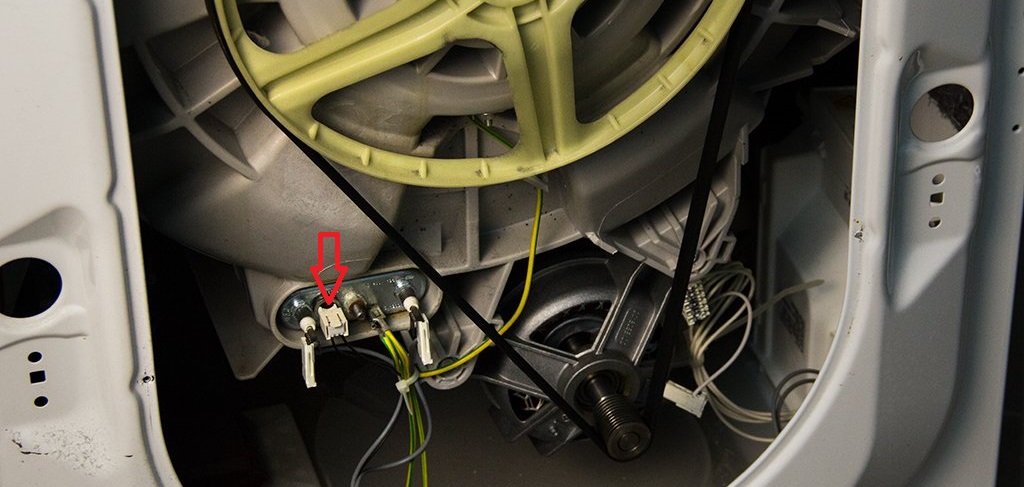
- remove the back panel from the device;
- find the sensor and disconnect the wires leading to the external temperature controller;
- slightly loosen the screw holding the heating element;
- remove the thermistor.
To check it, you need a multimeter. It can be used to measure the resistance. This can be done as follows:
- set the measuring device to determine resistance;
- connect the probes to the contacts of the temperature sensor;
- Next, you can test its functionality: immerse the thermistor in heated water and check the multimeter readings. They should be close to those shown in the previous section.
A faulty temperature sensor must be replaced. It cannot be repaired. To install a new part, follow the instructions for removing the thermistor, but in reverse order.
Interesting:




Readers' comments
Headings
Washing machine repair




For buyers




For users


Dishwasher




Add a comment