
How to hide washing machine hoses
 To ensure the machine operates properly, the electrical and water lines must be properly positioned so that nothing pinches them or interferes with their operation. In this article, we'll explain how to hide your washing machine hoses while maintaining their functionality.
Basic rules
When planning the installation, first consider that the back of the washing machine has numerous protrusions. Even if you think you've allocated enough space for the cables, they can get caught on these protrusions and become damaged or pinched. This is unavoidable! Therefore, people typically leave about 10 cm between the back of the machine and anything behind it (furniture, a wall). In extreme cases, 5-8 cm is possible, but this will make it more difficult to route the hoses correctly.
Important! The drain hose has some installation requirements. For example, it must have a bend, and the hose itself must be positioned at a certain height from the floor. Take this into account when planning.
If you're unable to find even 5-8 centimeters of space for wires and hoses, installing a washing machine in that space is unlikely. Even if you do manage to fit it, it won't work. Redesign the installation and find a more suitable location for your machine.
Solutions from the experts
It's difficult to find specific recommendations online, as technicians typically require machine dimensions, room parameters, and so on, so they can tailor their approach. However, we've tried to gather some general information that applies to any machine and any room.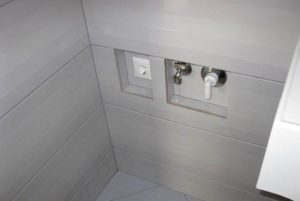
Typically, people prefer to install their washing machine in the bathroom. In this case, there are several recommendations suitable for any type of machine and any space. For example, some experts recommend placing the washing machine with its side facing the bathtub and its back facing the wall so that the drain hose and water supply hose can be pulled out under the bathtub. This way there will be enough space for the hoses and they will be hidden from view.
As for the electrical cable, it's much thinner and takes up less space, so you can leave just 4-5 centimeters between the rear of the car and the wall. This distance will be unobtrusive, and all utilities will be installed properly!
Some experts suggest covering the end of the bathtub, for example, with plasterboard boxes, where the hoses can be hidden. Another option is to brick up the end of the bathtub or cover it with a screen, and make holes in the resulting covering for the hoses. It all depends on what you prefer and which arrangement you find more aesthetically pleasing.
In some cases, due to small apartments or poorly planned layout, the washing machine must be installed sideways against the wall, leaving the back wall exposed with all its unsightly features. In this case, experts recommend connecting all hoses and wires to the utility lines and then covering the back wall with a curtain, either matte or in the same color as the washing machine. With proper installation, this will look very decorative, and all the wires and faucets will be hidden.
Some users prefer to install washing machines, for example, in the kitchen or hallway, where there are no objects like a bathtub that could conveniently hide the hoses. In this case, experts recommend installing the machine with the back against the wall, pre-drilling a hole in it. This way, everything will be hidden in the wall, eliminating the need to place the machine at a visible distance from the object behind it. Many DIYers also create plywood boxes to hide the wires and hoses. This is an interesting way to decorate an unsightly structure while still allowing you to place the washing machine where it's most convenient.
In any case, one must first consider ease of use, and only then the beauty of the appearance. However, if there is a way to hide unsightly wires and hoses, do it!
Interesting:


Readers' comments
Headings
Washing machine repair




For buyers




For users


Dishwasher




Add a comment