
The washing machine does not spin at full speed.
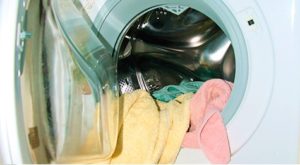 It's not uncommon for a washing machine to fail to spin. Everything appears to be fine, the machine continues washing, completing all stages of the program: wash, rinse, and spin. The program completes on time, and the self-diagnostic system remains silent, displaying no system errors. But something is still wrong. This becomes clear when we remove completely wet items from the drum.
It's understandable: if the drum speed drops or doesn't pick up at all, a proper spin cycle won't work. We'll try to figure out why this happens in this article. Just in case, we'll warn you beforehand: if you're having trouble with your appliance, it's best to contact a professional. Avoid tampering with the washing machine to avoid even bigger problems.
Problems with washing machine control
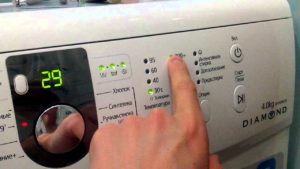
Some people have a hard time getting used to a new washing machine. There's nothing to be afraid of, just don't be overconfident and read the instructions first before trying. But more often than not, people start the wrong program, argue about why the new washing machine spins so much worse than the old one, and only then begin to figure out what's going on. There are some fairly common washing programs that run without spinning at all or with a low spin speed, for example:
- delicate fabrics;
- wool;
- silk;
- baby clothes.
If you accidentally select one of these programs, don't expect your washing machine to spin your laundry properly. Also, almost all modern washing machines have a "no spin" button or similar. If you accidentally press it or it was previously pressed, the washing machine will simply skip the spin cycle, regardless of the program you selected.
Some brands of washing machines have a special "no drain, no spin" button, which is specifically designed for situations where ultra-delicate items only need to be washed and rinsed.
Damage to the drive belt
The information in this section is intended for owners of washing machines with a drive belt and a commutator motor. If you have a washing machine with an inverter motor (for example, LG), you can skip this section. In washing machines with a drive belt, the commutator motor's speed is transmitted to the drum pulley via the belt. If the belt is not tensioned properly, slippage occurs, preventing the engine from spinning the drum to the required speed.
There are cases where the belt breaks or comes off, but then the washing machine won't run a single wash cycle, let alone spin. So, we'll only consider cases where the belt has simply stretched. To check the drive belt, follow these steps.
- We prepare the washing machine for disassembly and pull it out to a free place.
- Using a screwdriver, unscrew the fasteners that hold the back wall, after which the wall needs to be removed.
- We check the tension of the drive belt by trying to bend it with our hands and turn the pulley.
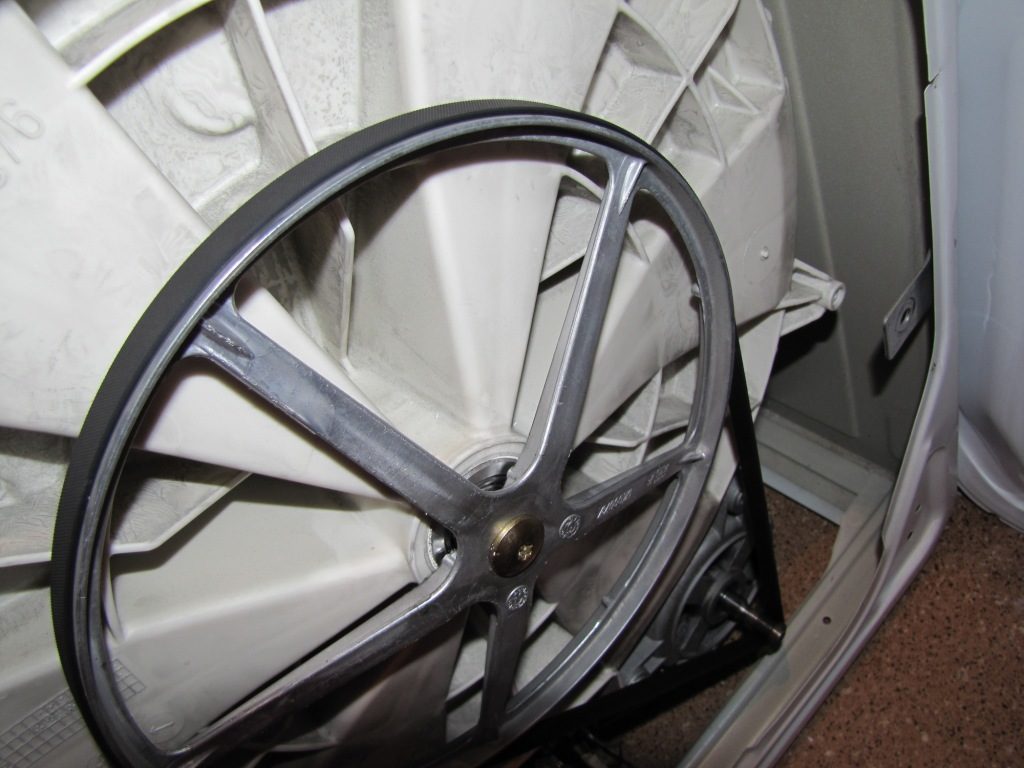
If the belt bends easily and tries to slide along the pulley, it's too stretched. A washing machine with such a drive belt will never be able to spin the laundry—the part needs to be replaced. How to change a belt on a washing machine You can read about it in the article of the same name, everything is described there in great detail. The main thing is to buy an original drive belt and change it strictly according to the instructions. After replacing the belt, the drum rotation speed should increase steadily.
The tachometer or engine is faulty
Besides the drive belt, the tachometer sensor or the engine itself could be the culprit for the aforementioned failure. It's best to start with the tachometer sensor, as it's the sensor that detects engine speed that fails most often, although the drive belt is the most common cause of failure. So, to check the Hall sensor, do the following:
- we pull the drive belt off the pulley and put it away so that it doesn’t get in the way;
- We take pictures of the wires leading to the engine and the tachometer so that later, when we put them back, we don’t mix anything up;
- remove the wires to free the motor and Hall sensor;
- we unscrew the screws that hold the engine in the mounting feet;
- press on the motor body, as if pushing it inward, it should move back a little, if this does not happen, lightly tap the pulley with a hammer;
- we pull off the motor and take it out of the washing machine body;
- remove the Hall sensor from the engine (a small part that looks like a ring);
- We place the multimeter probes on the contacts of the part and measure the resistance; values of 1 and 0 will indicate a sensor malfunction.
The Hall sensor must be replaced with an original one, despite the fact that the market offers a considerable number of replacements.
Besides the sensor, the washing machine's motor may also be faulty. Incidentally, the brushed motors found in washing machines are far from the most fragile; in some cases, they can even be considered reliable, but they do fail. This type of electric motor has two weak points: the stator winding and the brushes. The brushes can be easily replaced by hand, but if the winding fails, the entire motor will have to be replaced, as rewinding it will be even more expensive.
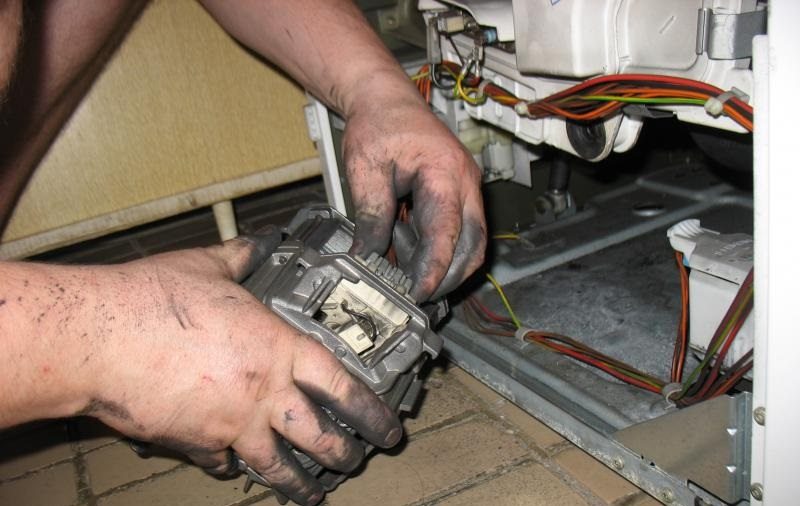
Let's start with the simplest part: the brushes. There are small screws on the side of the motor housing. Use a screwdriver to unscrew them, then pull out the spring-loaded brushes. Then everything is simple: if the brushes are intact, there is no need to change them, but if at least one of them is shorter than the other, we change both brushes together. This is exactly the case when parts are replaced in pairs at once, despite the fact that one may be completely intact.
Now it's time to pick up the multimeter again and check the motor winding for a breakdown. It's important to note that this task will require meticulous attention, as the breakdown may be in just one turn, not several, and it's not easy to find. A broken turn will cause the motor to lose power and fail to reach the required speed, even though it appears to be in good working order.
Please note! A burning smell is an indirect sign of a broken winding, so sniff it before disassembling the engine.
Something is wrong with the electronic module.
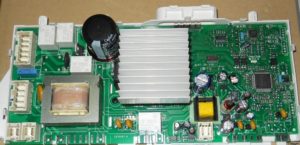 If you suspect your washing machine's electronic module is broken, it's best to avoid it and immediately contact a technician who specializes in such parts. The technician will remove the control module, conduct a professional diagnosis, and determine whether the component is broken. If the component is broken, the technician will assess the module's repairability or, if repair is no longer practical, recommend replacing it.
Very few people can repair a washing machine's control module themselves, so we won't give you any hope. In this case, you're more likely to damage your washing machine than fix it.
In conclusion, I'd like to point out the following. There are countless situations where a washing machine, for whatever reason, fails to spin the drum to the required speed during the spin cycle, and in almost every case, there's a specific cause. Our experts advise you to not be lazy and immediately begin troubleshooting the problem using the algorithm presented in this article. Good luck!
Interesting:


1 reader comment
Add a comment
Headings
Washing machine repair




For buyers




For users


Dishwasher




I set the washing machine to run and the first few spins were going well. I set it to extra spins, but the spin cycle doesn't accelerate. Maybe the motor burned out and now only the low-speed winding is working?