
Stains appear after washing in the washing machine
 There are stains left on my laundry after washing it in the washing machine! It sounds unlikely, since a washing machine is supposed to clean clothes, not dirty them. However, this situation is not uncommon, and in most cases, it happens to owners of older "home helpers" that have been in service for 5, 10, or even 15 years. Why does a washing machine leave stains and dirty clothes? It's crucial to understand this issue.
Why doesn't the washing machine wash the laundry, but instead makes it dirty?
Indeed, the situation is more than a little strange. The machine washed laundry reliably for years, and then suddenly "rebelled," went into rebellion, and started soiling the laundry. It's a bit odd, don't you think? And yet, there's nothing strange about it. The machine soils the laundry, naturally, not because the manufacturer intended it to, but for a compelling reason. And there are quite a few such reasons.
- Bearing and seal defects.
- Dirt accumulated in and under the cuff.
- Mold accumulated on the drum, in the pipes.
- Dirty water.
- Low-quality washing powder.
Some causes are more common than others, but all deserve attention; perhaps you've encountered one of them. All causes of gray, brown, black, or even green stains on freshly washed clothes are caused by user error, and in very rare cases, a manufacturing defect is at play. People simply run their washing machines without taking care of them.
Please note! Only 0.5% of stains on clothing are caused by defective factory seals and bearings.
Mold in the pipes and powder tray
Poor or improper washing machine maintenance can cause mold to form in the detergent drawer. This typically occurs when the user closes the door and detergent drawer after washing, preventing the machine from drying completely.As we know, mold thrives in dampness. Add warmth to the mix, and you've got the perfect conditions for the growth of dangerous black mold, which releases harmful spores into the air. Where inside a car does mold most often grow?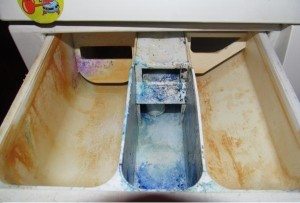
- In a powder tray.
- In the pipes running from the cuvette to the tank.
- On the walls of the drum.
- On the cuff.
- At the top of the tank on the walls.
If you have at least a normal sense of smell, then you simply won’t be able to miss the mold. Just stick your head in the hatch a little and a sharp, unpleasant smell will immediately hit your nostrils. This is a signal to inspect the car's components more closely. Follow these steps:
- Bend back the edge of the hatch cuff with your fingers and look into the gap;
- inspect the drum walls;
- open the powder tray and look inside;
- Take out the cuvette and look into the hole for it.
You'll likely quickly spot an ugly black deposit growing and developing in your machine. If your laundry comes into contact with this deposit during the wash cycle, it will leave behind smeared black spots.
Please note: Black mold often forms on and under the sunroof seal.
Mold must be removed immediately. Pour 150 g of baking soda into the detergent dispenser and run an empty wash cycle at high temperature with an extra rinse. The baking soda and aggressive wash cycle will help wash away the mold completely. If this doesn't work, you can repeat the process.
The cuff is dirty or there are problems with the seal.
Mold inside the washing machine is not the only thing that stains clothes during washing. If 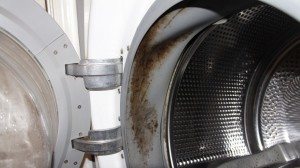 The machine hasn't been maintained for several years, and a thick, grayish deposit has formed on and underneath the cuff. During washing, items come into contact with this deposit, leaving light marks. And sometimes the plaque builds up so much that it starts to fall out of the cuff grooves during washing and settle in large grey spots on light-coloured items – a terrible sight!
What should you do in this case? It's simple: grab a brush (both a regular brush and a toothbrush) and a rag, and begin dry cleaning the cuff. Remove the gray residue from everywhere, from every crevice, but be careful not to overdo it and damage the cuff.
Important! When cleaning, do not use aggressive alkaline or acid-based detergents, as they may damage the seal, leading to a loss of the hatch seal.
If your washing machine leaves oil stains on your laundry, there may be a problem with the seals. The problem is that when seals deteriorate, they begin to release grease into the drum, which in turn ends up on your laundry. This is a major problem that needs to be addressed immediately, as deteriorating seals not only result in your laundry becoming constantly dirty, but also allow water to seep into the bearings. Water causes corrosion and very rapid wear of the bearings.
You may have overlooked it, and the bearings are already broken. They give away their presence by creaking and grinding sounds as the drum rotates. In either case, you can't wait; both the seals and the bearings need to be replaced immediately. Bearing replacement Changing a washing machine's seal is a fairly complex task, so it's best to entrust it to a professional. Just think about it:
- completely disassemble the machine;
- saw or unscrew her tank;
- Correctly remove the old bearings and install new ones.
But if you're not afraid of challenges and want to do the job yourself, go for it. You might even succeed, but be prepared for some extra expenses.
Or maybe the reason is in the washing powder or dirty water?
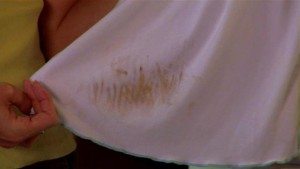 You think your washing machine is leaving stains on your clothes, but it might not be the washing machine at all! The reason for the appearance of stains may be due to poor quality washing powder. You might argue, "I've been washing with the same detergent for years, and everything was fine before." The truth is, washing with the same detergent doesn't guarantee consistent quality. You could buy a counterfeit, or you could buy a pack from a defective batch—anything can happen.
If you suspect something's wrong with your detergent, try washing a second load of laundry with a different detergent or even a liquid detergent. If the stains don't remain, then the detergent may indeed be the problem. The nature of the stains can also indicate a problem with the detergent. If the stains:
- green color;
- reddish;
- light brown;
- white (on dark linen).
Please note! Sometimes low-quality laundry detergent can leave multicolored rainbow stains on clothes. If this happens to you, don't doubt it's the detergent.
Most likely, you really do need to change your detergent, although you should double-check to be sure. A bad laundry detergent, which can leave marks on clothes, can be identified by the following signs.
- It dissolves poorly in water, leaving undissolved granules on clothes after washing, and a lot of undissolved product remaining in the powder container.
- A good automatic washing powder produces a moderate amount of foam; if the powder does not produce foam or produces too much foam, it is not suitable for washing.
- After washing with such a powder, items acquire a sharp, unpleasant chemical smell that does not disappear for a long time; such a powder cannot be used.
The quality of our tap water leaves much to be desired, and when carrying out plumbing repairs (replacing pipes), it is better not to use a washing machine or dishwasher at all. Experts recommend opening the cold water tap before starting the washing machine. If your tap water is dirty, rusty, and full of small debris, it's best to wait a couple of hours before washing your clothes. Wait until the water is relatively clear before running the washing machine.
It's not uncommon for dirty tap water to ruin all the white items you put in the washing machine. Considering that rust stains are very difficult to remove, it's important to consider whether it's worth checking the water quality before washing.
Interesting:


Readers' comments
Headings
Washing machine repair




For buyers




For users


Dishwasher




Add a comment