
The washing machine jumps or vibrates during the spin cycle.
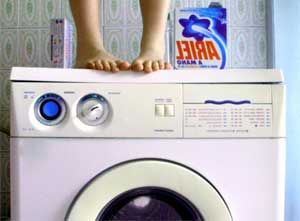 What's going on with a washing machine when it starts jumping and vibrating for no apparent reason? The first thing that comes to mind is that the machine's feet are out of alignment, and it's not level. Many people dismiss this as trivial and leave the problem unaddressed. However, it needs to be addressed, as this isn't just the machine shaking; it could be a symptom of a serious technical issue. And if left untreated, it could worsen the situation. That's why it's important to thoroughly investigate why your washing machine is jumping so much during the spin cycle, sometimes even causing neighbors to hear the noise.
Causes of vibration
There are many reasons why a washing machine may vibrate. Some are very simple and can be identified quickly and easily. Others, on the contrary, require a thorough investigation and subsequent repair. Unhealthy vibration can be caused by:
- improper installation of the machine on supports, its unstable position;
- imbalance of laundry in the machine drum;
- transport bolts that were not removed before installing the machine;
- small objects stuck between the tub and the drum, such as coins, pins, buttons or metal bra wires;
- failure of springs and shock absorbers;
- bearing failure;
- weakened fastening or destruction of the counterweight;
- breakdown of the electric motor.
Troubleshooting
As you can see, the causes are completely different, and to understand what's wrong, you need to at least understand the issue a little. Where should you start troubleshooting when your washing machine jumps during the spin cycle? What should you do? First, let's rule out the most common causes.
One of them is the imbalance of the machine drum, namely:
- During the spin cycle, the laundry gathered into a lump, for example, small items got stuck in the duvet cover;
- the weight of the laundry exceeds the maximum permissible value for the selected washing mode;
- Exceeding the drum capacity by volume, when the items fill the drum more than 2/3 full.
Important! On some washing machine models, in this case, the UE or UB error may appear on the display.
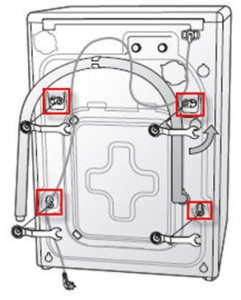 If you are washing on a new machine and there is a strong vibration when the spinning process starts, then you should check whether the transport boltsThey ensure the safe transportation of the washing machine by securing the drum. The picture shows the location of these bolts. Typically, there are four of them.
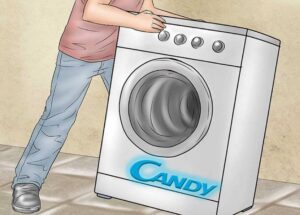
Another simple, easy-to-detect cause is improper installation. Try rocking the car while it's off. If you can easily do this and the car moves, you'll immediately know it's not stable. This is what causes the car to shake violently and bounce. You can also use a level to check how level the car is.
To check for foreign objects stuck between the tank and the drum, simply shine a flashlight inside the drum. By moving the drum to different positions, you may be able to spot such an object.
Once the first four causes of severe vibration have been checked, but the shaking continues, we move on to identifying more serious causes. If the shock absorbers or springs inside the car have failed, in addition to the shaking, you'll hear the drum knocking against the body. A weakened counterweight will also cause a characteristic knocking sound. In case of bearing wear, in addition to strong shaking, a grinding noise appears.
For a more accurate self-diagnosis, you'll need to remove the top cover of the washing machine. If the above components are in good working order, there are two possible causes for the machine to shake violently. Either the electric motor has failed, or there's a manufacturing defect.
Please note! Washing machines that are still under warranty cannot be opened, so only a qualified technician can determine the exact cause of the vibration.
We fix the problem ourselves
Once we've determined the cause of the washing machine's shaking, we can begin troubleshooting it. If the cause is imbalance, the solution is simple:
- turn off and de-energize the machine;
- we wait until the drum door is unlocked;
- open the drum;
- If the drum does not open, we perform an emergency water drain;
- we take out things and straighten them out; if there are a lot of things, we put some of them away;
- close the drum;
- We start the machine on spin cycle.
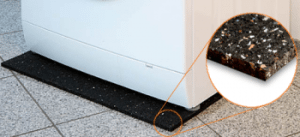 In case of incorrect installation, you need to:
- level the floor or surface on which the machine is installed using a level;
- adjust the legs;
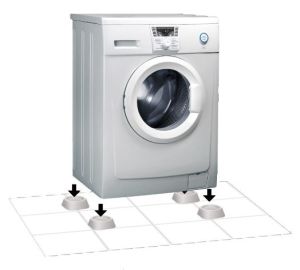
- If necessary, place anti-vibration pads underneath to prevent the machine from sliding on the floor surface.
If the machine shakes during the spin cycle due to objects stuck under the drum, you'll have to remove them. The easiest way to remove a stuck bra wire is to try to pry it out. However, if that's not possible, removing the heating element and disassembling the washing machine is essential. This is a job best left to a professional.
Defective shock absorbers and springs inside the car will need to be replaced. They wear out over time and cannot be repaired. Even if one shock absorber appears to be in good condition, both must be replaced to ensure even load distribution. The process of replacing springs and shock absorbers is quite complex and time-consuming, so a full description can be found in the article. How to change springs and shock absorbers.
What should you do if the counterweight is causing the vibration? First, open the top cover of the machine. This may require pliers, a screwdriver, and wrenches. The counterweight, a weight made of cast iron or concrete, is located under the cover. A similar counterweight is located in the lower part of the machine. Here's how to do it:
- if the fasteners are loose, try to tighten them;
- If the fasteners cannot be tightened, they will have to be replaced with new ones;
- If the concrete counterweight is deformed, it must be replaced with a similar one.
A fairly common cause of a washing machine "jumping" is bearing failure. Bearing replacement is quite complex and is best left to a service center specialist. If you'd like to figure it out yourself, read on. article about replacing bearings.
Please note: Due to constant contact with water, bearings in washing machines last an average of 7 years.
A broken electric motor can be the most frustrating and costly repair. Few people can replace or repair this washing machine part at home. Therefore, in this case, consulting a specialist is essential. After all, they can tell you whether it's worth taking it in for repairs or whether you should consider buying a new machine.
What you need to know: which machines are prone to vibration
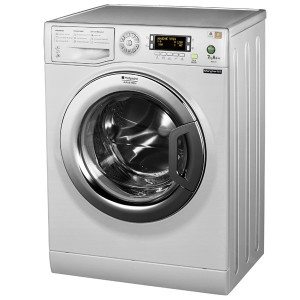 In conclusion, I'd like to say a few words about washing machines that vibrate excessively. It's impossible to completely avoid machine vibration. Even a properly installed machine will shake during the spin cycle at high RPMs—it's a fact of physics.
However, narrow washing machines tend to vibrate more, making more noise. This is because the support surface of such a machine is smaller than that of a wider machine. This means it's less stable, inevitably leading to "jumping." Furthermore, a small washing machine has a narrow drum, which is more likely to cause laundry to bunch up, which can lead to imbalance.
Important! When installing such machines, be sure to use rubber pads under the feet and other vibration-reducing devices.
So, a washing machine is a complex electronically controlled appliance. Repairing a technical problem yourself requires certain skills. Otherwise, if "unhealthy" vibrations occur, it's best to call a specialist rather than risk damaging an expensive appliance.
Interesting:




2 reader comments
Add a comment
Headings
Washing machine repair




For buyers




For users


Dishwasher




How are drum speeds adjusted?
The display shows numbers: 400, 800, 1000. These are the revolutions. The lower the number, the lower the revolutions, and vice versa.