
My Samsung washing machine is displaying the HE2 error code.
 The HE2 error code is quite common in Samsung washing machines. It's safe to say that this error code, or a code with a similar meaning, is the most common. Why is this? Because the part of your Samsung washing machine that causes this error is its main weak point. Even novice technicians know this. Read our article to learn what this part is, how to decode this error code, and how to fix the problem that caused it.
Code options
We've previously mentioned that Samsung washing machine self-diagnostic error codes are far from standardized. Some models display an HE2 error code when a similar malfunction occurs, others an E5, others an E6, and still others even display an H1, H2, or HE1. In this scenario, even a professional, much less a novice, can easily get confused by these codes, so we recommend you exercise particular care and caution.
Please note! The decodings for HE2, E5, E6, H1, H2, and HE1 codes are similar but not identical. For more information, please examine each decoding.
- H1 – The heating element heats up too quickly, up to 40 in 2 minutes0With and more, which can lead to its burnout.
- HE1 – fast uncontrolled heating of the heating element up to 950From and above.
- HE2 – the heating element heats the water in the tank very slowly, no more than 20Within 10 minutes.
- H2 – the heating element does not heat up due to a break in the circuit.
- E5, E6 – decoding is similar to H1 and H2, respectively.
Error E6 should not be confused with error 6E, since these errors are deciphered in completely different ways. There is a separate publication on our website about the error code H2, which is called Error H2 on a washing machine SamsungIf you are interested in the details, read it, you won’t regret it.
What does it mean?
As we have already indicated, the HE2 code is deciphered as slow heating of water in the tank, no more than 20C for 10 minutes. In this case, the electronic module receives information from the temperature sensor that the heating element is heating the water more slowly than programmed. The control module immediately responds by disabling the heating element and stopping the washing machine, simultaneously displaying the HE2 code on the display.
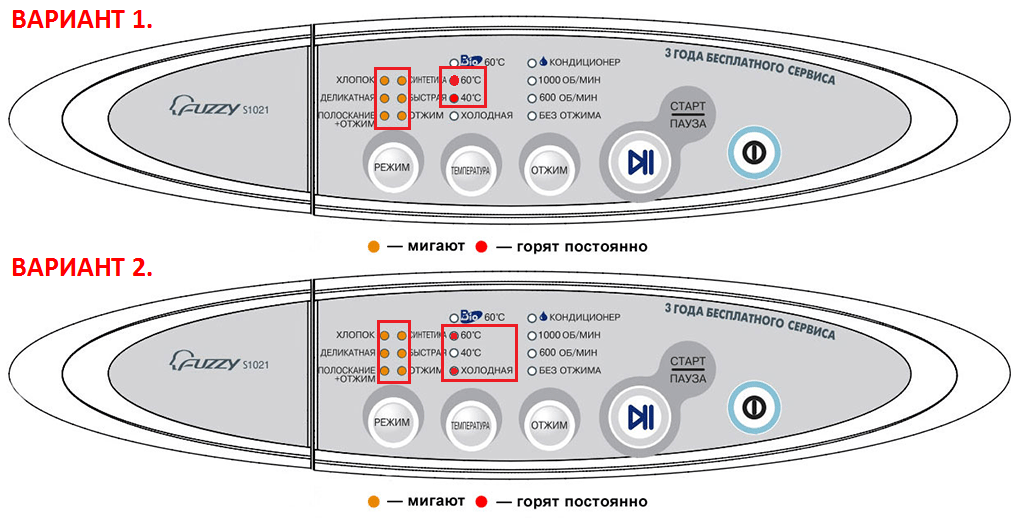
If your Samsung washing machine doesn't have a display but does have a self-diagnostic system, this error is indicated by a specific pattern of illuminated and flashing lights on the control panel. There are two possible causes. The first is when lights 60 are illuminated.0C and 400With , and the lights opposite the different washing modes blink frequently. The second one – the lights 60 are on0It's cold and the lights opposite the different washing programs are blinking frequently.
We do without repairs
Unfortunately, when the HE2 error appears on a Samsung washing machine, it means it needs repairs. According to statistics, in 90% of cases this error is caused by a broken heating element, but don't despair and immediately rush to disassemble the washing machine. Try the following.
- Disconnect the washing machine from the power supply, unplug the power cord from the socket and wait 2-3 minutes, then turn on the washing machine and start the program again.
- The problem may be caused by a lack of water in the water supply. Check if your water has been shut off.
- Check the stability of your Samsung washing machine on the floor and whether it's level. Sometimes the surface underneath the washing machine becomes unstable and loose over time, causing the machine to rock and vibrate more intensely during operation, which can cause HE2 errors.
In very rare cases, increased vibration can cause the most unexpected errors, which, it would seem, should not appear at all in this case.
We carry out repairs ourselves
If you see the HE2 error code on your Samsung washing machine's display, you can be 100% sure that the circuit is intact, there's contact, and the temperature sensor is properly transmitting information about the heating element's operation to the control module. Power is supplied to the heating element, but for some reason it's not working properly. In this case, you can contact a qualified technician who will quickly resolve the issue for an additional fee, or you can perform the repair yourself. If you're used to repairing appliances yourself, follow these steps.
- Turn off the washing machine and take it out to a place where nothing will interfere with disassembly.
- Remove any remaining water from your Samsung washing machine. To do this, remove the detergent drawer and unscrew the dust filter, making sure to place plenty of absorbent cloths underneath.
- Next, you need to remove the top wall of the Samsung washing machine, as it may interfere with removing the control panel.
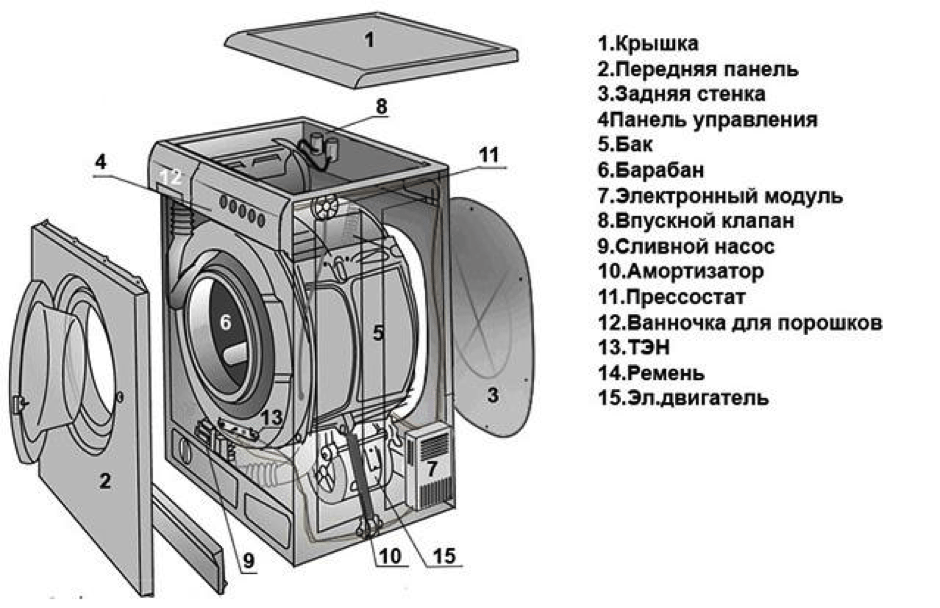
Please note! The heating element in the Samsung washing machine is located at the front of the machine, not at the back of the drum like most other machines. This means it's more difficult to access, as you'll need to remove the front panel of the machine to access it.
- We find two screws near the powder receptacle niche and unscrew them.
- We unscrew another screw, which is located on the right end of the control panel.
- We remove the clamp that holds the large rubber seal (cuff) of the Samsung washing machine hatch. There is no need to remove the cuff, just push it deeper into the washing machine.
- We remove the narrow lower front panel of the Samsung washing machine and set it aside. Underneath, we see the screws that hold the front panel in place; we unscrew them.
- Remove the control panel and place it on top of the washing machine. Be careful, as there will be a large bundle of wires behind the panel; be careful not to tear anything.
- There are two screws under the panel that hold the front wall of the Samsung washing machine from above; we unscrew them.
- Pull off the front panel of the washing machine, but be careful not to pull it sharply, as the wire from the interlock device located near the door will be pulled behind the panel. Do not rip the wire out under any circumstances; disconnect it carefully.
So, the front panel of the Samsung washing machine is removed, giving us access to the heating element, which protrudes from the side of the drum just under the hatch. We remove the wires from it, taking a photo of their location with our phone first, unscrew the mounting nut, and pull the problematic part out of the drum.
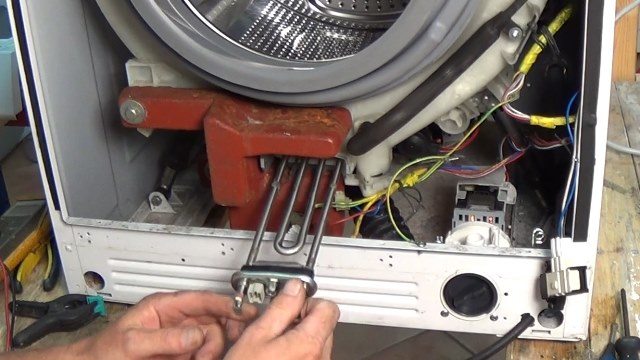
Most often, heating problems are caused by scale buildup. Samsung's much-touted ceramic heating elements, which supposedly prevent scale buildup, actually attract more scale than conventional metal heating elements. Ultimately, even cleaning the heating element doesn't help, and the part becomes irreparably damaged. What should you do if you notice a similar problem in your machine?
- We find a suitable heating element in the store or order it, but without a ceramic coating.
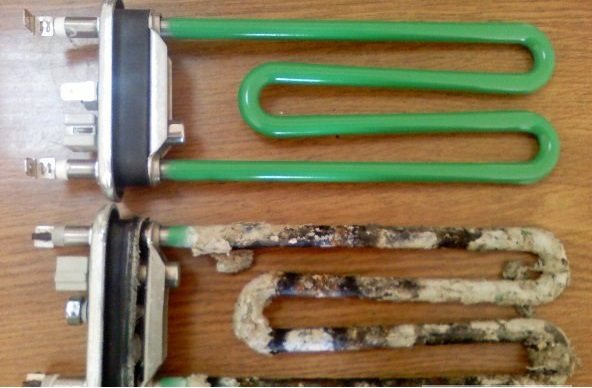
- We reach into the washing machine's tank through the heating element hole and clean out all the dirt we can reach.
- Using fine-grained sandpaper, clean the seat for the new heating element, and then lubricate the walls of the heating element niche with laundry soap.
- We “plant” the new heating element in place, connect the wires to it, and then assemble the washing machine in the reverse order described above.
In conclusion, we note that washing machine repair technicians were furious when they first encountered the new heating elements that Samsung began installing in their washing machines. It is this "miracle of technology" with a ceramic coating that most often causes the HE2 error. So, be careful, and if you need to replace a heating element, never install a ceramic heating element—metal is much better. Happy repairing!
Interesting:
3 reader comments
Add a comment
Headings
Washing machine repair




For buyers




For users


Dishwasher




I replaced the 1900W heating element with a 1600W one, but the error still appeared. I had to look for one with the correct wattage. Everything was fixed (Samsung 5.2kg Diamond).
Thank you
Thanks for the advice, I'll try to fix it myself.