
Samsung washing machine does not spin
 The spin cycle in my washing machine has stopped working—this is a common problem that users of automatic machines often report to appliance repair shops. While the spin cycle may be working, the laundry remains too damp. We'll explain the causes of this malfunction and provide repair recommendations, using a Samsung washing machine as an example.
User reasons
The most common reason why a washing machine's spin cycle doesn't work is user carelessness and disregard for operating instructions. For example, selecting the wrong wash cycle or not understanding the cycle settings can result in damp or even wet laundry being removed from the drum. Some delicate wash cycles do not include a spin cycle to avoid damaging delicate fabrics.
Sometimes, users unwittingly turn off the spin cycle. This problem can be easily solved by turning on the spin cycle after washing.
A clogged drain filter and pump can cause serious problems with your washing machine. This type of clog is primarily caused by neglect. Regular cleaning of the filter will prevent clogged drains and stagnant water, which can cause unpleasant odors. If the machine has stopped spinning and there is clearly water in the drum, then first check the drain filter..
In a Samsung machine, it's located in the lower right corner behind a small door. Next to the filter cover, you'll see a hose through which you can drain the remaining water from the drum. Then, unscrew the filter counterclockwise and check for clogs.
A common cause of poor spin results is overloading or underloading the drum with laundry. Overloading the machine with bulky items not only increases the load on the machine's components, but also prevents the laundry from spinning properly. Avoid washing lightweight curtains or multiple pairs of socks in a machine with a large drum; they may also fail to spin properly, causing imbalances.
Breakdown of parts
My Samsung washing machine isn't spinning, what should I do? More serious causes of a lack of spin are technical problems. To determine the cause, you'll need to take a sequential approach. It's best to check the parts in the following order:
- pump;
- tachometer;
- engine;
- pressure switch;
- control module.
The explanation for this is simple. We've determined the order of testing the above-mentioned components based on their accessibility. The pump, tachometer, and motor can be accessed through the bottom of the washing machine, the pressure switch through the top cover, and the control module will have to be removed by partially disassembling the front panel. The easiest way to access the insides of the washing machine is through the bottom, as we'll be able to check the pump, tachometer, and motor all at once. That's what we'll do.
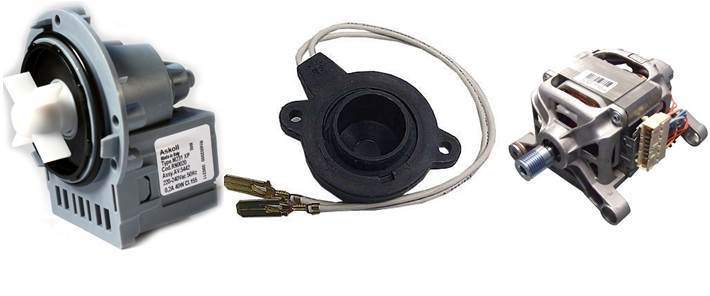
- We turn off the water and disconnect the washing machine from the sewer and water supply.
- We take the washing machine out of the niche in which it is installed.
- We take out the powder receptacle.
- Lay the washing machine on its side very carefully. It should be on its left side to prevent water from leaking onto the electrical parts.
- Remove the oil pan. Be careful not to tear the leak sensor wire.
- We remove the plastic clamps that secure the pipe running from the tank to the pump.
- We put the pipe aside, having first checked that it is not clogged with dirt or foreign objects.
- We unscrew the screws holding the pump and remove it.
- We check the pump for mechanical damage, paying special attention to the impeller.
- Using a multimeter, measure the resistance at the pump contacts. If the drain pump is working properly, the device will show a three-digit number.
Now it's the tachometer's turn. It's a small device that looks like a ring with wires sticking out. The tachogenerator is located on the engine, transmitting information about the rotation rate of its moving parts to the control module; without it, the washing machine cannot spin the laundry. Disconnect the tachogenerator wires and remove the sensor from the engine. Check the resistance with a multimeter to determine whether the sensor is working.
Now we disconnect the wires from the engine. Do this carefully to avoid accidentally tearing anything. Remove the drive belt from the pulley.
We recommend taking a photo of the wire locations on your phone so that you don't get anything mixed up when you put the motor back in place.
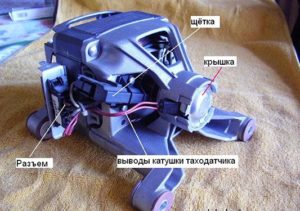 We unscrew the mounting bolts holding the motor in place. Carefully remove the motor. First, let's remove and inspect the brushes; this is a fairly common problem with brushed motors. Next, we'll check the winding resistance with a multimeter. If it's broken, there's no point in rebuilding the motor. Sure, you could try having the motor rewound by a mechanic, but that would cost you about the same as a new motor plus the wait. Basically, it's not worth it!
The next step in testing the hypothesis of why a Samsung washing machine isn't spinning leads us to examine the pressure switch. This sensor prevents the washing machine from spinning because the control module, unable to receive water level data in the drum, triggers an alarm and freezes before the spin cycle even begins. Where is the pressure switch located on a Samsung washing machine?
This sensor is located at the top of the washing machine, just under the top cover. Therefore, we need to remove the cover. We've already described the best way to do this in the article. Removing the top cover of the washing machine, read it and everything will become clear to you.
Under the cover, we immediately notice an unusual part: a plastic washer with a tube—this is the pressure switch. We disconnect the wires from the sensor and remove it. The pressure switch, mostly made of plastic, also has an electrical component, which we test with a multimeter. While we're at it, we need to blow out and clean the pressure switch tube with a toothpick.
Next up is the control module, but we wouldn't advise you to mess with this part. Qualified specialists can quickly and painlessly remove and inspect this element, but you may find this operation too complicated. Moreover, during a home-made inspection and repair of the control module, you risk causing even more damage to it, so it’s better to abandon this idea and contact a specialist – it will be cheaper.
How to troubleshoot
By checking the above components, we'll inevitably find the component that's causing the spin-drying issues in our Samsung washing machine. Fixing these problems typically involves replacing the damaged components, but there are exceptions. For example, if the drain pump impeller is damaged, it can be easily replaced without replacing the entire pump.
If you can find a suitable impeller in the store, you will save about $10 on repairs, but if you can’t find an impeller, you can always buy a new pump.
In rare cases, it's also possible to "revive" a broken pressure switch by replacing its electrical component. Again, this depends on whether you can find a suitable replacement for the electrical component. If you can find a replacement, you'll save about $6; if not, you'll have to buy and install a new pressure switch.
To summarize, a Samsung washing machine can stop spinning for a number of reasons. These could be simple user errors or serious malfunctions, but in any case, the cause will need to be investigated, and it's best not to delay. Good luck!
Interesting:




8 reader comments
Add a comment
Headings
Washing machine repair




For buyers




For users


Dishwasher




It doesn't squeeze out all the way.
So what?
Hello. I have a question: I set the machine to the quick wash cycle. It did everything it could, but when it came time for the spin cycle, it stopped after two minutes. It spun for about 15 minutes, but didn't spin the laundry. Then I paused, and the 3-minute cycle indicator came on. The lock came off after a few minutes. What could be causing this, and what should I do?
I have the same thing and I can’t find the reason?
The drum also didn't spin, let alone spin. It fills with water, drains, but doesn't spin. I took it apart, the brushes are like new. I tugged on all the wires, got mad, hit the control unit with a hammer, and damn... it works, I still don't understand what happened!
Hammer is powerful))
This is the reason for a loose belt!
You should have used a sledgehammer instead of a hammer.