
How to install a washing machine in a walk-in closet
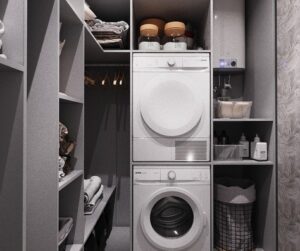
 Installing a washing machine in a walk-in closet is often the best solution. This option saves space in the bathroom and kitchen, but it does present some challenges with plumbing and other space preparation. It's necessary to assess the hardness of the floor, calculate the distance to the water supply and sewer lines, refit the outlet, and consider ventilation. Whether this is feasible and whether it's worth the effort is a detailed analysis.
Installation Feasibility Assessment
You definitely shouldn't immediately cut a groove in the wall for a new outlet and drag the machine into the closet. First, you need to assess the installation location. First, we determine whether the washing machine's body will fit into the space allotted for it: carefully measure the width, depth, and height, not forgetting about protruding elements. Add another 7-10 centimeters to the resulting values - there should be room for the hoses behind the unit, and the sides should not be compressed by adjacent objects.
If the dimensions are within specifications, we can begin assessing the flooring. A solid floor that won't sag under a 70-80 kg load is essential. Ideally, concrete or tile. Wood, chipboard, and linoleum are prohibited, as they pose a high risk of the machine's frame collapsing and causing the drum to become unbalanced during washing. Unevenness of the floor isn't a concern; the main thing is to use a spirit level to level the washing machine's feet.
The distance to the nearest utilities is also important. For example, if the sewer pipe is 3 meters or more away from the intended location, it's best to avoid placing the machine in the closet. Pumping dirty water will put too much strain on the pump and cause premature failure. Installing an additional pump can solve the problem, but this will be more expensive and technically complex.
It's worth keeping in mind that most washing machine hoses are on average 1.4-1.5 m long, and to extend them over longer distances, you'll need to replace them with longer ones or extend them with special attachments.
We're also considering options for providing adequate ventilation. A washing machine is constantly damp, so ventilation is essential to prevent dampness, mold, and mildew. Keeping the pantry door open all the time is inconvenient and unsightly; only a forced-air system will do.
It's not that installing a washing machine in a walk-in closet is an impossible task. But if the work ahead is too complicated and costly, it's better to place the machine in the kitchen or bathroom. If the difficulties are easily overcome or resolved, let's get to work.
Connection to water and sewerage
The most difficult part is connecting the unit to the water supply and sewerage system. Especially since the old methods of connecting to the central water supply using taps and a piece of rubber hose are no longer relevant. Now, the inlet and drain hoses are already built into the washing machine and need to be attached to the pipes using elbows or tees.
It is better to install adapters with a shut-off valve, which will allow you to shut off the water after the end of the cycle, during repair work or when moving the machine to another location.
The task is simple: cut a hole and install a tee. The sequence of steps and required tools depend on the pipe material. For example, it's easier to cut into a PVC pipe with a cold water supply: install an adapter with a faucet and connect the washing machine hose to the outlet. The machine is also connected to the sewer system. However, if you lack the necessary experience, attempting the cut-in yourself is not recommended: it's much safer to seek the help of a professional plumber.
Installing a socket
Electrical outlets in the dressing room are rare, but even if one is present, it is better to install a new one. The fact is that a washing machine requires more power, therefore, the wires must be of sufficient cross-section.Otherwise, the conductor will overheat, ignite and cause a fire.
It is not recommended to use an extension cord to connect the machine; it is better to provide direct contact with the electrical network.
To refit a socket or install a new one, you will need: 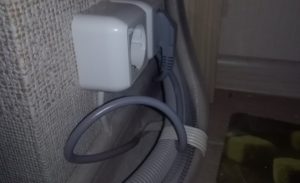
- socket with moisture-resistant housing;
- new wiring with a core cross-section of at least 2 sq. mm.;
- socket box;
- drill or wall chaser.
Once all the tools and materials are prepared, we begin installation. First, we select a location for the new outlet, and then we turn off the power to the apartment. Then, we proceed as follows.
- We make markings. We measure the height of the future outlet, 30-100 cm from the floor, and mark the corresponding hole with a pencil.
- We calculate how many meters of wiring are needed from the washing machine to the junction box. It's recommended to leave a 20-30 cm margin to facilitate installation and possible repairs. Mark the path to the panel with a pencil.
- We equip the drill with an attachment suitable for the type of wall and electrical fittings.
If you don't have a suitable drill attachment, you can use a standard one: simply drill a few holes in the wall and then remove the remaining bits with a chisel and hammer.
- We put on personal protective equipment: glasses, a respirator and gloves.
- Connect the door to the power supply. Using an extension cord is permitted, as it doesn't restrict your ability to use the tool.
- Carefully drill a hole for the socket, using the markings as a guide.
- We make a 2-3 cm groove using a grinder or a chisel with a hammer.
- We clean all drilled holes from dust and remains of building materials.
- We take out the socket box and fix it in the hole we made.
- We place the wire in the groove and push one end into the panel and the other into the socket box.
- We seal the holes with wires with plaster or putty and wait until it dries completely.
- We insert the socket and connect the wires.
- We head to the panel and connect the wires to the appropriate terminals. It is strongly recommended to use terminals for connections, as twisting the wires together is dangerous and unreliable.
We check the fasteners again for tightness and turn on the main power. For a few minutes, listen for any suspicious odors or smoke. Finally, plug any appliance into the new outlet and check the power quality. If everything is done correctly, there shouldn't be any problems.
Ventilation organization
It would seem that with electricity and water, you can put a washing machine in the walk-in closet and start using it. But don't rush if your closet is minimal in square footage and doesn't have windows or vents. A closed room without any ventilation gaps is absolutely not suitable for a moisture-distributing machine. It will be necessary to organize ventilation in the following ways: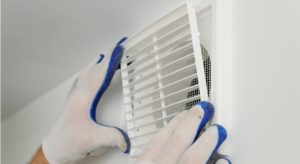
- Make a gap between the door and the floor.
- Select a special door with ventilation grilles or holes installed in the door leaf.
- Drill several holes in the walls at a distance of up to 30 cm from the floor. Ideally, 5 cm above the baseboards.
- Leave special gaps of 2-3 cm at the top of the partition.
- Consider a ventilation hole in the floor if you are considering private houses with a ground floor/basement with acceptable humidity.
A proper dressing room should have a free flow of air, as without oxygen circulation, clothes begin to smell and get dirty faster. Furthermore, there are standards for the size of air intake openings, which depend on the occupied square footage and the ventilation source. For example, to ensure a single exchange, a room 1.5 meters wide, 2 meters long, and 2.8 meters high collects 8.4 cubic meters of air, and within an hour it must be completely renewed by incoming and outgoing airflow. However, this figure is for standard clothing storage; with a washing machine, the figure should be tripled.
Calculating the air volume in a dressing room is simple: just multiply its length, height, and width.
In a room with properly functioning ventilation, an air intake opening of 100 cm in area is sufficient. The shape is not important – round, square, or rectangular are acceptable. Larger dimensions are also permitted.
In addition to the supply air gap, an exhaust duct must also be provided. This will be a similar ventilation grille, but located on the opposite side of the room, preferably closer to the ceiling. Ideally, it should be as far away as possible, so that the circulating air covers the entire room. If the air intake is planned from the center of the room, there should be two "exits" – one on the right and one on the left, spaced at least 25 cm from the corners. Ideally, air from the walk-in closet should exit through the ventilation duct and enter from the outside.
Only by reinforcing the floor, carefully planning the connections to utilities, ensuring air circulation, and installing a powerful outlet can you move the washing machine to the closet and safely use it for its intended purpose. If done correctly and wisely, water interruptions, short circuits, and mold will not threaten your laundry or your home.
Interesting:


Readers' comments
Headings
Washing machine repair




For buyers




For users


Dishwasher




Add a comment