
My washing machine won't spin or drain—what should I do?
 Why won't my washing machine spin or drain? Nearly every tenth call to our specialists begins with this question, and almost always the answer is the same: you need to investigate on-site, as it's impossible to pinpoint what's wrong with your beloved "home helper." If your washing machine won't drain and won't spin, it's not necessarily a malfunction; the problem could very well be caused by simpler reasons, but, as they say, let's not get ahead of ourselves.
Learning to use a typewriter
Some users believe that because they bought an automatic washing machine, all the washing and other functions should be automatic. Their task, it seems, is simply toss the laundry into the drum, add detergent and fabric softener, and then it's a matter of technique. This is a very common misconception, and in some cases, it can be fatal to the washing machine.
- You need to carefully monitor the program or function you select for your specific washing machine model. An incorrect choice or simple carelessness can damage not only your clothes but also the washing machine itself. For example, suppose you mistakenly select the intensive wash cycle and load sneakers into the drum. After a spin at 1200 rpm, the shoes will likely be reduced to tatters, and the drum itself will be in serious trouble.
- Carefully monitor the process of loading laundry into the drum. You shouldn't overload the washing machine with laundry, but at the same time, you shouldn't put too little laundry in it either. A medium load is ideal. For example, if your washing machine has a maximum load of 7 kg, load no more than 5.5-6 kg of dry laundry. This will ensure excellent spinning and excellent wash and rinse quality, provided all other conditions are met.
It's not just the weight that's important, but also the volume of the items you load into the drum. If your laundry is light but bulky, don't pack it tightly to fill the drum, as this will significantly reduce wash performance.
- Be careful what you put in your washing machine drum. Make sure that the items are washed before you put them in.
 Machine-washed items should be sorted by color and fabric type. Items that fade should be washed separately. Carefully inspect items before washing, especially pockets—they should be empty. If there are loose buttons or decorative items, they should be reattached securely. Avoid washing items with rhinestones or other embellishments; they won't do any good.
 - Be sure to remove and clean the debris filter about once every two weeks. If you let the filter clog, it will cause drainage problems. In addition to cleaning the filter, you should also give the washing machine a thorough cleaning every three months. If you don't know how to do this, read this article. Cleaning your washing machine yourselfIt describes the entire process in detail.
The above rules should never be neglected, even if you have a state-of-the-art automatic washing machine with intelligent controls. Any washing machine requires attention and care, and if you take proper care of your appliance, it will repay you a hundredfold.
It will work as you install it.
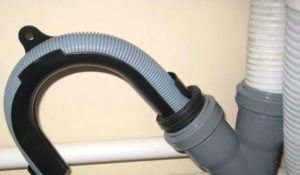 Often, a washing machine does not spin or drain water because the user initially installed it incorrectly. In this case, the connection of the drain hose to the sewer plays a major role. If the hose is improperly connected to the trap and drain pipe, a siphon effect will often occur. Wastewater and wastewater will rush from the sewer back into the washing machine. Washing machine pumps are usually underpowered and simply cannot overcome this siphon effect.
As a result, we constantly receive system errors, and the washing machine doesn't drain or spin. Furthermore, wastewater from the sewer draining into the washing machine will contaminate the laundry. And when you open the door, you'll notice an unpleasant odor emanating from within.
If the washing machine cannot drain the water, the spin cycle will not start. In general, an incorrectly positioned drain hose causes a whole host of problems.
There is only one way to solve these problems - correctly. connect the washing machine to the sewerIn addition to connecting to the sewer system, you need to ensure that your "home helper" is leveled and placed on a flat, stable surface. Otherwise, the washing machine will periodically stop spinning due to imbalances, which in turn are caused by the machine's body being unevenly positioned on an unstable surface.
Pump and pressure switch failure
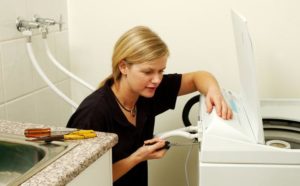
Very often, a washing machine fails to drain not because of user error, but for a very objective reason—a malfunction. Not every malfunction produces such symptoms, so we need to figure out which components of the washing machine to look at if your "home helper" suddenly stops draining and spinning. First of all, you need to check the following parts: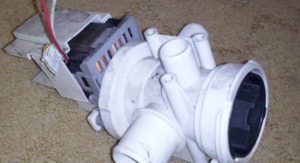
- drain pump;
- overpressure sensor (water level sensor);
- drive belt;
- Hall sensor;
- engine;
- electronic module.
Let's start by checking the pump. An indirect indication of a pump malfunction is the absence of a specific sound from the drain pump when the water drain starts. If the pump doesn't turn on within a few minutes, the washing machine automatically stops and displays a specific error code on the display. If this sounds familiar, you can safely begin checking the drain pump.
In most cases, it's best to do this from the bottom of the washing machine. If your "home helper" has a tray, remove it. If not, simply pull out the detergent drawer and lay the machine on its left side. Unscrew the pump and disassemble it. Inspect the internal components, especially the impeller, and clean them of dirt and foreign objects. Next, use a multimeter to measure the resistance at the contacts. After unscrewing the pump, you should also remove and inspect the drain hose to see if it's clogged.
Next up is the pressure switch. This sensor also needs to be checked. It's located under the top cover on most washing machines. How to check the pressure switch on a washing machine, you can read in the article of the same name.
Drive belt, tachometer or engine
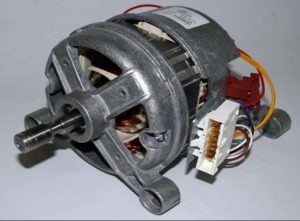 Spin problems are often caused by the drive belt. If the belt becomes damaged or simply stretches, it loses its ability to transmit motor speeds at high speeds. As a result, the machine performs the wash and rinse cycles normally, since these stages of the program don't require high drum rotation. However, the spin cycle can be a serious problem. Even if the spin cycle does start, the laundry set spun this way can be safely wrung out by hand.
With a stretched drive belt, even a properly functioning washing machine motor won't be able to spin the drum at more than 600 rpm. While belt wear should certainly be taken into account, a rough estimate suggests this is the case. This problem is quite easy to solve: buy a new belt and replace it. However, keep in mind that the belt must be the original one.
The machine can spin out laundry more or less efficiently at a speed of at least 800 rpm; if the speed is lower, the laundry will remain wet.
The engine and tachometer are always checked after the drive belt. We've described how to check these two components in previous publications, and we don't want to repeat ourselves. For example, read the article Why a washing machine Indesit does not drain water and does not spin, everything is explained there briefly and clearly.
The electronics are faulty
As you know, the electronic control unit is the brain of a modern washing machine, controlling all its systems. It also contains semiconductor components that control the pump, pressure switch, and motor. If, due to a power surge, moisture, or any other reason, one of these components simply burns out, your "home assistant" will cease to function properly.
To solve this problem, you'll need to find the faulty component, carefully desolder it so as not to damage the small circuits, and then solder a new, identical semiconductor component in its place. If you have little or no understanding of washing machine electronics, it's best not to attempt this task. It will all end with you having to buy a new module, since the old one will be hopelessly damaged. And our craftsmen encounter the results of DIY work very often.
In conclusion, it's worth noting that a washing machine of any brand can suddenly stop draining and spinning. There are many, many possible causes for this behavior. Besides what we've discussed in this post, there are a ton of other specific cases that we'll likely discuss in a separate article. Happy repairs!
Interesting:


Readers' comments
Headings
Washing machine repair




For buyers




For users


Dishwasher




Add a comment