
Machine wash with cold water
 Many housewives mistakenly believe that washing in cool water is useless. They believe that only high temperatures can remove stains. Therefore, some users, without thinking, constantly use the high-temperature cycle. Let's explore the benefits of "cold" cleaning and prove that sometimes it can be much more beneficial and superior to "hot" washing.
How do I turn off the heating in my washing machine?
Programs stored in the memory of an automatic washing machine require heating water to a specific temperature. Typically, washing machines have settings for 30°C, 40°C, 60°C, and 95°C. All washing machine models from different manufacturers allow the option to completely turn off the heating to perform a wash in cold water.
For example, on LG washing machines, to start a wash cycle without the heating element, press the "Temperature" button on the control panel until the indicator next to "Cold" lights up. In this case, the heating element is not activated, and the machine will use tap water at the initial temperature.
Indesit washing machines have a dedicated temperature selector. If you turn the dial to the "Snowflake" symbol and start a wash, the water will not heat up. Bosch washing machines have a button with a "°C" symbol. Press it repeatedly until the indicator light next to the snowflake symbol lights up. Candy washing machines have a dedicated button on the control panel that turns off the water heating on any cycle.
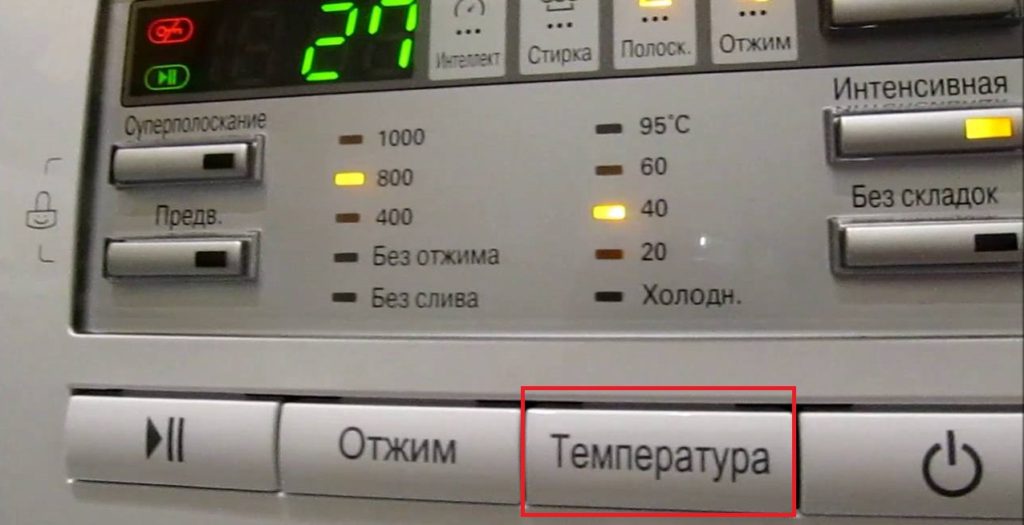
The instructions for your specific washing machine model will tell you how to wash in cold water.
If the user manual has long been lost, you can find the information you need online. To do this, enter a search query using the full name of the washing machine, for example, "Samsung WF8590NLW8DYLP manual." This will find the manual in electronic format.
Benefits of cold washing
How does washing in cold water benefit the user? First of all, it significantly reduces energy consumption per cycle. Heating consumes a fair amount of energy, and in this case, the heating element simply won't work. Don't worry about this type of cleaning being ineffective. Modern, high-quality detergents dissolve quickly even in cool water and remove stains without any problems.
There's a common misconception that you need to add more detergent to your washing machine when using a cold wash cycle. In fact, you don't need to add extra detergent; the standard dosage is sufficient.
However, in some cases, washing in hot water may be necessary. For example, if:
- carry out antibacterial treatment of things, disinfect the fabric;
- remove old, stubborn stains;
- wash towels, bed linen.
For example, a hot wash is useful for items that harbor more bacteria than everyday clothing. This includes towels, which can even be swirled occasionally on the "Boil" setting. Meanwhile, it's best to wash T-shirts, dresses, shirts, skirts, and blouses in cold water or at 30°C. This will prevent them from becoming misshapen, shrinking, or fading.
Housewives' arguments for cold water
 Everyone knows that high-temperature washing damages the fiber structure of fabrics. This is especially true for wool and other delicate materials. If you load a wool sweater into the drum and run it at 60°C or 90°C, you might find it shrinking 2-3 sizes, making it look like a "baby sweater."
Other clothing, on the other hand, can stretch and permanently lose its shape when exposed to high temperatures. Hot water can also sometimes cause holes in the seams of garments, due to the weakening of the fabric fibers during such harsh treatment. After a few washes, the item may be beyond repair and will have to be thrown out.
The main arguments in favor of cold water are:
- does not destroy fabric fibers, preserves their original structure;
- It doesn't cause fading of items, but rather maintains the vibrancy of colors. Hot water, on the other hand, washes out rich colors from the material;
- does not contribute to the appearance of white stains on clothes, which often remain after high-temperature washing.
An additional benefit of cold washing is energy savings.
If you stop "refreshing" your laundry daily at 40°C or even 60°C and instead run a cold wash, you might be pleasantly surprised by your bills. Your electricity bill will be much lower than usual.
It's also worth noting that the sealing cuff, which can be damaged by boiling water, experiences less wear. The heating element also doesn't need to operate, extending the life of the washing machine's heating element. And, of course, the clothes themselves will retain their original shape longer.
Washing on cold cycles allows homemakers to forget about damage, shrinkage, fading, and stains. High-temperature cycles should only be used in extreme cases, when absolutely necessary. If you buy high-quality detergents, stain removal won't be a problem—cool water is just as effective.
Interesting:




1 reader comment
Add a comment
Headings
Washing machine repair




For buyers




For users


Dishwasher




What temperature should I choose for washing clothes in hot water in a Candy machine?