
There is water in the dishwasher tray
 If you discover water in the dishwasher's tray, you should immediately turn off the power to your dishwasher and begin investigating the cause. Why is it necessary to immediately turn off the power to your dishwasher? It's simple: we don't know where the leak is coming from. Perhaps there's a leak in the hose located near a relay for some appliance—the last thing we need is a short circuit. We'll explain how to find the source of the leak and how to remove water from the tray yourself in this article.
For what reason did this happen?
Clearly, water leaking into the dishwasher tray is the result of some kind of malfunction, but here's what it is. Some people assume that if water is leaking into the tray, there's a leak somewhere. But with dishwashers, things aren't that simple. Water could, for example, be leaking from the wash chamber, but let's not get ahead of ourselves. Let's list the possible causes of the problem.
- Clogged waste filter and overflowing wash chamber.
- Leak due to damage to the pipe.
- Violation of the integrity of the circulation block.
- Wash chamber defect
- Clogged or damaged drain pump.
If the pump is heavily clogged, excess pressure may build up inside the part, and water will be forced directly through the part body.
Experienced mechanics say that the reasons for breakdowns usually given offhand may turn out to be empty. Until you open the case, you won't know what's really broken. This is what we will do now.
We fix it ourselves
Don't rush to disassemble the dishwasher. First, let's check for any visible defects. Let's start with the dust filter.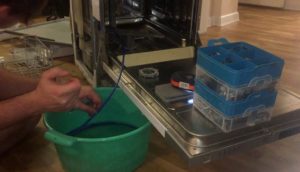
- Let's open the dishwasher door wide.
- We'll roll out the lower basket, which will probably get in our way, and remove the lower sprinkler.
- Let's remove the trash filter and the grill located nearby.
- We will wash the removed parts and put them back in place.
If the filter is clean, it's not the problem. You'll have to partially disassemble the dishwasher, but first you'll need to drain the water. Turn off the dishwasher and move it to a safe place to work. The machine isn't too heavy; one pair of hands should be enough.
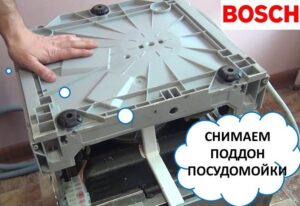
To drain the water, you need to remove the dishwasher's side panels. Removing the panels will also help later when we're looking for a leak, as the resulting openings will make almost all the components of the tray clearly visible. After removing the panels, lay some cloths on the floor and tilt the dishwasher on its side. Tilt it firmly, almost flat, so the water will quickly drain onto the floor. If you have a large, flat container of suitable size, it's best to use it, as there will be quite a lot of water and it's not advisable to drain it on a laminate floor.
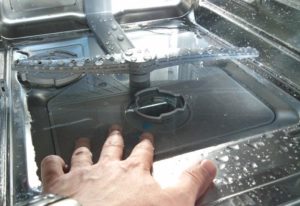 After removing the water, we check for potential leaks. This will involve feeling the hoses, their connections to the pan components, and everything in general. It will be necessary to remove the drain pump, disassemble it and check for blockages. If instead of a blockage you find a serious breakdown, you need to replace the pump in the dishwasherYou can read about how to do this in the article of the same name on our website.
If you still can't find the leak, take a large bucket of water, unscrew the waste filter, pour some water into the hole where the waste filter was installed, and inspect the tray from underneath. Water will likely start dripping somewhere, indicating the leak.
Don't try to seal the damaged part. It's better to simply replace it with a new one. Otherwise, the leak will return after a while, and you'll have to delve into the dishwasher again.
So, we've figured out what to do if there's standing water in the dishwasher tray. The most tedious step is finding the leak, but with patience, even a layman can do it. But if you can't find and fix the problem yourself, call a professional—they'll help. Good luck!
Interesting:





Readers' comments
Headings
Washing machine repair




For buyers




For users


Dishwasher




Add a comment