
Dishwasher diagrams
 To begin repairing a dishwasher yourself, you need to understand its internal structure and the purpose of each component. You may also need a wiring diagram, although if problems arise with the electronic module, the chances of a successful repair are very slim. In this article, we'll discuss how a dishwasher works, as well as the location and functions of its internal components.
What do all dishwashers have in common?
Modern dishwashers of any brand, whether Bosch, Electrolux, or Indesit, have quite a lot in common, despite their appearances varying. The main similarities lie in their functions and the layout of their internal components. If you visit a store specializing in home appliances, you can experiment. Go to the dishwasher aisle and open the doors of several of them. Inside, you'll see roughly identical spray arms, baskets, and drawers.
If you ever come across a dishwasher schematic, you'll realize that the similarities between different models far outweigh the differences. Although they vary in design, size, program packages, and the availability of various specific features, the schematic still applies to all models.
Please note! Some people believe that compact dishwashers differ significantly in their internal design from narrow and standard dishwashers. This is not actually true; the only difference is the size of the dishwashing tank.
- Absolutely all dishwasher models (whether Bosch, Electrolux, or others) have a tank (or bin) containing baskets for dishes. These baskets are where the dishes are placed.
- Each model has a sprayer or sprayers that spray jets of water onto dirty dishes, washing them.
- All dishwashers have a circulation pump that circulates the collected water, delivering it in a circle through the spray arms into the tank.
- All dishwashers also have a drain pump and a heater. The former drains wastewater into the sewer, while the latter heats the water to the desired temperature, ensuring dishes are washed with warm or hot water (depending on the program).
- Every dishwasher has a detergent drawer. While the drawers are designed differently and their functionality varies, the operating principle is essentially the same.
This list could go on and on, but I think the point is clear: all dishwashers are very similar. All that's left is to take a closer look at their design, and everything will fall into place.
How does a dishwasher work?
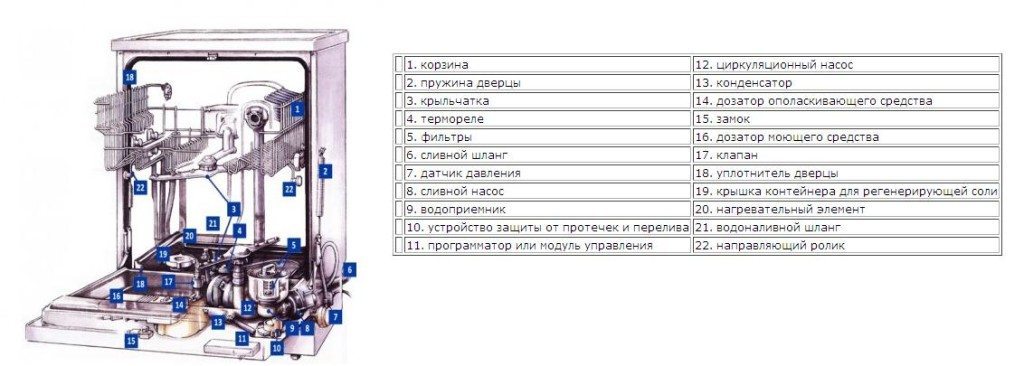
The structure of a dishwasher can be clearly illustrated in a diagram. As you can see, it doesn't contain many components, just over 20 in total. You can see the names of the components in the diagram, but it's impossible to immediately understand how they work and how they interact with each other.
- The basket is designed to accommodate dishes; it is placed on special guides and pushed directly into the dishwasher tank.
Please note! The tank is the working area inside the dishwasher where the dishes are washed.
- Door springs or door closers are designed to ensure smooth closing of the door. Thanks to the closers, the door does not slam, the closing and locking mechanism does not wear out and can last much longer.
- Thanks to rotating impellers located at the bottom and top of the tank, powerful jets of hot water hit the dishes from all sides, ensuring high-quality washing.

- The temperature relay, indicated in the figure under number 4, allows you to regulate the temperature of the water supplied to the tank.
- Waste filters are needed to collect food residue and other debris washed off the dishes.
- The drain hose, indicated in the figure as number 6, helps drain the water used by the machine into the sewer.
- The pressure switch determines the amount of water pumped into the tank, allowing the machine to know exactly when to start and stop filling with water, and when to discharge the waste water.
- The pump is used to pump waste water into the sewer system.
- A reservoir or water receiver is needed to accumulate clean water that will be used for washing dishes.
- The leak protection system, designated by the number 10, allows you to shut off the water in the event of a leak, thereby saving your property and the property of your neighbors.
- At number 11 is the control unit, which ensures interaction with all the dishwasher sensors and allows you to set the desired washing program.
- The heart of the dishwasher is the circulation pump (number 12). It is this unit that actually washes the dishes, supplying hot water from the reservoir through the impeller into the dishwasher tank directly onto the dirty dishes.
- The surge protector protects the dishwasher from power surges.
- At number 16 is the detergent drawer, into which 3-in-1 tablets, powder, liquid detergent and rinse aid are loaded, each in its own compartment.
- At number 17 there is a fill valve that shuts off the water supply and allows you to fill it up with the same water if necessary.
- Number 18 indicates the rubber seal, which serves to ensure the door is sealed.
- Number 19 indicates a container with a lid, which contains special regenerating salt.
- The number 20 represents the dishwasher's heating element, which heats the water for washing dishes. When the heating element breaks, it requires Replacing the heating element in a dishwasherYou can do the replacement yourself.
- Number 21 denotes the inlet hose. It supplies tap water directly to the dishwasher. For safety reasons, modern equipment manufacturers protect inlet hoses with a leak protection system.
- And finally, number 22 marks the guide that allows you to position the dish basket evenly inside the tank.
Please note: All dishwashers have the above components. Each component must function properly, otherwise the machine will simply stop working.
Electrical diagram of a dishwasher
We've covered the basic layout of components and assemblies in Bosch, Siemens, Aeg, and other dishwashers. However, this isn't enough to perform a quality repair, as a problem can arise not only with one component but also with an element of the electronic or electrical circuit. To identify a fault in an electrical circuit, you'll need to study the circuit diagram. The diagram below shows just such a circuit. Study it carefully, and you can begin repairing your "hardware" helper.

To summarize, when examining the schematics of various dishwashers, you'll find that they're all pretty much the same (or at least most of them are). Therefore, it's important to study the schematics to easily repair similar appliances in the future.
Interesting:





Readers' comments
Headings
Washing machine repair




For buyers




For users


Dishwasher




Add a comment